Wang Wei-Wei, Wang Wei-Qi, Wang Shan-Shan, Pan Lei
Department of Pulmonary and Critical Care Medicine, Beijing Shijitan Hospital, Capital Medical University, Beijing, China.
Department of General Practice, Liu Li He Community Health Service Center, Beijing, China.
Ann Transl Med. 2022 May;10(10):593. doi: 10.21037/atm-22-1849.
Non-small cell lung cancer (NSCLC) is the most common subtype of all lung cancers, and KRAS is the most common mutation in this population. Unfortunately, this subgroup remains "undruggable" with the lack of an approved targeted therapy. Selumetinib has been investigated as a secondary therapy in several trials and compared to various drug regimens. Therefore, we conducted this systematic review and network meta-analysis to determine the comparative effectiveness of this drug as compared to others in patients with late-stage and malignant NSCLC.
Up to July 1, 2020, 9 databases (PubMed, Scopus, Web of Science, mRCT, ICTRP, clinicaltrials.gov, VHL, SIGLE, and Google Scholar) were searched for studies following the PICOS framework: randomized trials reporting the efficacy (rate of disease progression/lack of response) of selumetinib compared to other therapies in patients with late-stage/metastatic NSCLC. The quality of retrieved studies were assessed with the revised Cochrane risk-of-bias tool. Frequentist network meta-analysis was conducted to estimate the efficacy of selumetinib as compared to other therapies and/or placebo.
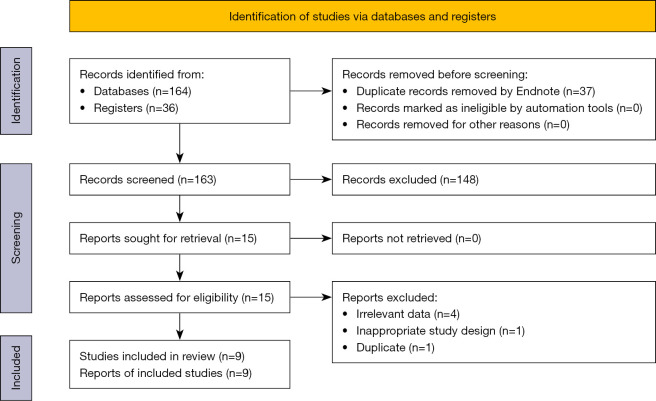
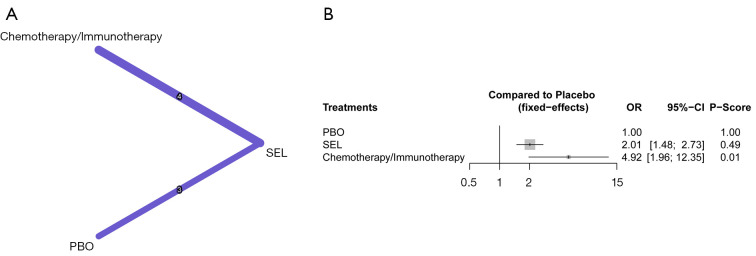
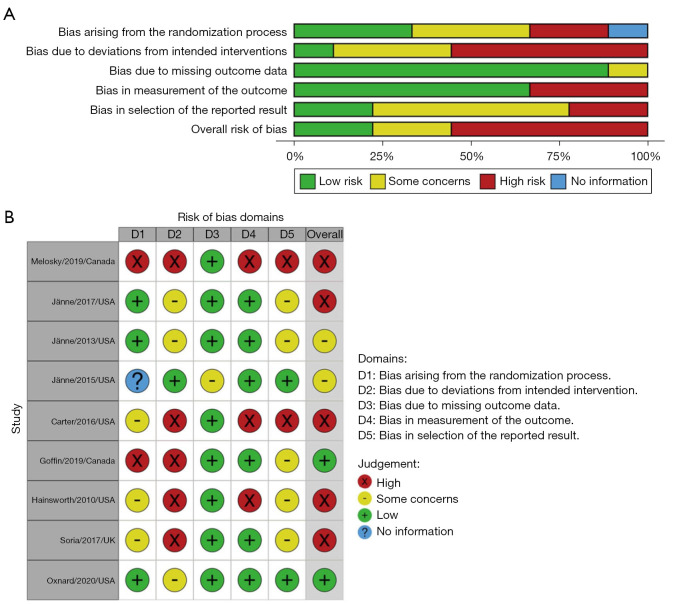
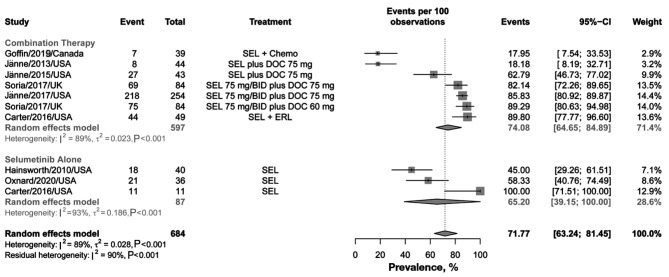
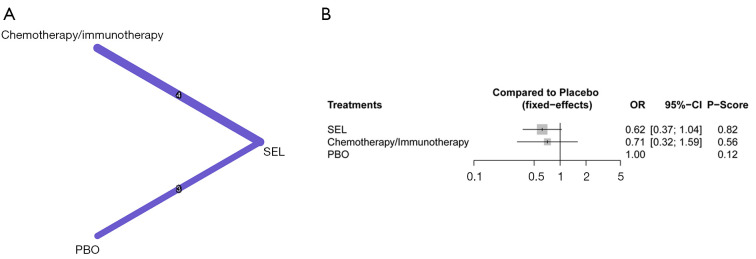
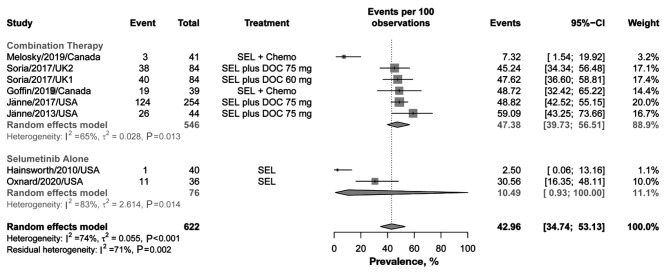
Out of the 163 articles yielded from the primary search, 9 studies (1,195 patients) were finally included in our systematic review. The majority of clinical cases had a performance status (PS) of 0-2, and the mean age was 62 years. The overall efficacy of selumetinib was 71.77% (95% CI: 63.24-81.45%), with selumetinib administered alone having better efficacy compared to combined therapy (65.20% 74.08%). In the network analysis, selumetinib had higher efficacy compared to chemo- or immune therapy, but not significantly so. The overall SAE rate of selumetinib was 42.96% (95% CI: 34.74-53.13%), with selumetinib having a significantly better safety profile compared to combined therapy (10.49% 47.38%). In the network analysis, the placebo had the best safety profile followed by selumetinib and chemo- and immune therapy. Five studies had high risk of bias, 2 had some concerns, and 2 had low risk of bias.
The efficacy of selumetinib is not superior compared to combined therapy for treating NSCLC but does have a better safety profile. Current evidence is still limited, and more robust trials are still required.
非小细胞肺癌(NSCLC)是所有肺癌中最常见的亚型,KRAS是该人群中最常见的突变类型。不幸的是,由于缺乏获批的靶向治疗药物,这一亚组患者仍然“无药可治”。在多项试验中,司美替尼已被作为二线治疗药物进行研究,并与各种药物方案进行了比较。因此,我们进行了这项系统评价和网状Meta分析,以确定该药物与其他药物相比,在晚期恶性NSCLC患者中的相对疗效。
截至2020年7月1日,按照PICOS框架在9个数据库(PubMed、Scopus、Web of Science、mRCT、ICTRP、clinicaltrials.gov、VHL、SIGLE和谷歌学术)中检索研究:随机试验报告司美替尼与其他疗法相比,在晚期/转移性NSCLC患者中的疗效(疾病进展/无反应率)。使用修订后的Cochrane偏倚风险工具评估检索到的研究的质量。进行频率学派网状Meta分析,以估计司美替尼与其他疗法和/或安慰剂相比的疗效。
在初步检索得到的163篇文章中,最终有9项研究(1195例患者)纳入我们的系统评价。大多数临床病例的体能状态(PS)为0 - 2,平均年龄为62岁。司美替尼的总体疗效为71.77%(95%CI:63.24 - 81.45%),单独使用司美替尼的疗效优于联合治疗(65.20%对74.08%)。在网状分析中,司美替尼与化疗或免疫治疗相比疗效更高,但差异不显著。司美替尼的总体严重不良事件(SAE)发生率为42.96%(95%CI:34.74 - 53.13%),与联合治疗相比,司美替尼的安全性显著更好(10.49%对47.38%)。在网状分析中,安慰剂的安全性最佳,其次是司美替尼以及化疗和免疫治疗。5项研究存在高偏倚风险,2项存在一些问题,2项存在低偏倚风险。
司美替尼在治疗NSCLC方面的疗效并不优于联合治疗,但确实具有更好的安全性。目前的证据仍然有限,仍需要更有力的试验。