
与小鼠吗啡成瘾相关的伏隔核中长链非编码RNA-微小RNA-信使RNA相互作用的转录组学分析
Transcriptomic Analysis of Long Non-coding RNA-MicroRNA-mRNA Interactions in the Nucleus Accumbens Related to Morphine Addiction in Mice.
作者信息
Li Xiaojie, Xie Bing, Lu Yun, Yang Hongyu, Wang Jian, Yu Feng, Zhang Ludi, Cong Bin, Wen Di, Ma Chunling
机构信息
Hebei Key Laboratory of Forensic Medicine, Research Unit of Digestive Tract Microecosystem Pharmacology and Toxicology, Collaborative Innovation Center of Forensic Medical Molecular Identification, College of Forensic Medicine, Chinese Academy of Medical Sciences, Hebei Medical University, Shijiazhuang, China.
出版信息
Front Psychiatry. 2022 Jun 2;13:915398. doi: 10.3389/fpsyt.2022.915398. eCollection 2022.
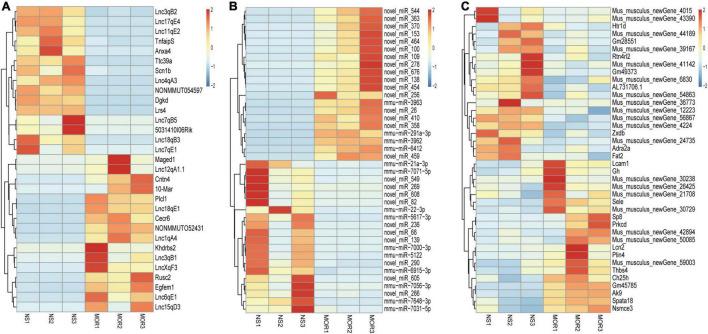
Recent research suggest that some non-coding RNAs (ncRNAs) are important regulators of chromatin dynamics and gene expression in nervous system development and neurological diseases. Nevertheless, the molecular mechanisms of long non-coding RNAs (lncRNAs), acting as competing endogenous RNAs (ceRNAs), underlying morphine addiction are still unknown. In this research, RNA sequencing (RNA-seq) was used to examine the expression profiles of lncRNAs, miRNAs and mRNAs on the nucleus accumbens (NAc) tissues of mice trained with morphine or saline conditioned place preference (CPP), with differential expression of 31 lncRNAs, 393 miRNAs, and 371 mRNAs found. A ceRNA network was established for reciprocal interactions for 9 differentially expressed lncRNAs (DElncRNAs), 10 differentially expressed miRNAs (DEmiRNAs) and 12 differentially expressed mRNAs (DEmRNAs) based on predicted miRNAs shared by lncRNAs and mRNAs. KEGG pathway enrichment analyses were conducted to explore the potential functions of DEmRNAs interacting with lncRNAs in the ceRNA network. These DEmRNAs were enriched in synaptic plasticity-related pathways, including pyrimidine metabolism, ECM-receptor interaction, and focal adhesion. The correlation between the relative expression of lncRNAs, miRNAs and mRNAs was analyzed to further validate predicted ceRNA networks, and the Lnc15qD3-miR-139-3p-Lrp2 ceRNA regulatory interaction was determined. These results suggest that the comprehensive network represents a new insight into the lncRNA-mediated ceRNA regulatory mechanisms underlying morphine addiction and provide new potential diagnostic and prognostic biomarkers for morphine addiction.
近期研究表明,一些非编码RNA(ncRNAs)是神经系统发育和神经疾病中染色质动力学和基因表达的重要调节因子。然而,长链非编码RNA(lncRNAs)作为竞争性内源性RNA(ceRNAs)在吗啡成瘾中的分子机制仍不清楚。在本研究中,采用RNA测序(RNA-seq)检测吗啡或生理盐水条件性位置偏爱(CPP)训练小鼠伏隔核(NAc)组织中lncRNAs、miRNAs和mRNAs的表达谱,发现31个lncRNAs、393个miRNAs和371个mRNAs存在差异表达。基于lncRNAs和mRNAs共享的预测miRNAs,为9个差异表达的lncRNAs(DElncRNAs)、10个差异表达的miRNAs(DEmiRNAs)和12个差异表达的mRNAs(DEmRNAs)建立了相互作用的ceRNA网络。进行KEGG通路富集分析,以探索ceRNA网络中与lncRNAs相互作用的DEmRNAs的潜在功能。这些DEmRNAs富集于突触可塑性相关通路,包括嘧啶代谢、细胞外基质-受体相互作用和粘着斑。分析lncRNAs、miRNAs和mRNAs相对表达之间的相关性,以进一步验证预测的ceRNA网络,并确定Lnc15qD3-miR-139-3p-Lrp2 ceRNA调控相互作用。这些结果表明,该综合网络为吗啡成瘾中lncRNA介导的ceRNA调控机制提供了新的见解,并为吗啡成瘾提供了新的潜在诊断和预后生物标志物。




 Zotero 插件