Department of Molecular Medicine, City of Hope National Medical Center, Duarte, California, USA.
Department of Hematology and Hematopoietic Cell Transplantation, City of Hope National Medical Center, Duarte, California, USA.
J Immunother Cancer. 2022 Jun;10(6). doi: 10.1136/jitc-2021-003752.
Chimeric antigen receptor (CAR) T cells engineered to recognize and target tumor associated antigens have made a profound impact on the quality of life for many patients with cancer. However, tumor heterogeneity and intratumoral immune suppression reduce the efficacy of this approach, allowing for tumor cells devoid of the target antigen to seed disease recurrence. Here, we address the complexity of tumor heterogeneity by developing a universal CAR.
We constructed a universal Fabrack-CAR with an extracellular domain composed of the non-tumor targeted, cyclic, twelve residue meditope peptide that binds specifically to an engineered binding pocket within the Fab arm of monoclonal antibodies (mAbs). As this site is readily grafted onto therapeutic mAbs, the antigen specificity of these universal Fabrack-CAR T cells is simply conferred by administering mAbs with specificity to the heterogeneous tumor.
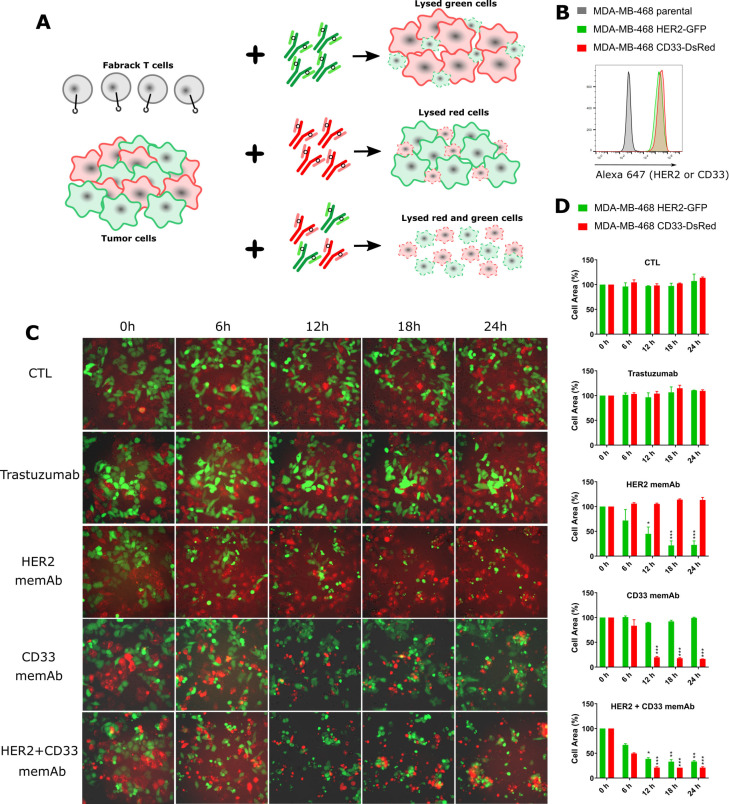
Using in vitro and in vivo studies with multiple meditope-engineered mAbs, we show the feasibility, specificity, and robustness of this approach. These studies demonstrate antigen- and antibody-specific T cell activation, proliferation, and IFNγ production, selective killing of target cells in a mixed population, and tumor regression in animal models.
Collectively, these findings support the feasibility of this universal Fabrack-CAR T cell approach and provide the rationale for future clinical use in cancer immunotherapy.
嵌合抗原受体 (CAR) T 细胞经工程设计可识别和靶向肿瘤相关抗原,这为许多癌症患者的生活质量带来了深远的影响。然而,肿瘤异质性和肿瘤内免疫抑制会降低这种方法的疗效,使缺乏靶抗原的肿瘤细胞能够引发疾病复发。在这里,我们通过开发通用型 CAR 来解决肿瘤异质性的复杂性。
我们构建了一种通用的 Fabrack-CAR,其胞外结构域由非肿瘤靶向的、十二残基的环状 meditope 肽组成,该肽特异性结合单克隆抗体 (mAb) Fab 臂内的工程化结合口袋。由于该位点可轻易地被移植到治疗性 mAb 上,因此这些通用 Fabrack-CAR T 细胞的抗原特异性可通过施用特异性针对异质性肿瘤的 mAb 来赋予。
通过对多种经 meditope 工程化的 mAb 的体外和体内研究,我们证明了这种方法的可行性、特异性和稳健性。这些研究表明,该方法可实现抗原和抗体特异性 T 细胞激活、增殖和 IFNγ产生,在混合群体中选择性杀伤靶细胞,并在动物模型中实现肿瘤消退。
总之,这些发现支持了这种通用 Fabrack-CAR T 细胞方法的可行性,并为未来在癌症免疫治疗中的临床应用提供了依据。