Department of Rheumatology, Guangzhou First People's Hospital, South China University of Technology, Guangzhou, Guangdong, China.
The Biomedical Translational Research Institute, Faculty of Medical Science, Jinan University, Guangzhou, Guangdong, China.
Lupus Sci Med. 2022 Jun;9(1). doi: 10.1136/lupus-2022-000660.
T cells display significant phenotypical changes and play multiple roles in promoting the immune response in SLE. The frequencies of T cell subpopulations in SLE are still not well understood. To better understanding the phenotypic abnormalities of T cells in SLE will help us to clarify disease immunopathology and to find promising biomarkers for disease monitoring and control.
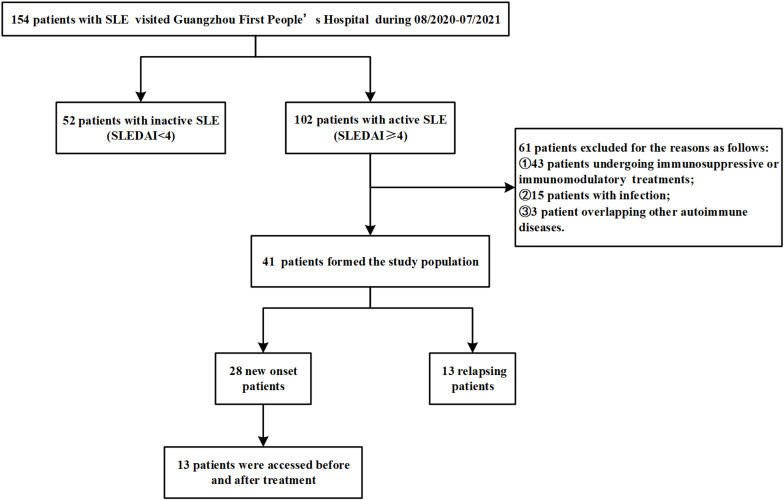
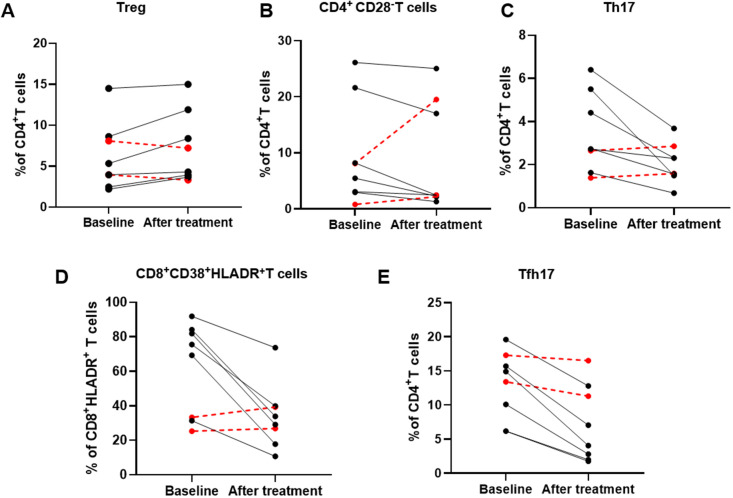
Peripheral blood CD4 and CD8 T cells and their subsets were determined by flow cytometry. Forty-one active SLE patients were selected, including 28 new-onset patients and 13 relapsing patients. One hundred healthy controls (HCs) were enrolled as the control group. The percentages of these cell subsets between patients with SLE and HCs and their relationships with disease activity and autoantibody titers were analysed. Thirteen of 28 new-onset SLE patients were assessed before and after treatment. The changes in the frequencies of these cell subsets and their relationships with renal response were analysed.
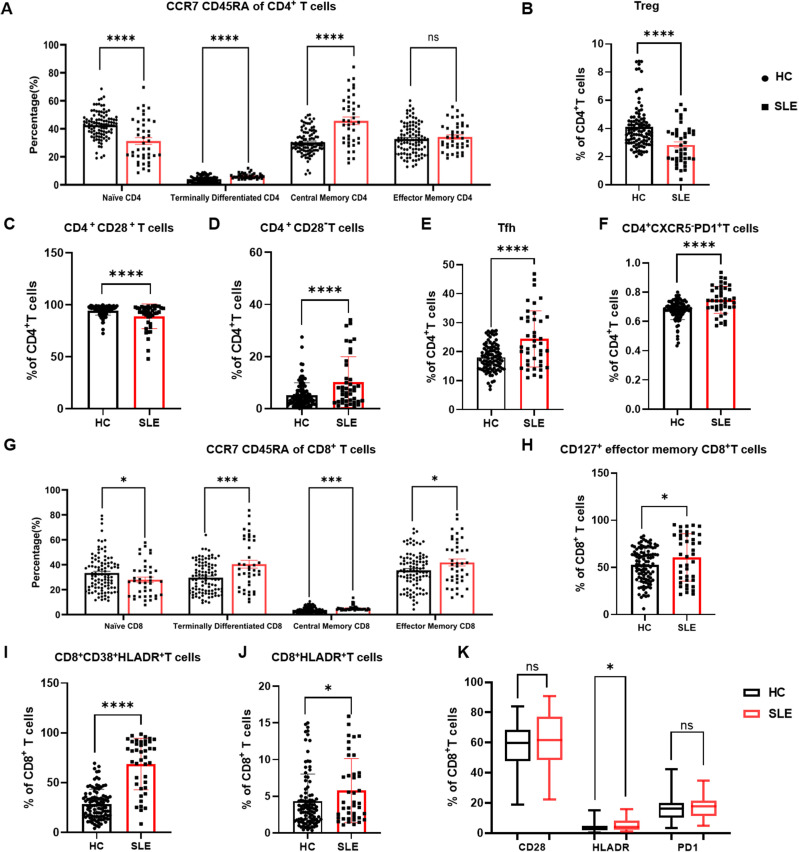
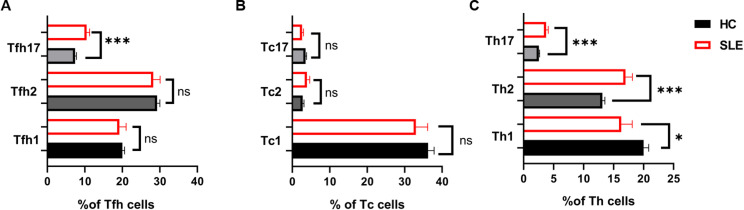
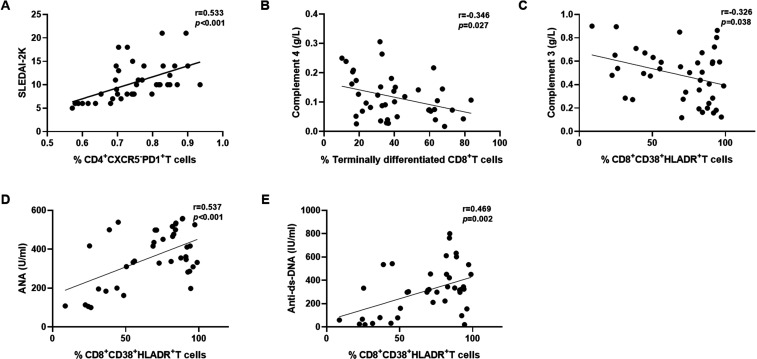
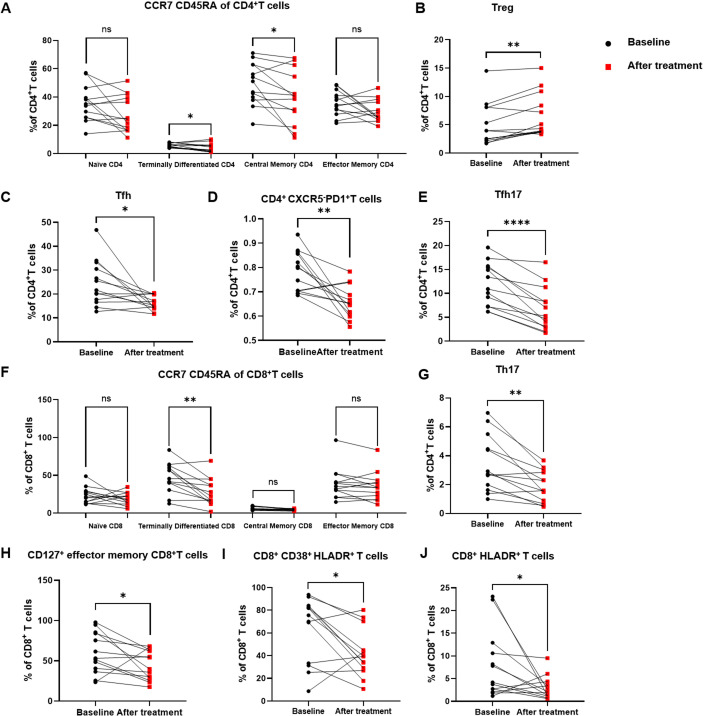
There was a broad range of anomalies in the proportion of T cell subsets in patients with SLE compared with that of the HCs. Compared with the HCs, a higher frequency of memory T cells and a lower frequency of naïve T cells were noted in patients with SLE. In addition, an imbalance of CD28 and CD28 cells in CD4 T cells was observed in patients with SLE. We found that the expanded CD4CD28 T cells did not decrease after treatment in patients who had impaired renal responses. It was very interesting to exhibit a negative correlation in the frequency between the CD4CD28 T cells and T regulatory (Treg) cells and a positive correlation between the frequency of CD4CD28 T cells and Treg cells in this study. Increased CD8HLADR T cell and CD8CD38HLADR T cell counts were observed in patients with SLE, suggesting an impaired cytotoxic capacity of CD8 T cells in SLE. Additionally, we found that CD8CD38HLADR T cells were closely associated with disease activity, autoantibody titres and renal prognosis. CD4 CXCR5PD1 T cells were expanded in patients with SLE in this study and were associated with disease activity in SLE. Th1 (T helper type 1) cells and Treg cells were decreased, but frequencies of T follicular helper (Tfh) cells, Th2 cells, Th17 cells and Tfh17 cells were increased. A strong correlation between Th17 cells and Tregs with renal involvement was observed in this study.
The proportions of CD4CD28 T cells, CD4CXCR5PD1 T cells, CD8HLADR T cells and CD8CD38HLADR T cells increased in patients with SLE and could be associated with disease activity and renal prognosis.
T 细胞在促进 SLE 免疫反应中表现出显著的表型变化并发挥多种作用。SLE 中 T 细胞亚群的频率仍未得到很好的理解。更好地了解 SLE 中 T 细胞的表型异常将有助于我们阐明疾病的免疫病理学,并找到有前途的疾病监测和控制的生物标志物。
通过流式细胞术测定外周血 CD4 和 CD8 T 细胞及其亚群。选择 41 例活动性 SLE 患者,包括 28 例新发病例和 13 例复发患者。招募 100 名健康对照者(HCs)作为对照组。分析 SLE 患者与 HCs 之间这些细胞亚群的百分比及其与疾病活动度和自身抗体滴度的关系。评估 28 例新发病例中的 13 例患者治疗前后的变化。分析这些细胞亚群频率的变化及其与肾反应的关系。
与 HCs 相比,SLE 患者 T 细胞亚群的比例存在广泛的异常。与 HCs 相比,SLE 患者记忆 T 细胞的频率较高,而幼稚 T 细胞的频率较低。此外,SLE 患者的 CD4 T 细胞中观察到 CD28 和 CD28 细胞的失衡。我们发现,在肾反应受损的患者中,治疗后 CD4CD28 T 细胞并未减少。在这项研究中,令人感兴趣的是,CD4CD28 T 细胞与调节性 T(Treg)细胞之间的频率呈负相关,而 CD4CD28 T 细胞与 Treg 细胞之间的频率呈正相关。SLE 患者中观察到 CD8HLADR T 细胞和 CD8CD38HLADR T 细胞计数增加,表明 SLE 中 CD8 T 细胞的细胞毒性能力受损。此外,我们发现 CD8CD38HLADR T 细胞与疾病活动度、自身抗体滴度和肾脏预后密切相关。在这项研究中,SLE 患者中扩增了 CD4CXCR5PD1 T 细胞,与 SLE 中的疾病活动度相关。Th1(辅助性 T 细胞 1)细胞和 Treg 细胞减少,但 Th2 细胞、Th17 细胞和 Th17/Tfh17 细胞的频率增加。在这项研究中观察到 Th17 细胞与 Tregs 与肾脏受累之间存在强烈的相关性。
SLE 患者中 CD4CD28 T 细胞、CD4CXCR5PD1 T 细胞、CD8HLADR T 细胞和 CD8CD38HLADR T 细胞的比例增加,可能与疾病活动度和肾脏预后相关。