Department of Anesthesiology, The Second Affiliated Hospital of Guangzhou University of Chinese Medicine: Guangdong Provincial Hospital of Chinese Medicine, Guangzhou City, Guangdong Province, 510120, People's Republic of China.
BMC Anesthesiol. 2022 Jun 22;22(1):194. doi: 10.1186/s12871-022-01734-1.
Cough caused by endotracheal tube (ETT) placement is ubiquitous and correlates with adverse outcomes. Remifentanil administration via target-controlled infusion (TCI) is one of the cough prevention measures used during recovery. In a pilot study, lidocaine administered via the perforated outer cuff of a dual-cuff endotracheal tube was also found to prevent cough due to ETT placement. We therefore compared these two cough prevention approaches during recovery after thyroidectomy in a single-centre, double-blind, randomised study conducted in China during the period from 09/10/2020 to 30/04/2021.
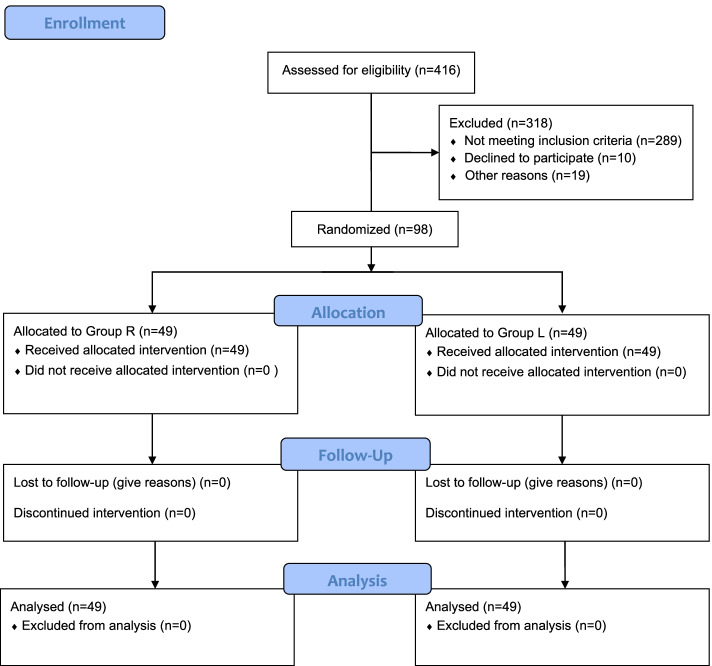
Ninety-eight female patients aged 18-65 years with American Society of Anaesthesiologists Physical Status scores of I and II were scheduled to undergo thyroidectomy. The ETT contained an internal cuff covered by a perforated outer cuff to allow for lidocaine delivery. Patients were randomised to receive either 4 ml of saline solution (Group R, n = 49) or 4 ml of 2% lidocaine in the outer cuff (Group L, n = 49) at the beginning of skin suturing. Remifentanil (2 ng/ml) was maintained in Group R until extubation, while remifentanil was maintained in Group L until the end of skin suturing. The primary outcome was cough during patient transfer, at 1 min before extubation, and at extubation. The secondary outcomes were haemodynamics and other recovery parameters.
Primary outcomes were compared between remifentanil vs. lidocaine application, namely, the incidence of cough during patient transfer (0% in Group R vs. 0% in Group L), at 1 min before extubation (22.45% in Group R vs. 4.08% in Group L; P = 0.015), and at extubation (61.22% in Group R vs. 20.41% in Group L; P < 0.001). Compared with remifentanil, lidocaine more effectively decreased heart rate elevation and hypoxemia at 5 min after extubation, the spontaneous respiration recovery time, the extubation time, the duration of post-anaesthesia care unit (PACU) stay, Richmond Agitation-Sedation Scale scores in the agitated range and Critical-Care Pain Observation Tool scores.
Lidocaine administered via the perforated outer cuff of the ETT significantly improved recovery from general anaesthesia compared to remifentanil in female patients after thyroidectomy.
Chinese Clinical Trial Registry (No. ChiCTR2000038653), registered on 27/09/2020.
气管内导管(ETT)置管引起的咳嗽是普遍存在的,并与不良结局相关。瑞芬太尼通过靶控输注(TCI)给药是恢复期间预防咳嗽的措施之一。在一项初步研究中,通过双囊气管内导管的穿孔外囊给予利多卡因也被发现可预防 ETT 置管引起的咳嗽。因此,我们在 2020 年 9 月 10 日至 2021 年 4 月 30 日期间在中国进行的一项单中心、双盲、随机研究中,比较了这两种预防复苏期咳嗽的方法。
98 名年龄在 18-65 岁之间、美国麻醉医师协会身体状况评分 I 和 II 的女性患者,拟行甲状腺切除术。ETT 内有一个被穿孔外囊覆盖的内囊,以允许给予利多卡因。患者在缝合皮肤时被随机分配接受 4ml 生理盐水(R 组,n=49)或 4ml 2%利多卡因在外囊(L 组,n=49)。R 组在拔除气管导管前 1 分钟给予瑞芬太尼(2ng/ml),L 组在缝合皮肤结束时给予瑞芬太尼。主要结局是患者转运时、拔管前 1 分钟和拔管时的咳嗽。次要结局为血流动力学和其他恢复参数。
瑞芬太尼与利多卡因应用的主要结局进行了比较,即患者转运时(R 组为 0%,L 组为 0%)、拔管前 1 分钟(R 组为 22.45%,L 组为 4.08%;P=0.015)和拔管时(R 组为 61.22%,L 组为 20.41%;P<0.001)的咳嗽发生率。与瑞芬太尼相比,利多卡因在拔管后 5 分钟时更有效地降低了心率升高和低氧血症、自主呼吸恢复时间、拔管时间、麻醉后监护室(PACU)停留时间、躁动镇静评分(Richmond Agitation-Sedation Scale)激动范围和关键护理疼痛观察工具(Critical-Care Pain Observation Tool)评分。
与瑞芬太尼相比,在甲状腺切除术后的女性患者中,通过 ETT 穿孔外囊给予利多卡因可显著改善全身麻醉后的恢复。
中国临床试验注册中心(注册号:ChiCTR2000038653),注册于 2020 年 9 月 27 日。