Farooq Malik Dilaver, Tak Farooq Ahmad, Ara Fauzia, Rashid Samia, Mir Irfan Ahmad
Department of Medicine, Government Medical College Srinagar, Srinagar 190010, India.
Department of Ophthalmology, Bangalore Medical College and Research Institute, Bengaluru 560002, India.
J Xenobiot. 2022 May 31;12(2):122-130. doi: 10.3390/jox12020011.
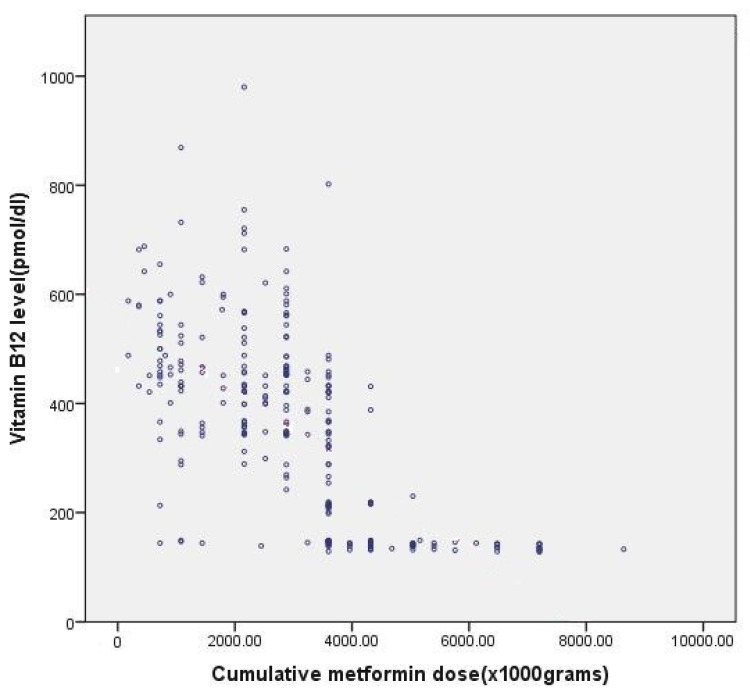
Introduction: Type 2 diabetes (T2DM), which is more prevalent (more than 90% of all diabetes cases) and the main driver of the diabetes epidemic, now affects 5.9% of the world’s adult population, with almost 80% of the total in developing countries. At present, 537 million adults (20−79 years) are living with diabetes—1 in 10. This number is predicted to rise to 643 million by 2030 and 783 million by 2045. In India, reports show that 69.2 million people are living with diabetes (8.7%) as per 2015 data. Long-term metformin treatment is a known pharmacological cause of vitamin B12 (Vit B12) deficiency, as was evident within the first 10−12 years after it started to be used. Methods: This was a cross-sectional study conducted in the Postgraduate Department of Medicine in one of the tertiary hospitals in Kashmir. A total of 1600 consecutive patients with T2DM were taken for the study. Out of which 700 patients met the inclusion criteria. These 700 patients were divided into two groups: those taking metformin, and those who were not on metformin. Cumulative metformin doses were recorded in patients taking metformin, using history of dose and duration of treatment. Serum Vit B12 levels were taken for all patients. Based on the results of Vit B12 levels, patients were classified into normal levels (20 pmol/L), possible B12 deficiency (150−220 pmol/l), and definite deficiency (<150 pmol/L). Results: Our results depicted that patients on prolonged metformin therapy showed an increase in Vit B12 deficiency by 11.16%. The prevalence of clinical neuropathy in the metformin-exposed group was 45%, whereas, a prevalence of 31.8% was found in the non-metformin group. The mean age of patients with neuropathy was higher than those without neuropathy (59.01 ± 7.14 vs. 49.95 ± 7.47) (p-value < 0.514, statistically insignificant). Conclusions: In our study, we found that metformin use is associated with Vit B12 deficiency, which is dependent upon the cumulative dose of metformin. Importantly, prolonged metformin use is also associated with an increase in the prevalence of clinical neuropathy.
2型糖尿病(T2DM)更为普遍(占所有糖尿病病例的90%以上),是糖尿病流行的主要驱动因素,目前影响着全球5.9%的成年人口,其中近80%在发展中国家。目前,有5.37亿成年人(20 - 79岁)患有糖尿病——每10人中就有1人患病。预计到2030年这一数字将增至6.43亿,到2045年将增至7.83亿。在印度,报告显示,根据2015年的数据,有6920万人患有糖尿病(8.7%)。长期使用二甲双胍治疗是维生素B12(Vit B12)缺乏的已知药理学原因,在其开始使用后的最初10 - 12年内就很明显。
这是一项在克什米尔一家三级医院的医学研究生部进行的横断面研究。总共选取了1600例连续的T2DM患者进行研究。其中700例患者符合纳入标准。这700例患者被分为两组:服用二甲双胍的患者和未服用二甲双胍的患者。记录服用二甲双胍患者的累积二甲双胍剂量,采用用药史和治疗持续时间。对所有患者检测血清Vit B12水平。根据Vit B12水平结果,将患者分为正常水平(≥20 pmol/L)、可能的B12缺乏(150 - 220 pmol/l)和确定的缺乏(<150 pmol/L)。
我们的结果表明,接受长期二甲双胍治疗的患者Vit B12缺乏增加了11.16%。接受二甲双胍治疗组的临床神经病变患病率为45%,而未接受二甲双胍治疗组的患病率为31.8%。有神经病变的患者的平均年龄高于无神经病变的患者(59.01 ± 7.14 vs. 49.95 ± 7.47)(p值<0.514,无统计学意义)。
在我们的研究中,我们发现使用二甲双胍与Vit B12缺乏有关,这取决于二甲双胍的累积剂量。重要的是,长期使用二甲双胍也与临床神经病变患病率的增加有关。