Friedli Olivier, Gasser Michael, Cusini Alexia, Fulchini Rosamaria, Vuichard-Gysin Danielle, Halder Tobler Roswitha, Wassilew Nasstasja, Plüss-Suard Catherine, Kronenberg Andreas
Swiss Centre for Antibiotic Resistance (ANRESIS), Institute for Infectious Diseases, University of Bern, 3012 Bern, Switzerland.
Division of Infectious Diseases, Cantonal Hospital Graubünden, 7000 Chur, Switzerland.
Antibiotics (Basel). 2022 Jun 11;11(6):792. doi: 10.3390/antibiotics11060792.
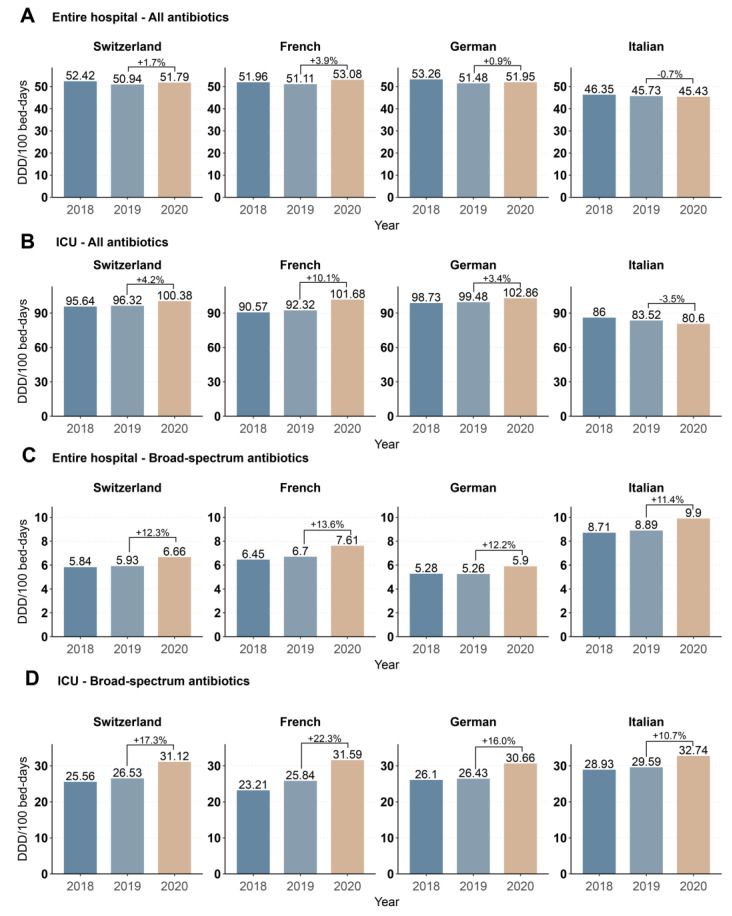
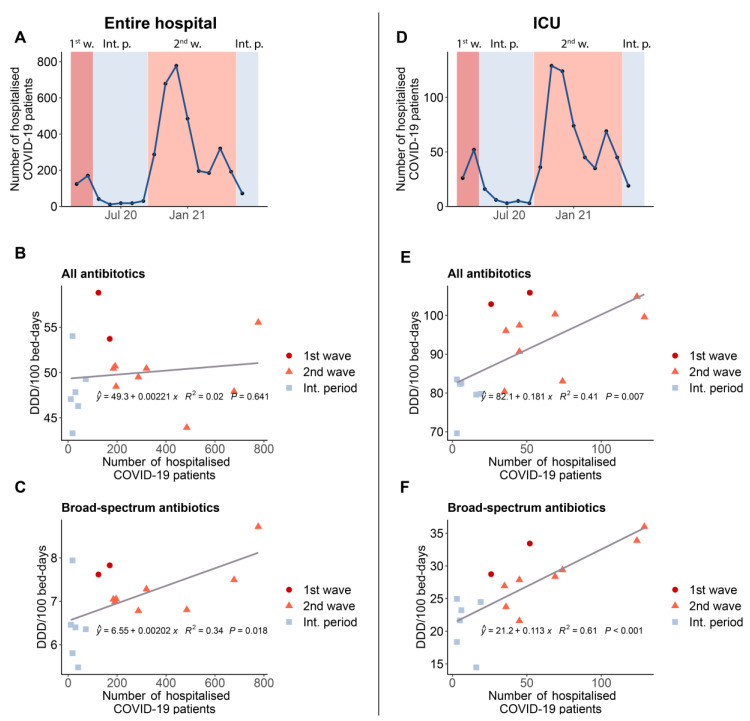
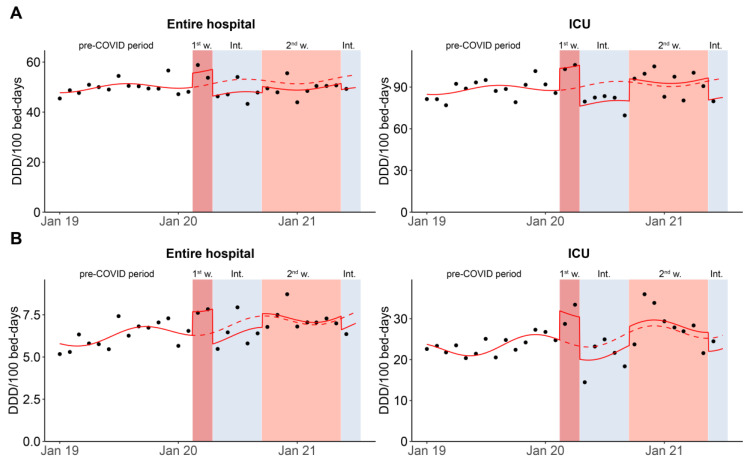
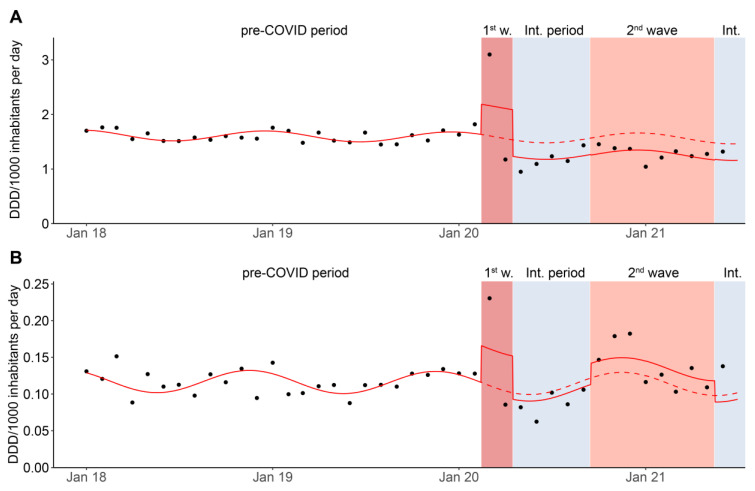
The aim of this study was to analyze inpatient antibiotic consumption during the first 16 months of the COVID-19 pandemic in Switzerland. The entire period (January 2018−June 2021) was divided into the prepandemic period, the first and second waves, and the intermediate period. In the first year of the pandemic, total overall inpatient antibiotic consumption measured in defined daily doses (DDD) per 100 bed-days remained stable (+1.7%), with a slight increase in ICUs of +4.2%. The increase in consumption of broad-spectrum antibiotics was +12.3% overall and 17.3% in ICUs. The segmented regression model of monthly data revealed an increase in overall antibiotic consumption during the first wave but not during the second wave. In the correlation analysis performed in a subset of the data, a significant positive association was found between broad-spectrum antibiotic consumption and an increasing number of hospitalized COVID-19 patients (p = 0.018). Restricting this dataset to ICUs, we found significant positive correlations between the number of hospitalized COVID-19 patients and total antibiotic consumption (p = 0.007) and broad-spectrum antibiotic consumption (p < 0.001). In conclusion, inpatient antibiotic use during the different periods of the COVID-19 pandemic varied greatly and was predominantly notable for broad-spectrum antibiotics.
本研究的目的是分析瑞士新冠疫情大流行前16个月期间住院患者的抗生素使用情况。整个时间段(2018年1月至2021年6月)被分为疫情前时期、第一波和第二波疫情时期以及中间时期。在疫情的第一年,以每100床日限定日剂量(DDD)衡量的住院患者总体抗生素使用量保持稳定(增长1.7%),重症监护病房(ICU)略有增长,为4.2%。广谱抗生素的使用量总体增长了12.3%,在ICU中增长了17.3%。月度数据的分段回归模型显示,第一波疫情期间总体抗生素使用量有所增加,但第二波疫情期间没有增加。在对部分数据进行的相关性分析中,发现广谱抗生素使用量与新冠住院患者数量增加之间存在显著正相关(p = 0.018)。将该数据集限制在ICU中,我们发现新冠住院患者数量与总抗生素使用量(p = 0.007)和广谱抗生素使用量(p < 0.001)之间存在显著正相关。总之,新冠疫情不同时期住院患者的抗生素使用情况差异很大,主要以广谱抗生素使用量显著为特征。