Fernández-Pascual Esaú, Manfredi Celeste, Martín Cristina, Martínez-Ballesteros Claudio, Balmori Carlos, Lledó-García Enrique, Quintana Luis Miguel, Curvo Raphael, Carballido-Rodríguez Joaquín, Bianco Fernando J, Martínez-Salamanca Juan Ignacio
LYX Institute of Urology, Faculty of Medicine, Universidad Francisco de Vitoria, 28223 Madrid, Spain.
Department of Urology, Hospital Universitario La Paz, 28046 Madrid, Spain.
Cancers (Basel). 2022 Jun 17;14(12):2988. doi: 10.3390/cancers14122988.
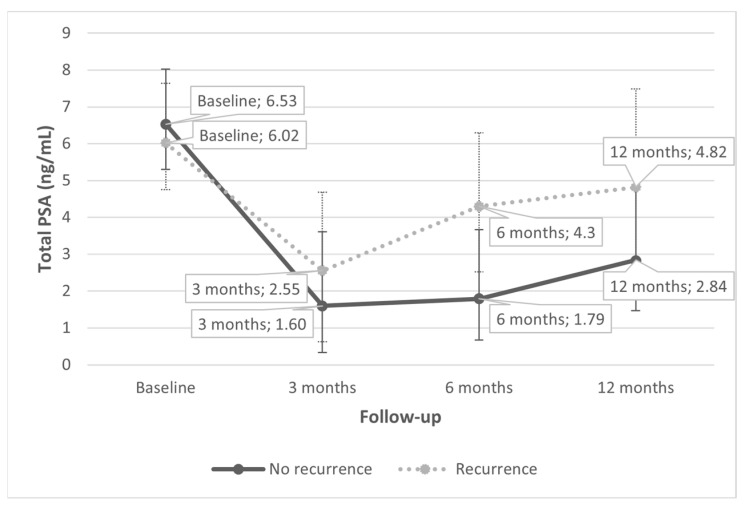
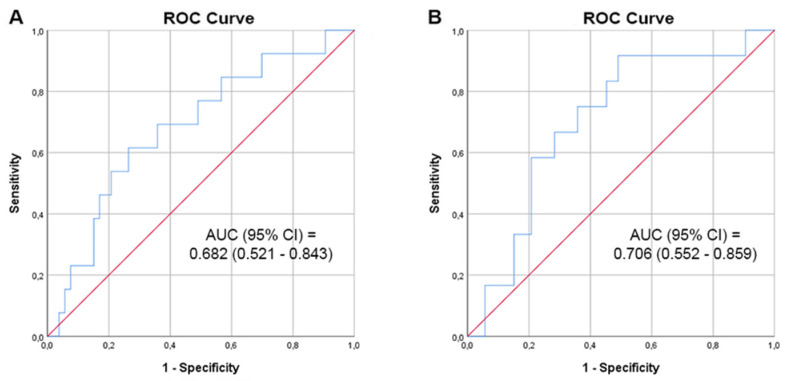
Targeted therapy (TT) for prostate cancer (PCa) aims to ablate the malignant lesion with an adequate margin of safety in order to obtain similar oncological outcomes, but with less toxicity than radical treatments. The main aim of this study was to evaluate the recurrence rate (RR) in patients with primary localized PCa undergoing mpMRI/US fusion targeted cryotherapy (FTC). A secondary objective was to evaluate prostate-specific antigen (PSA) as a predictor of recurrences. We designed a prospective single-center single-cohort study. Patients with primary localized PCa, mono or multifocal lesions, PSA ≤ 15 ng/mL, and a Gleason score (GS) ≤ 4 + 3 undergoing FTC were enrolled. RR was chosen as the primary outcome. Recurrence was defined as the presence of clinically significant prostate cancer in the treated areas. PSA values measured at different times were tested as predictors of recurrence. Continuous variables were assessed with the Bayesian -test and categorical assessments with the chix-squared test. Univariate and logistic regression assessment were used for predictions. A total of 75 cases were included in the study. Ten subjects developed a recurrence (RR: 15.2%), while fifty-six (84.8%) patients showed a recurrence-free status. A %PSA drop of 31.5% during the first 12 months after treatment predicted a recurrence with a sensitivity of 53.8% and a specificity of 79.2%. A PSA drop of 55.3% 12 months after treatment predicted a recurrence with a sensitivity of 91.7% and a specificity of 51.9%. FTC for primary localized PCa seems to be associated with a low but not negligible percentage of recurrences. Serum PSA levels may have a role indicating RR.
前列腺癌(PCa)的靶向治疗(TT)旨在以足够的安全 margins 消融恶性病变,以获得相似的肿瘤学结果,但毒性低于根治性治疗。本研究的主要目的是评估接受 mpMRI/US 融合靶向冷冻治疗(FTC)的原发性局限性 PCa 患者的复发率(RR)。次要目标是评估前列腺特异性抗原(PSA)作为复发的预测指标。我们设计了一项前瞻性单中心单队列研究。纳入了原发性局限性 PCa、单灶或多灶性病变、PSA≤15 ng/mL 且 Gleason 评分(GS)≤4 + 3 并接受 FTC 的患者。RR 被选为主要结局。复发定义为治疗区域存在临床显著的前列腺癌。在不同时间测量的 PSA 值作为复发的预测指标进行测试。连续变量采用贝叶斯检验评估,分类评估采用卡方检验。单变量和逻辑回归评估用于预测。本研究共纳入 75 例病例。10 名受试者出现复发(RR:15.2%),而 56 名(84.8%)患者无复发状态。治疗后前 12 个月 PSA 下降 31.5%预测复发的敏感性为 53.8%,特异性为 79.2%。治疗后 12 个月 PSA 下降 55.3%预测复发的敏感性为 91.7%,特异性为 51.9%。原发性局限性 PCa 的 FTC 似乎与低但不可忽视的复发率相关。血清 PSA 水平可能在指示 RR 方面发挥作用。