Sax Oliver C, Hlukha Larysa P, Kowalewski Kyle A, Herzenberg John E, McClure Philip K
International Center for Limb Lengthening, Rubin Institute for Advanced Orthopedics, Sinai Hospital of Baltimore, Baltimore, MD 21215, USA.
Children (Basel). 2022 Jun 9;9(6):860. doi: 10.3390/children9060860.
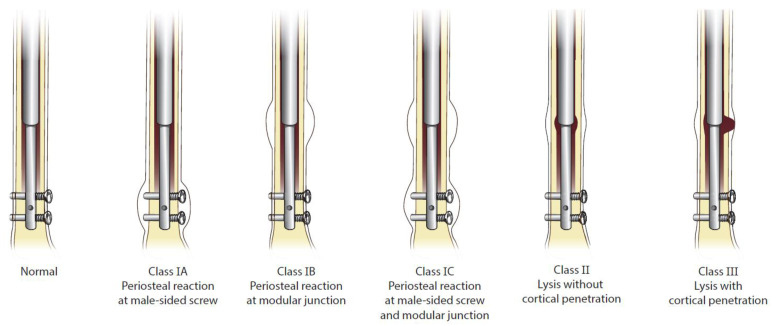
Concerns surrounding osteolysis near and around the modular junction of a stainless-steel intramedullary lengthening rod prompted a manufacturer recall from the United States market in early 2021. These actions were preceded by similar steps taken in Europe. A concomitant review of stainless-steel lengthenings at our institution demonstrated signs of adverse tissue reaction including periosteal reaction and osteolysis at the modular junction and/or male-sided locking screws. Nearly half of our patients presented with these findings on radiographic images. At the time of the previous review, only half of the nearly 60 implanted stainless-steel devices met a 6-month follow-up. At this juncture, many patients have had their devices explanted. Given the suspected adverse tissue reactions caused by a component of the internal device, we sought to examine the rate of osteolysis post-explantation following removal of a stainless-steel nail. We reviewed a consecutive series of patients who underwent implantation of a stainless-steel limb lengthening device in the femur and/or tibia at a single institution between December 2018 and December 2020. Patients were included if their device was explanted. Periosteal reaction and osteolysis was classified according to a novel and validated classification system, as analyzed by five fellowship-trained surgeons. In addition, changes observed prior to explantation were tracked post-explantation to assess for resolution. The incidence of periosteal reaction and osteolysis prior to explantation was 22/57 (39%) and 15/57 (26%), respectively. Of the 15 patients with osteolysis pre-explantation, 14 patients' implants were explanted. Of these, eight patients had available follow-up films. Two patients were identified as having partial osteolysis resolution at mean 1-year follow-up, while six patients were identified as having complete osteolysis at mean 18-months follow-up. Periosteal tissue reaction and osteolysis largely resolved following explantation in a subset of patients. These results provide further support to the claim that the stainless-steel device contributed to the changes seen. Further follow-up is warranted to examine the longer-term effects of adverse tissue reaction in this patient population.
围绕不锈钢髓内延长杆模块化连接处及其周围骨溶解的担忧,促使制造商于2021年初从美国市场召回产品。在此之前,欧洲也采取了类似举措。我们机构对不锈钢延长装置进行的一项同步审查显示,存在不良组织反应迹象,包括模块化连接处和/或阳侧锁定螺钉处的骨膜反应和骨溶解。在我们的患者中,近一半在影像学图像上出现了这些表现。在上次审查时,近60个植入的不锈钢装置中只有一半进行了6个月的随访。此时,许多患者的装置已被取出。鉴于怀疑内部装置的一个部件会引起不良组织反应,我们试图研究取出不锈钢钉后骨溶解的发生率。我们回顾了2018年12月至2020年12月期间在单一机构接受股骨和/或胫骨不锈钢肢体延长装置植入的一系列连续患者。如果患者的装置被取出,则纳入研究。骨膜反应和骨溶解根据一种新的且经过验证的分类系统进行分类,由五位接受过专科培训的外科医生进行分析。此外,跟踪取出装置前观察到的变化,以评估其消退情况。取出装置前骨膜反应和骨溶解的发生率分别为22/57(39%)和15/57(26%)。在15例取出装置前有骨溶解的患者中,14例患者的植入物被取出。其中,8例患者有可用的随访影像。两名患者在平均1年的随访中被确定为部分骨溶解消退,而6例患者在平均18个月的随访中被确定为完全骨溶解。在一部分患者中,取出装置后骨膜组织反应和骨溶解在很大程度上得到消退。这些结果进一步支持了不锈钢装置导致所见变化这一说法。有必要进行进一步随访,以研究该患者群体中不良组织反应的长期影响。