Joergensen Mie Laerkegaard, Hyvärinen Petteri, Caporali Sueli, Dau Torsten
Hearing Systems Section, Department of Health Technology, Technical University of Denmark, 2800 Copenhagen, Denmark.
WS Audiology, 3540 Lynge, Denmark.
Brain Sci. 2022 May 31;12(6):719. doi: 10.3390/brainsci12060719.
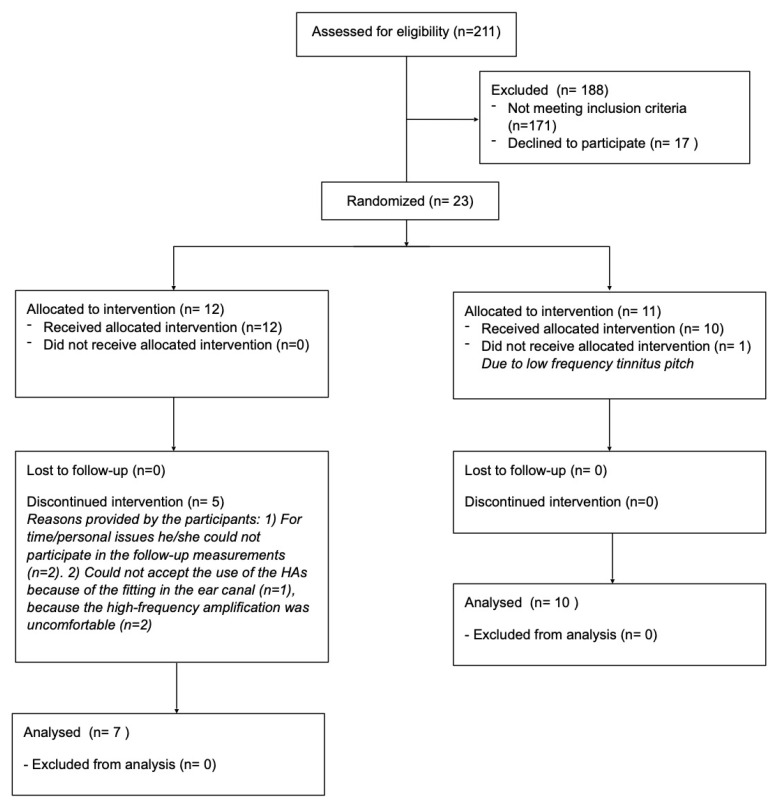
This study investigated the effect of broadband amplification (125 Hz to 10 kHz) as tinnitus treatment for participants with high-frequency hearing loss and compared these effects with an active placebo condition using band-limited amplification (125 Hz to 3-4 kHz). A double-blinded crossover study. Twenty-three participants with high-frequency (≥3 kHz) hearing loss and chronic tinnitus were included in the study, and 17 completed the full treatment protocol. Two different hearing aid treatments were provided for 3 months each: Broadband amplification provided gain in the frequency range from 125 Hz to 10 kHz and band-limited amplification only provided gain in the low-frequency range (≤3-4 kHz). The effect of the two treatments on tinnitus distress was evaluated with the Tinnitus Handicap Inventory (THI) and the Tinnitus Functional Index (TFI) questionnaires. The effect of the treatment on tinnitus loudness was evaluated with a visual analog scale (VAS) for loudness and a psychoacoustic loudness measure. Furthermore, the tinnitus annoyance was evaluated with a VAS for annoyance. The tinnitus pitch was evaluated based on the tinnitus likeness spectrum. A statistically significant difference was found between the two treatment groups (broadband vs. band-limited amplification) for the treatment-related change in THI and TFI with respect to the baseline. Furthermore, a statistically significant difference was found between the two treatment conditions for the annoyance measure. Regarding the loudness measure, no statistically significant differences were found between the treatments, although there was a trend towards a lower VAS-based loudness measure resulting from the broadband amplification. No changes were observed in the tinnitus pitch between the different conditions. Overall, the results from the present study suggest that tinnitus patients with high-frequency hearing loss can experience a decrease in tinnitus-related distress and annoyance from high-frequency amplification.
本研究调查了宽带放大(125赫兹至10千赫)作为高频听力损失参与者耳鸣治疗方法的效果,并将这些效果与使用限带放大(125赫兹至3 - 4千赫)的活性安慰剂条件进行比较。一项双盲交叉研究。23名患有高频(≥3千赫)听力损失和慢性耳鸣的参与者被纳入研究,17人完成了完整的治疗方案。提供了两种不同的助听器治疗,每种治疗为期3个月:宽带放大在125赫兹至10千赫的频率范围内提供增益,限带放大仅在低频范围(≤3 - 4千赫)提供增益。用耳鸣障碍量表(THI)和耳鸣功能指数(TFI)问卷评估两种治疗对耳鸣困扰的影响。用响度视觉模拟量表(VAS)和心理声学响度测量评估治疗对耳鸣响度的影响。此外,用烦恼VAS评估耳鸣烦恼程度。根据耳鸣相似性频谱评估耳鸣音调。在THI和TFI与基线相比的治疗相关变化方面,两个治疗组(宽带与限带放大)之间发现了统计学上的显著差异。此外,在烦恼测量方面,两种治疗条件之间发现了统计学上的显著差异。关于响度测量,尽管宽带放大导致基于VAS的响度测量有降低的趋势,但在治疗之间未发现统计学上的显著差异。在不同条件下,耳鸣音调未观察到变化。总体而言,本研究结果表明,高频听力损失的耳鸣患者可因高频放大而使耳鸣相关困扰和烦恼程度降低。