Laboratory of Immunology, Department of Translational Physiology, Infectiology and Public Health, Faculty of Veterinary Medicine, Ghent University, 9000 Ghent, Belgium.
Int J Mol Sci. 2022 Jun 13;23(12):6589. doi: 10.3390/ijms23126589.
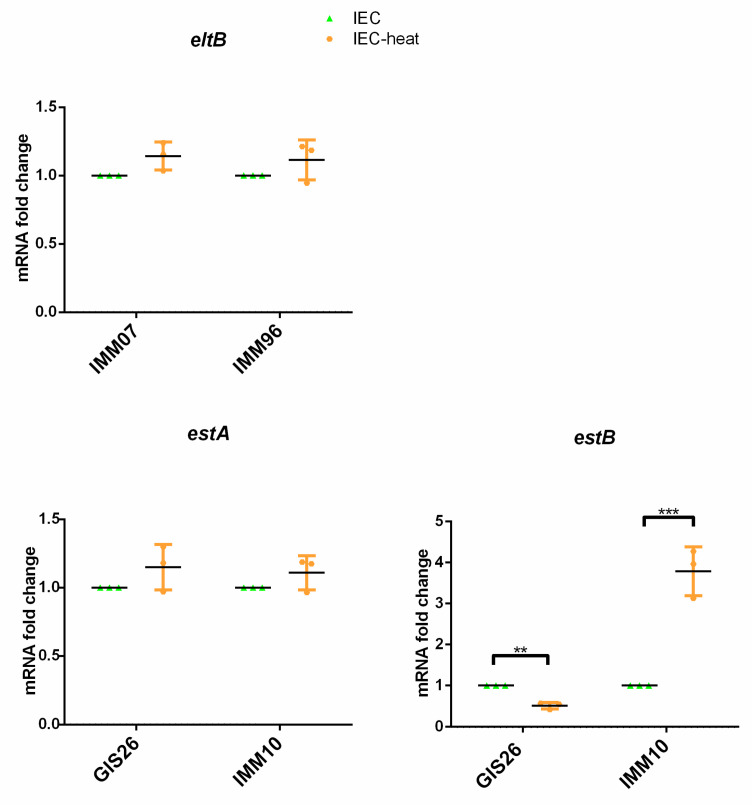
Enterotoxigenic (ETEC) strains are one of the most common etiological agents of diarrhea in both human and farm animals. In addition to encoding toxins that cause diarrhea, ETEC have evolved numerous strategies to interfere with host defenses. These strategies most likely depend on the sensing of host factors, such as molecules secreted by gut epithelial cells. The present study tested whether the exposure of ETEC to factors secreted by polarized IPEC-J2 cells resulted in transcriptional changes of ETEC-derived virulence factors. Following the addition of host-derived epithelial factors, genes encoding enterotoxins, secretion-system-associated proteins, and the key regulatory molecule cyclic AMP (cAMP) receptor protein (CRP) were substantially modulated, suggesting that ETEC recognize and respond to factors produced by gut epithelial cells. To determine whether these factors were heat sensitive, the IEC-conditioned medium was incubated at 56 °C for 30 min. In most ETEC strains, heat treatment of the IEC-conditioned medium resulted in a loss of transcriptional modulation. Taken together, these data suggest that secreted epithelial factors play a role in bacterial pathogenesis by modulating the transcription of genes encoding key ETEC virulence factors. Further research is warranted to identify these secreted epithelial factors and how ETEC sense these molecules to gain a competitive advantage in the early engagement of the gut epithelium.
肠产毒性(ETEC)菌株是人类和农场动物腹泻的最常见病因之一。除了编码引起腹泻的毒素外,ETEC 还进化出了许多策略来干扰宿主防御。这些策略很可能依赖于宿主因子的感应,例如肠道上皮细胞分泌的分子。本研究测试了 ETEC 暴露于极化 IPEC-J2 细胞分泌的因子是否会导致 ETEC 来源的毒力因子的转录变化。在添加宿主来源的上皮因子后,编码肠毒素、分泌系统相关蛋白和关键调节分子环腺苷酸(cAMP)受体蛋白(CRP)的基因被大量调节,表明 ETEC 识别并响应肠道上皮细胞产生的因子。为了确定这些因子是否对热敏感,将 IEC 条件培养基在 56°C 下孵育 30 分钟。在大多数 ETEC 菌株中,热处理 IEC 条件培养基会导致转录调节的丧失。总之,这些数据表明,分泌的上皮因子通过调节编码关键 ETEC 毒力因子的基因的转录在细菌发病机制中发挥作用。有必要进一步研究以确定这些分泌的上皮因子以及 ETEC 如何感应这些分子,以在肠道上皮的早期参与中获得竞争优势。