Shim Eunha, Choi Wongyeong, Song Youngji
Department of Mathematics, Soongsil University, 369 Sangdo-ro, Donjak-gu, Seoul 06978, Korea.
J Clin Med. 2022 Jun 7;11(12):3269. doi: 10.3390/jcm11123269.
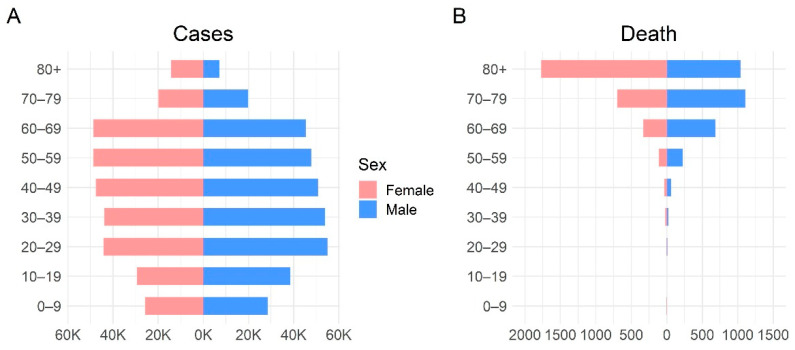
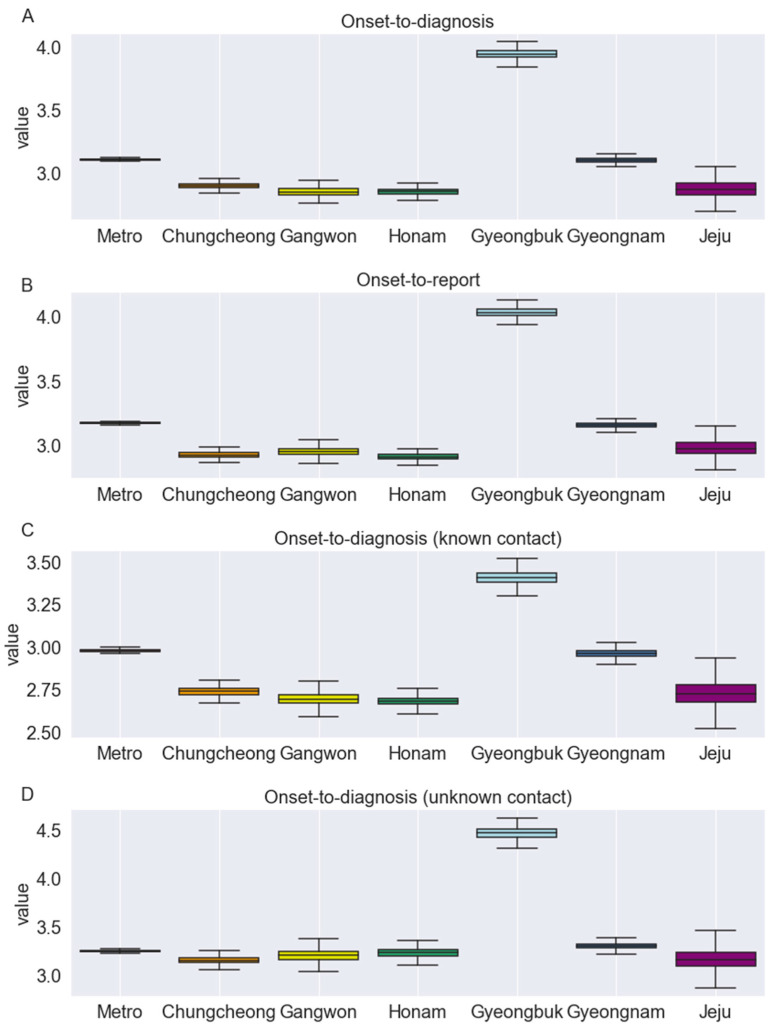
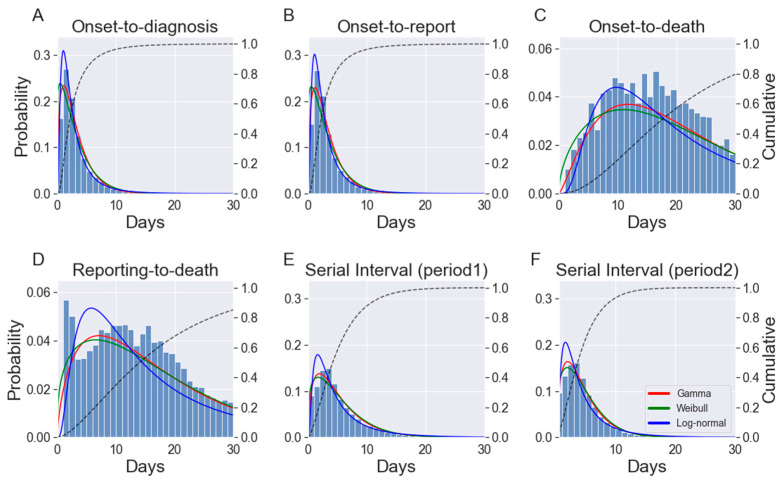
Epidemiological distributions of the coronavirus disease 2019 (COVID-19), including the intervals from symptom onset to diagnosis, reporting, or death, are important for developing effective disease-control strategies. COVID-19 case data (from 19 January 2020 to 10 January 2022) from a national database maintained by the Korea Disease Control and Prevention Agency and the Central Disease Control Headquarters were analyzed. A joint Bayesian subnational model with partial pooling was used and yielded probability distribution models of key epidemiological distributions in Korea. Serial intervals from before and during the Delta variant's predominance were estimated. Although the mean symptom-onset-to-report interval was 3.2 days at the national level, it varied across different regions (2.9-4.0 days). Gamma distribution showed the best fit for the onset-to-death interval (with heterogeneity in age, sex, and comorbidities) and the reporting-to-death interval. Log-normal distribution was optimal for ascertaining the onset-to-diagnosis and onset-to-report intervals. Serial interval (days) was shorter before the Delta variant-induced outbreaks than during the Delta variant's predominance (4.4 vs. 5.2 days), indicating the higher transmission potential of the Delta variant. The identified heterogeneity in region-, age-, sex-, and period-based distributions of the transmission dynamics of COVID-19 will facilitate the development of effective interventions and disease-control strategies.
2019冠状病毒病(COVID-19)的流行病学分布,包括从症状出现到诊断、报告或死亡的时间间隔,对于制定有效的疾病控制策略至关重要。分析了韩国疾病控制与预防机构及中央疾病控制总部维护的国家数据库中的COVID-19病例数据(从2020年1月19日至2022年1月10日)。使用了带有部分合并的联合贝叶斯次国家级模型,并得出了韩国关键流行病学分布的概率分布模型。估计了德尔塔变异株占主导之前和期间的序列间隔。尽管在国家层面,症状出现到报告的平均间隔为3.2天,但在不同地区有所不同(2.9 - 4.0天)。伽马分布对症状出现到死亡间隔(在年龄、性别和合并症方面存在异质性)和报告到死亡间隔显示出最佳拟合。对数正态分布对于确定症状出现到诊断和症状出现到报告间隔最为合适。在德尔塔变异株引发疫情之前,序列间隔(天数)比德尔塔变异株占主导期间更短(4.4天对5.2天),这表明德尔塔变异株具有更高的传播潜力。在COVID-19传播动态的基于地区、年龄、性别和时期的分布中所确定的异质性,将有助于制定有效的干预措施和疾病控制策略。