Schoen Clinic Roseneck, Am Roseneck 6, 83209 Prien am Chiemsee, Germany.
Forschungsprogramm für Psychotherapieevaluation im komplexen Therapiesetting, PMU Paracelsus Medical University Salzburg, 5020 Salzburg, Austria.
Nutrients. 2022 Jun 8;14(12):2378. doi: 10.3390/nu14122378.
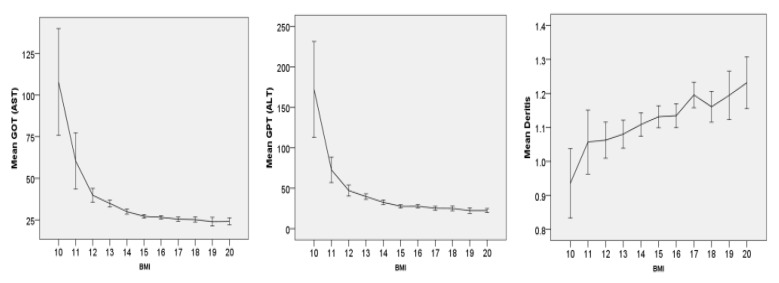
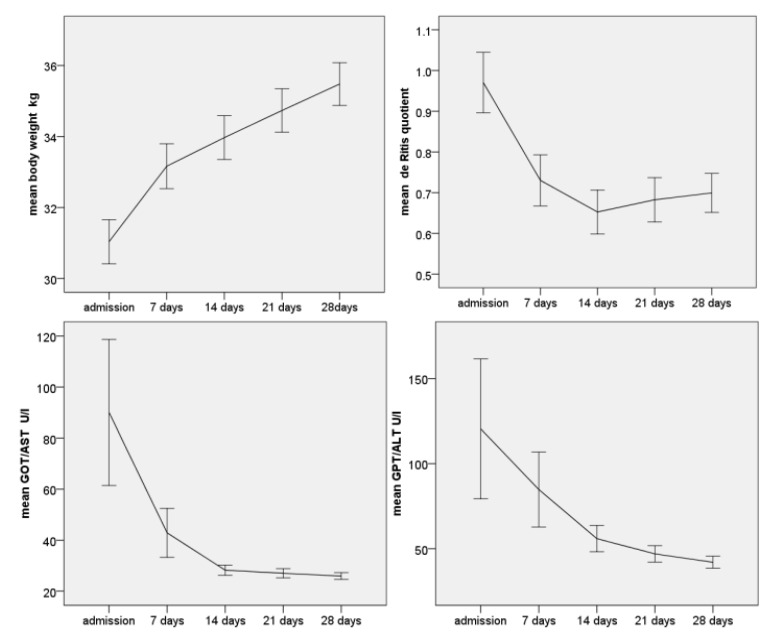
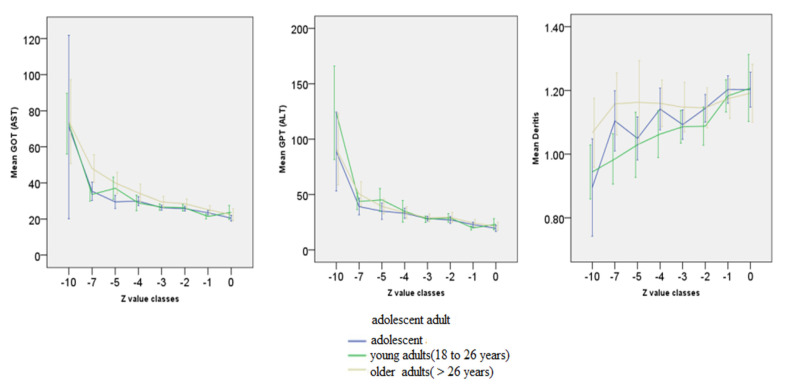
Background: The present study investigates the relationship between hypertransaminasemia and malnutrition on the basis of a very large number of patients. We assume that the level of transaminases not only reflects the extent of underlying liver cell damage but also provides information about the metabolic situation under conditions of energy deficiency. Methods: We present an observational study in two different samples. The first sample consists of 3755 patients (mean age 22.7 years, Range 12−73 years; mean BMI 15.4 kg/m2, range 8.1−25.7) out of a total of 4212 patients with anorexia nervosa treated in the Roseneck Clinic within five years for whom a complete admission laboratory was available. The second sample was obtained from a special ward for medically at-risk patients with eating disorders. During the period in question, four hundred and ten patients with anorexia nervosa were treated. One hundred and forty-two female patients (mean age 26.4 years, Range 18−63 years; mean BMI 11.5 kg/m2, range 8.4−13) had a BMI of thirteen or less and a complete data set was obtained at admission and weekly in the following four weeks after admission. Results: The increase in liver transaminases shows a very high correlation with weight in sample one (N = 3755). The analysis of variance shows highly significant (<0.001) correlations with an F-value of 55 for GOT/AST and 63 for GPT/ALT. Nevertheless, the variance within the groups with the same BMI is quite high. With re-nutrition in sample two, GOT/AST decreased on average from 71 U/L to 26 U/L (MANOVA F 10.7, p < 0.001) and GPT/ALT from 88 to 41 U/L (F = 9.9, p < 0.001) within four weeks. Discussion: Below a BMI of about 13, the nutritional status of the patients becomes so critical that the energy supply of the patient is increasingly dependent on the autophagy of the liver, which can be seen in the very strong increase in transaminases here. Refeeding leads very quickly to the normalisation of the transaminases and, thus, a stabilisation of the metabolism leading also to a decrease in autophagy.
本研究基于大量患者调查了高氨基转移酶血症与营养不良之间的关系。我们假设氨基转移酶水平不仅反映了潜在肝细胞损伤的程度,还提供了在能量缺乏情况下代谢情况的信息。方法:我们在两个不同样本中进行了一项观察性研究。第一个样本由罗塞内克诊所五年内收治的 4212 名神经性厌食症患者中的 3755 名(平均年龄 22.7 岁,范围 12-73 岁;平均 BMI 为 15.4kg/m2,范围 8.1-25.7)组成,他们均完成了入院时的全面实验室检查。第二个样本来自一个特殊病房,用于收治有医疗风险的进食障碍患者。在此期间,共收治了 410 名神经性厌食症患者。142 名女性患者(平均年龄 26.4 岁,范围 18-63 岁;平均 BMI 为 11.5kg/m2,范围 8.4-13)的 BMI 小于等于 13,并且在入院时和接下来的四周内每周都获得了完整的数据。结果:在第一个样本(N=3755)中,肝氨基转移酶的升高与体重呈高度正相关。方差分析显示,GOT/AST 的 F 值为 55,具有非常显著的相关性(<0.001),GPT/ALT 的 F 值为 63。然而,具有相同 BMI 的组内的方差却相当高。在第二个样本中,随着再营养治疗,GOT/AST 平均从 71U/L 降至 26U/L(MANOVA F 值为 10.7,p<0.001),GPT/ALT 从 88U/L 降至 41U/L(F 值为 9.9,p<0.001),这一变化发生在四周内。讨论:BMI 低于约 13 时,患者的营养状况变得非常危急,患者的能量供应越来越依赖于肝脏的自噬,这可以从这里氨基转移酶的强烈升高中看出。再喂养很快导致氨基转移酶正常化,从而使代谢稳定,也导致自噬减少。