Bukhari Syed Nasir Abbas, Zakaria Mohamed Y, Munir Muhammad Usman, Ahmad Naveed, Elsherif Mervat A, Badr Rasha Emad, Hassan Ahmad Khalaf, Almaaty Ali H Abu, Zaki Islam
Department of Pharmaceutical Chemistry, College of Pharmacy, Jouf University, Sakaka 72388, Saudi Arabia.
Department of Pharmaceutics and Industrial Pharmacy, Faculty of Pharmacy, Port Said University, Port Said 42526, Egypt.
Pharmaceuticals (Basel). 2022 May 28;15(6):679. doi: 10.3390/ph15060679.
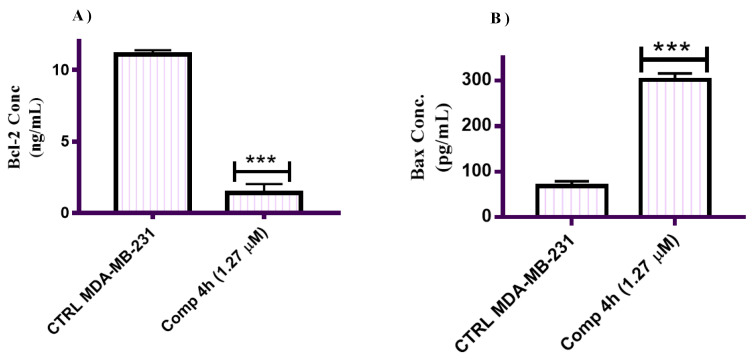
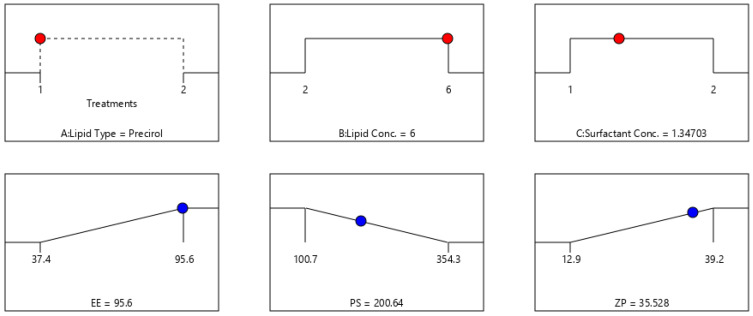
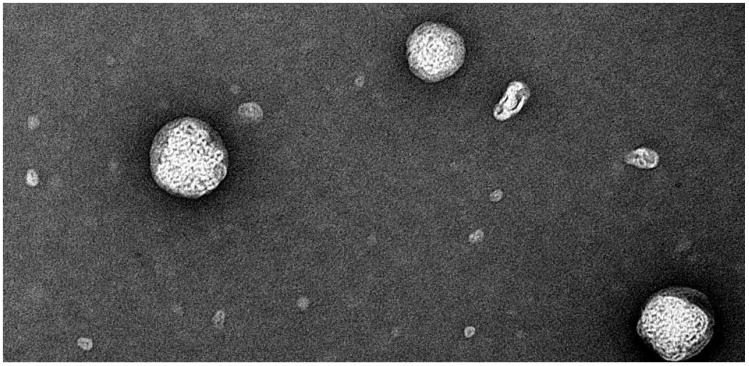
A series of novel Schiff bases-based TMP moieties have been designed and synthesized as potential anticancer agents. The target Schiff bases were screened for their cytotoxic activity against the MDA-MB-231 breast cancer cell line. Most of the tested molecules revealed good cytotoxic activity, especially compounds 4h, 4j and 5d. Being the most potent, compound 4h showed good tubulin polymerization inhibition activity as revealed by immunofluorescence analysis and ELISA assay. Additionally, compound 4h was screened for cell cycle disturbance and apoptosis induction. Pre-G1 apoptosis and cell growth halt at the G2/M phase were discovered to be caused by it. Moreover, compound 4h induced apoptosis via p53 and Bax activation, as well as reduced the level of Bcl-2. Additionally, the most potent compound 4h was lodged on nanostructured lipid carriers (NLCs). 23 full factorial design was involved to govern the influence of the fabrication variables on the in vitro characters of the casted NLCs. F3 was picked as the optimum formula exhibiting dominant desirability value 0.805, EE% 95.6 ± 2.4, PS 222.4 ±18.7, PDI 0.23 ± 0.05 and ZP −39.2 ± 3.9 Mv. Furthermore, F3 affirmed improved solubility and release over the drug suspension. In the comparative cytotoxic activity, F3 was capable of diminishing the IC50 by around 2.15 times for pure 4h, while nearly close to the IC50 of the reference drug. Thus, NLCs could be a potential platform for boosted antitumor activity.
一系列基于新型席夫碱的替莫泊芬(TMP)衍生物被设计并合成出来,作为潜在的抗癌药物。对目标席夫碱进行了针对MDA - MB - 231乳腺癌细胞系的细胞毒性活性筛选。大多数测试分子显示出良好的细胞毒性活性,尤其是化合物4h、4j和5d。作为最有效的化合物,免疫荧光分析和酶联免疫吸附测定显示化合物4h具有良好的微管蛋白聚合抑制活性。此外,对化合物4h进行了细胞周期干扰和凋亡诱导筛选。发现它会导致G1期前凋亡以及细胞在G2/M期生长停滞。此外,化合物4h通过激活p53和Bax诱导凋亡,并降低了Bcl - 2的水平。此外,将最有效的化合物4h负载于纳米结构脂质载体(NLCs)上。采用23全因子设计来控制制备变量对浇铸NLCs体外特性的影响。选择F3作为最佳配方,其具有显著的合意性值0.805,包封率(EE%)为95.6±2.4,粒径(PS)为222.4±18.7,多分散指数(PDI)为0.23±0.05,zeta电位(ZP)为 - 39.2±3.9 mV。此外,F3相比于药物悬浮液具有更好的溶解性和释放性能。在比较细胞毒性活性方面,F3能够使纯4h的半数抑制浓度(IC50)降低约2.15倍,同时几乎接近参考药物的IC50。因此,NLCs可能是增强抗肿瘤活性的潜在平台。