Nail Vincent, Louis Béatrice, Moyon Anaïs, Chabert Adrien, Balasse Laure, Fernandez Samantha, Hache Guillaume, Garrigue Philippe, Taïeb David, Guillet Benjamin
Centre Européen de Recherche en Imagerie Médicale (CERIMED), Aix-Marseille University, CNRS, 13005 Marseille, France.
Radiopharmacy Department, Assistance Publique-Hôpitaux de Marseille, CHU La Timone, CHU Nord, 13005 Marseille, France.
Pharmaceutics. 2022 Jun 16;14(6):1276. doi: 10.3390/pharmaceutics14061276.
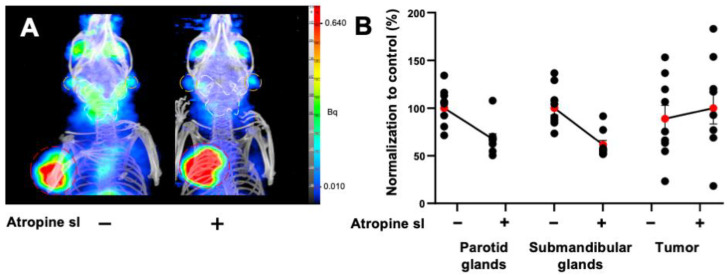
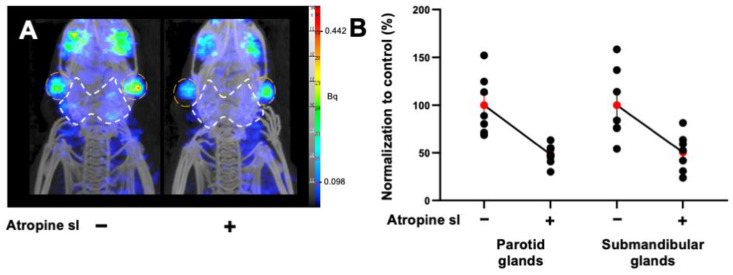
Prostate Specific Membrane Antigen (PSMA)-directed radionuclide therapy has gained an important role in the management of advanced castration-resistant prostate cancer. Although extremely promising, the prolongation in survival and amelioration of disease-related symptoms must be balanced against the direct toxicities of the treatment. Xerostomia is amongst the most common and debilitating of these, particularly when using an alpha emitter. It is therefore of main importance to develop new preventive strategies. This preclinical study has evaluated the effect of α-adrenergic and anticholinergic drugs on [99mTc]TcO4− Single Photon Emission Computed Tomography/Computed Tomography (SPECT/CT) and [68Ga]Ga-PSMA-11 Positron Emission Tomography (PET/CT). Methods: The effects of phenylephrine, scopolamine, atropine, and ipratropium on salivary glands uptake were evaluated in non-tumor-bearing mice by [99mTc]TcO4− microSPECT/CT. The most efficient identified strategy was evaluated in non-tumor-bearing and xenografted mice by [68Ga]Ga-PSMA-11 PET/CT. Results: Scopolamine and atropine showed a significant decrease in the parotid glands’ uptake on SPECT/CT whereas phenylephrine and ipratropium failed. Atropine premedication (sublingual route), which was the most effective strategy, also showed a drastic decrease of [68Ga]Ga-PSMA-11 salivary glands’ uptake in both non-tumor-bearing mice (−51.6% for the parotids, p < 0.0001) and human prostate adenocarcinoma xenografted mice (−26.8% for the parotids, p < 0.0001). Conclusion: Premedication with a local administration of atropine could represent a simple, safe, and efficient approach for reducing salivary glands’ uptake.
前列腺特异性膜抗原(PSMA)导向的放射性核素治疗在晚期去势抵抗性前列腺癌的治疗中发挥了重要作用。尽管前景极为广阔,但生存时间的延长和疾病相关症状的改善必须与治疗的直接毒性相权衡。口干症是其中最常见且使人衰弱的症状之一,尤其是在使用α发射体时。因此,制定新的预防策略至关重要。这项临床前研究评估了α肾上腺素能药物和抗胆碱能药物对[99mTc]TcO4−单光子发射计算机断层扫描/计算机断层扫描(SPECT/CT)以及[68Ga]Ga-PSMA-11正电子发射断层扫描(PET/CT)的影响。方法:通过[99mTc]TcO4−微SPECT/CT评估去氧肾上腺素、东莨菪碱、阿托品和异丙托溴铵对无肿瘤小鼠唾液腺摄取的影响。通过[68Ga]Ga-PSMA-11 PET/CT在无肿瘤小鼠和异种移植小鼠中评估确定的最有效策略。结果:东莨菪碱和阿托品使腮腺在SPECT/CT上的摄取显著降低,而去氧肾上腺素和异丙托溴铵则无效。最有效的策略——阿托品预处理(舌下给药途径),也使无肿瘤小鼠(腮腺摄取降低51.6%,p<0.0001)和人前列腺腺癌异种移植小鼠(腮腺摄取降低26.8%,p<0.0001)的[68Ga]Ga-PSMA-11唾液腺摄取大幅下降。结论:局部给予阿托品进行预处理可能是一种简单、安全且有效的减少唾液腺摄取的方法。