School of Public Health, Brown University, Providence, RI, USA.
School of Public Health, Brown University, Providence, RI, USA.
Lancet HIV. 2022 Aug;9(8):e574-e584. doi: 10.1016/S2352-3018(22)00076-5. Epub 2022 Jun 21.
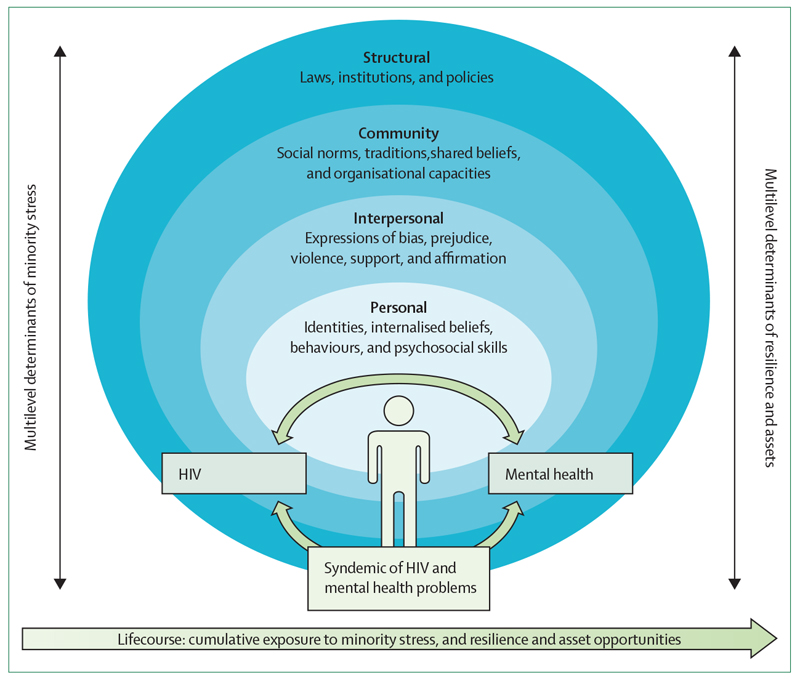
In this Series paper, we review evidence on the co-occurring and synergistic epidemics (syndemic) of HIV and mental health problems worldwide among men who have sex with men (MSM). The multilevel determinants of this global syndemic include structural factors that enable stigma, systematic bias, and violence towards MSM across geographical and cultural contexts. Cumulative exposure to these factors over time results in population-level inequities in the burden of HIV infections and mental health problems among MSM. Evidence for this syndemic among MSM is strongest in the USA, Canada, western Europe, and parts of Asia and Latin America, with emerging evidence from sub-Saharan Africa. Integrated interventions are needed to address syndemics of HIV and mental health problems that challenge the wellbeing of MSM populations worldwide, and such interventions should consider various mental health conditions (eg, depression, anxiety, trauma, and suicidality) and their unique expressions and relationships with HIV outcomes depending on cultural contexts. In addition, interventions should identify and intervene with locally relevant structural factors that result in HIV and mental health vulnerabilities among MSM.
在本系列论文中,我们回顾了全球男男性行为者(MSM)中艾滋病毒和心理健康问题同时发生和协同流行(综合征)的证据。这种全球综合征的多层次决定因素包括在地理和文化背景下使针对 MSM 的污名化、系统偏见和暴力成为可能的结构性因素。随着时间的推移,这些因素的累积暴露导致 MSM 中艾滋病毒感染和心理健康问题的负担在人群层面上出现不平等。在 MSM 中,这种综合征的证据在美国、加拿大、西欧以及亚洲和拉丁美洲的部分地区最为有力,在撒哈拉以南非洲也出现了新的证据。需要采取综合干预措施来应对艾滋病毒和心理健康问题的综合征,这些问题挑战着全球 MSM 人群的福祉,并且这些干预措施应考虑到各种心理健康状况(例如,抑郁、焦虑、创伤和自杀意念)及其与艾滋病毒结果的独特表达和关系,具体取决于文化背景。此外,干预措施应确定并干预导致 MSM 中艾滋病毒和心理健康脆弱性的本地相关结构性因素。