Division of Infectious Diseases and Geographic Medicine, Stanford University, Stanford, CA, USA.
Child Health Research Foundation, Dhaka, Bangladesh; Department of Medical Microbiology and Infectious Diseases, Erasmus University Medical Center, Rotterdam, Netherlands.
Lancet Microbe. 2022 Aug;3(8):e567-e577. doi: 10.1016/S2666-5247(22)00093-3. Epub 2022 Jun 21.
The emergence of increasingly antimicrobial-resistant Salmonella enterica serovar Typhi (S Typhi) threatens to undermine effective treatment and control. Understanding where antimicrobial resistance in S Typhi is emerging and spreading is crucial towards formulating effective control strategies.
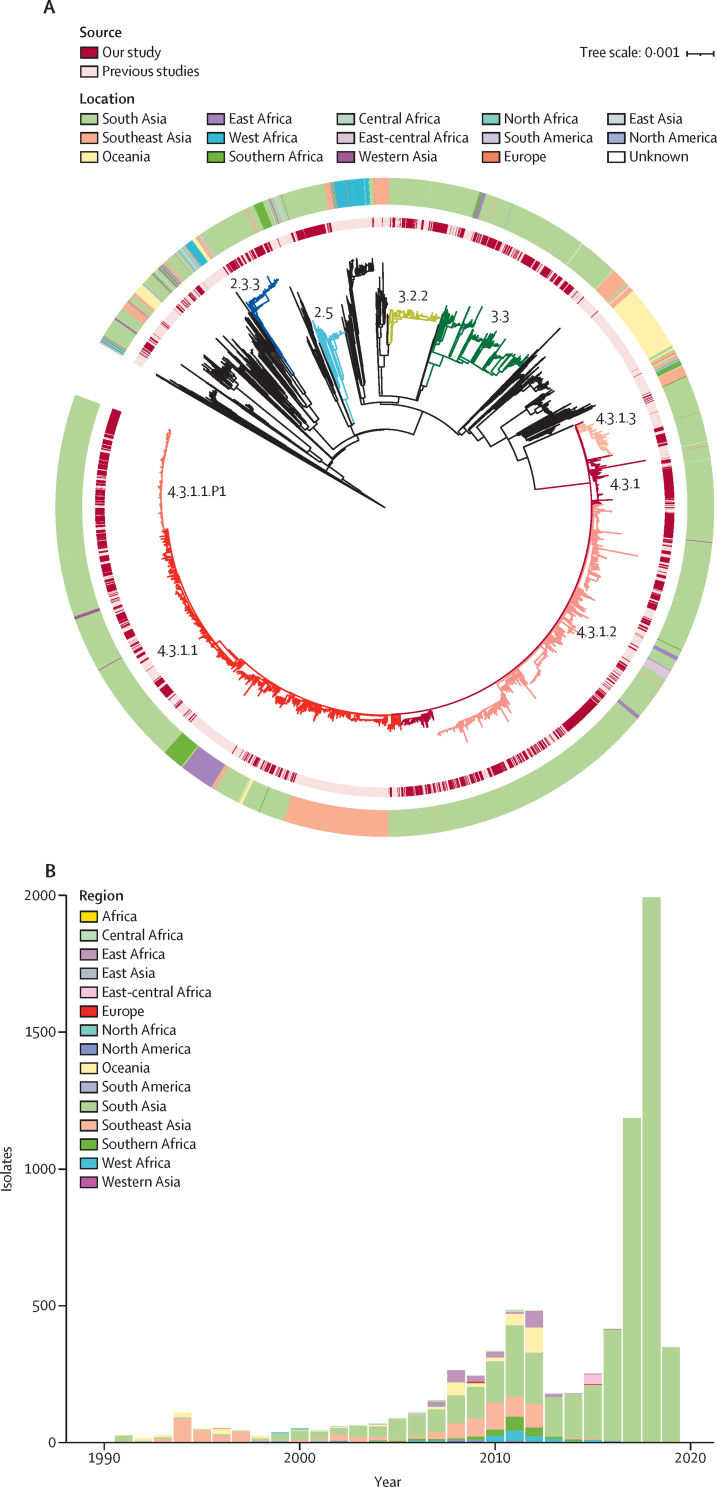
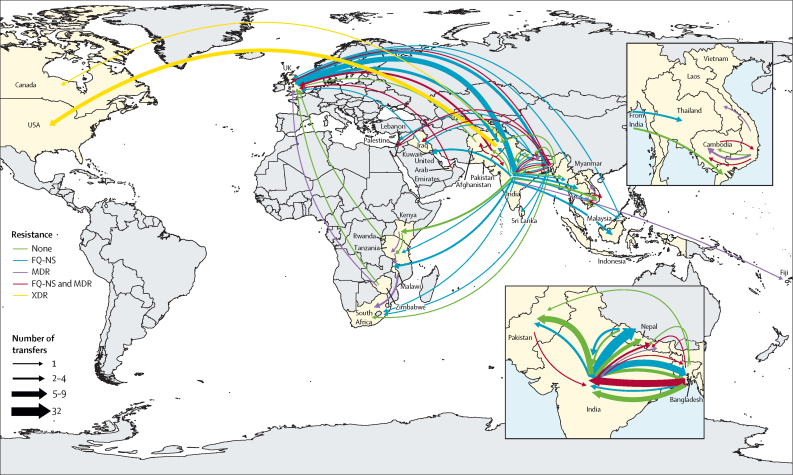
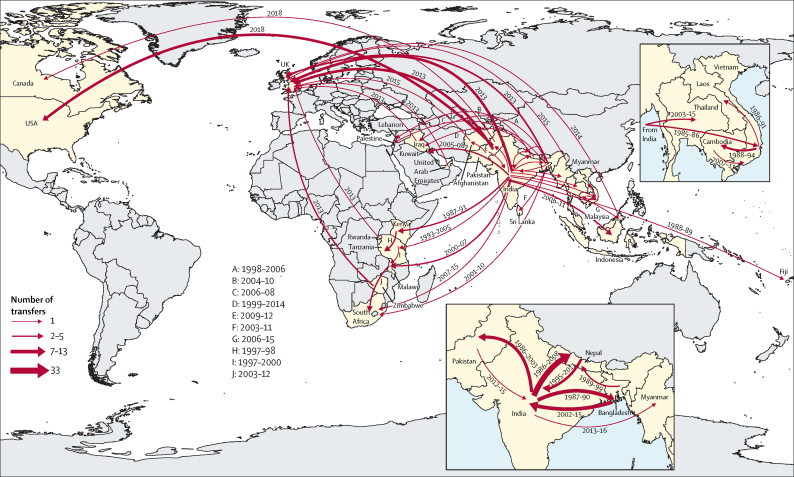
In this genomic epidemiology study, we sequenced the genomes of 3489 S Typhi strains isolated from prospective enteric fever surveillance studies in Nepal, Bangladesh, Pakistan, and India (between 2014 and 2019), and combined these with a global collection of 4169 S Typhi genome sequences isolated between 1905 and 2018 to investigate the temporal and geographical patterns of emergence and spread of antimicrobial-resistant S Typhi. We performed non-parametric phylodynamic analyses to characterise changes in the effective population size of fluoroquinolone-resistant, extensively drug-resistant (XDR), and azithromycin-resistant S Typhi over time. We inferred timed phylogenies for the major S Typhi sublineages and used ancestral state reconstruction methods to estimate the frequency and timing of international and intercontinental transfers.
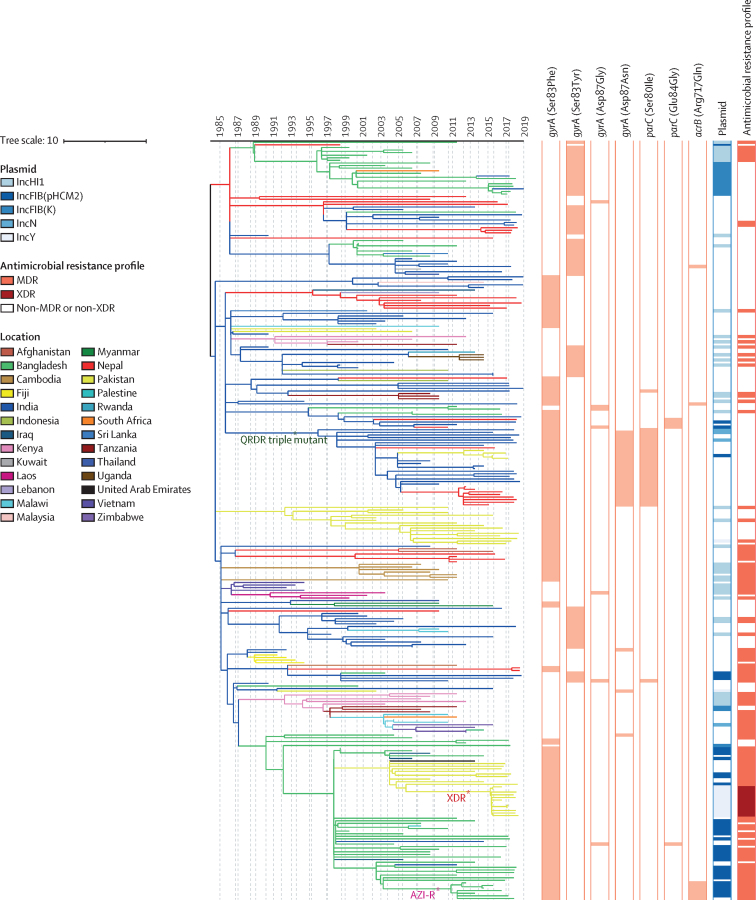
Our analysis revealed a declining trend of multidrug resistant typhoid in south Asia, except for Pakistan, where XDR S Typhi emerged in 2016 and rapidly replaced less-resistant strains. Mutations in the quinolone-resistance determining region (QRDR) of S Typhi have independently arisen and propagated on at least 94 occasions, nearly all occurring in south Asia. Strains with multiple QRDR mutations, including triple mutants with high-level fluoroquinolone resistance, have been increasing in frequency and displacing strains with fewer mutations. Strains containing acrB mutations, conferring azithromycin resistance, emerged in Bangladesh around 2013 and effective population size of these strains has been steadily increasing. We found evidence of frequent international (n=138) and intercontinental transfers (n=59) of antimicrobial-resistant S Typhi, followed by local expansion and replacement of drug-susceptible clades.
Independent acquisition of plasmids and homoplastic mutations conferring antimicrobial resistance have occurred repeatedly in multiple lineages of S Typhi, predominantly arising in south Asia before spreading to other regions.
Bill & Melinda Gates Foundation.
越来越多的耐抗生素沙门氏菌肠亚种 Typhi(S Typhi)的出现威胁到有效的治疗和控制。了解 S Typhi 中抗生素耐药性的出现和传播的地点对于制定有效的控制策略至关重要。
在这项基因组流行病学研究中,我们对从尼泊尔、孟加拉国、巴基斯坦和印度的前瞻性肠热病监测研究中分离的 3489 株 S Typhi 菌株进行了基因组测序(2014 年至 2019 年),并将这些菌株与全球在 1905 年至 2018 年之间分离的 4169 株 S Typhi 基因组序列进行了组合,以研究耐抗生素 S Typhi 的出现和传播的时间和地理模式。我们进行了非参数系统发育分析,以描述氟喹诺酮耐药、广泛耐药(XDR)和阿奇霉素耐药 S Typhi 的有效种群大小随时间的变化。我们推断了主要 S Typhi 亚系的时间系统发育,并使用祖先状态重建方法估计了国际和洲际转移的频率和时间。
我们的分析显示,南亚的多药耐药性伤寒呈下降趋势,但巴基斯坦除外,2016 年出现了 XDR S Typhi,并迅速取代了耐药性较低的菌株。S Typhi 喹诺酮耐药决定区(QRDR)中的突变独立出现并传播了至少 94 次,几乎都发生在南亚。具有多个 QRDR 突变的菌株,包括具有高水平氟喹诺酮耐药性的三突变体,其频率不断增加,并取代了具有较少突变的菌株。含有 acrB 突变的菌株,可导致阿奇霉素耐药,于 2013 年左右在孟加拉国出现,这些菌株的有效种群大小一直在稳步增加。我们发现了耐抗生素 S Typhi 的频繁国际(n=138)和洲际转移(n=59)的证据,随后是耐药性克隆的本地扩张和取代。
在 S Typhi 的多个谱系中,独立获得的质粒和同型突变赋予了抗生素耐药性,主要发生在南亚,然后传播到其他地区。
比尔及梅琳达·盖茨基金会。