Division of Spine Surgery, Department of Orthopedic Surgery, Nanjing Drum Tower Hospital, The Affiliated Hospital of Nanjing University Medical School, Nanjing, China.
Joint Scoliosis Research Center of The Chinese University of Hong Kong and Nanjing University, Nanjing & Hong Kong, China.
Orphanet J Rare Dis. 2022 Jun 25;17(1):247. doi: 10.1186/s13023-022-02380-z.
X-linked early-onset osteoporosis, caused by mutations in plastin3 (PLS3), is an extremely rare disease characterized by low bone mineral density (BMD) and recurrent osteoporotic fractures. There is limited information on genetic and phenotypic spectrum, as well as genotype-phenotype correlations of the disease. Moreover, whether decreased PLS3 levels were also involved in osteoporosis among subjects without PLS3 pathogenic mutations remains unknown.
Whole-exome sequencing and bidirectional Sanger sequencing were performed for screening and validation of pathogenic mutations. Serum biochemical parameters and clinical information of the subjects were retrospectively collected. ELISA and online datasets were utilized to investigate the association between PLS3 expression and BMD.
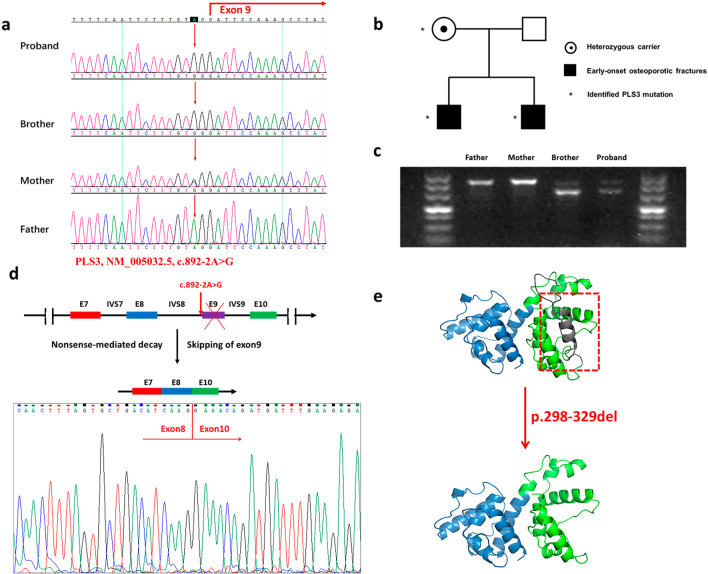
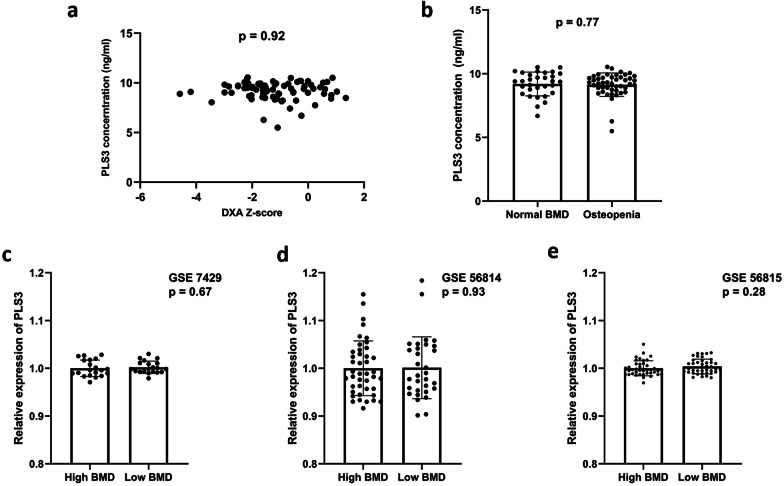
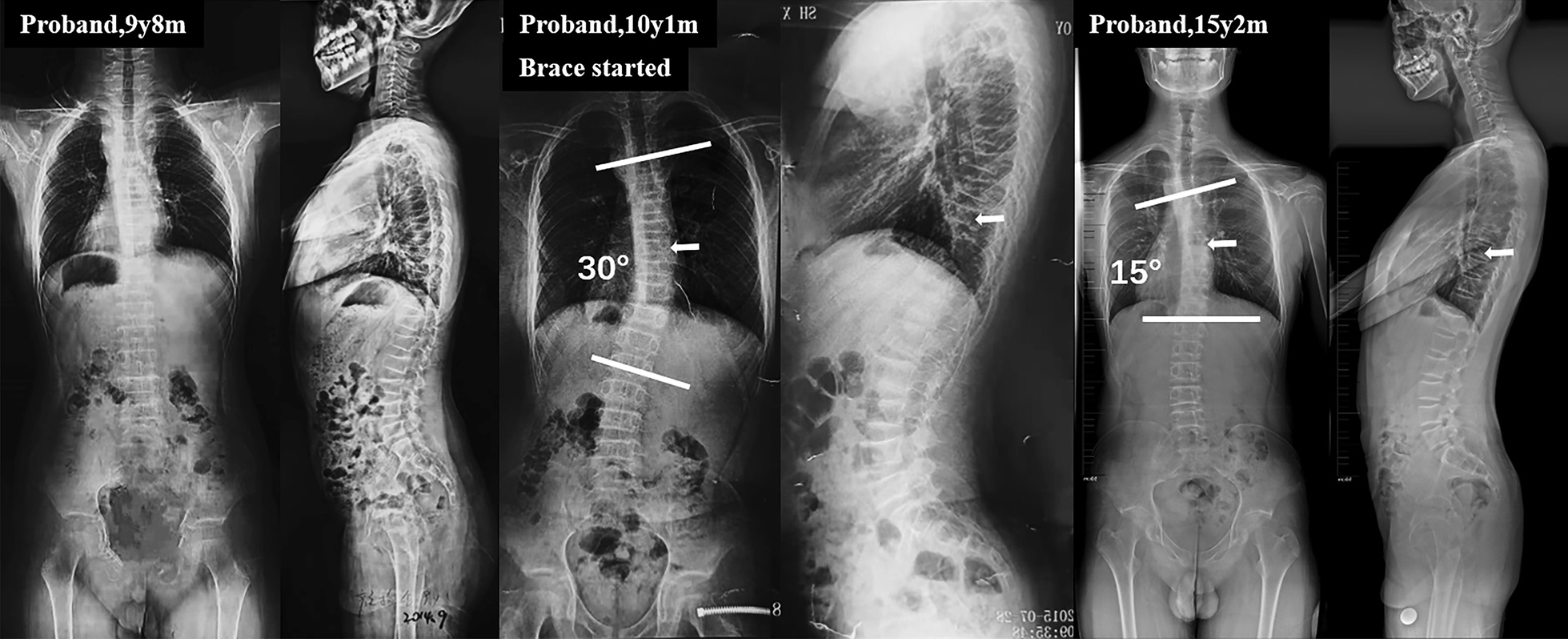
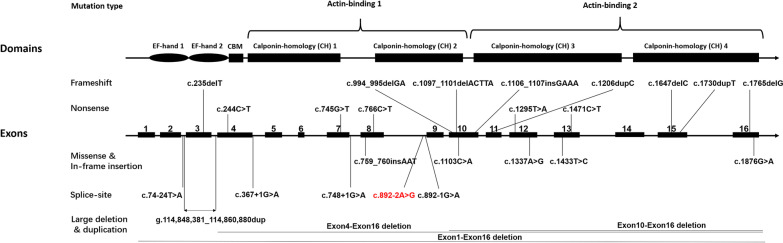
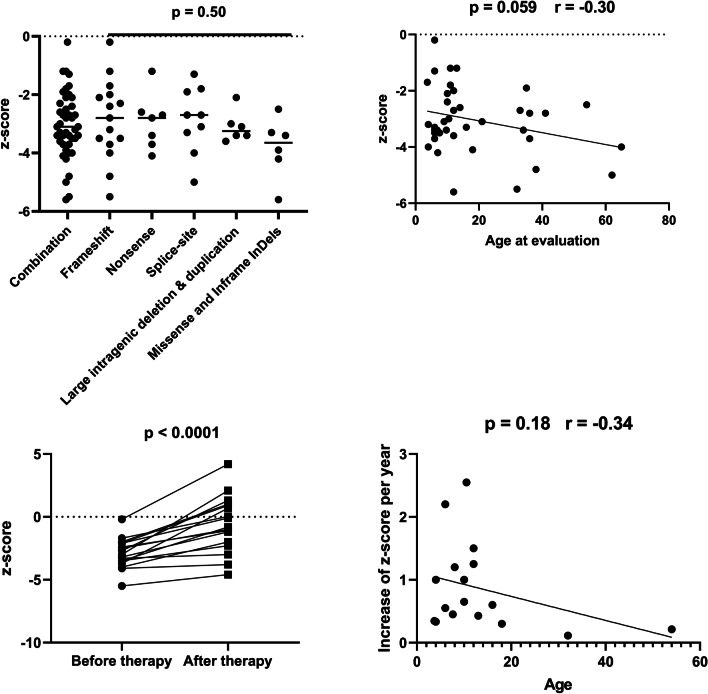
We identified a novel splicing mutation (c.892-2A > G) which led to the skipping of exon 9 in a family with X-linked early-onset osteoporosis. Scoliosis represents a potential new phenotype in the patients harboring PLS3 mutations, which may be corrected by brace treatment. Genotype-phenotype analysis reveals that there was no significant difference in BMD z-scores between different types of reported mutations including this study (p = 0.5). There is a marginally significant negative correlation between age and BMD z-score (p = 0.059, r = - 0.30). The conditions of osteoporosis in all patients were improved after bisphosphonates therapy, with mean BMD z-score increased from - 2.9 to - 0.57 (p < 0.0001). Serum PLS3 levels in adolescents and adults without PLS3 pathogenic mutations but representing osteoporosis were also evaluated, while no association was found between bone mineral density and PLS3 levels (p > 0.05).
Our findings expanded the mutation and phenotype spectrum of the rare disease and highlights the importance of early diagnosis and early treatment with bisphosphonates. More reports of cases with PLS3 mutation and function studies of the gene are warranted to understand genotype-phenotype correlations.
X 连锁早发性骨质疏松症是一种极其罕见的疾病,由 plastin3(PLS3)基因突变引起,其特征是骨矿物质密度(BMD)低和反复发生骨质疏松性骨折。关于该疾病的遗传和表型谱以及基因型-表型相关性的信息有限。此外,在没有 PLS3 致病性突变的受试者中,PLS3 水平降低是否也与骨质疏松症有关尚不清楚。
进行全外显子组测序和双向 Sanger 测序以筛选和验证致病性突变。回顾性收集受试者的血清生化参数和临床信息。利用 ELISA 和在线数据集研究 PLS3 表达与 BMD 之间的关系。
我们在一个 X 连锁早发性骨质疏松症家系中发现了一个新的剪接突变(c.892-2A > G),导致外显子 9 跳跃。携带 PLS3 突变的患者中,脊柱侧凸是一种潜在的新表型,可能通过支架治疗得到矫正。基因型-表型分析表明,不同类型的报告突变(包括本研究)之间的 BMD z 评分无显著差异(p=0.5)。年龄与 BMD z 评分呈负相关(p=0.059,r=-0.30),但相关性较弱。所有患者在接受双膦酸盐治疗后骨质疏松症状况得到改善,平均 BMD z 评分从-2.9 增加至-0.57(p<0.0001)。还评估了青少年和成年人中无 PLS3 致病性突变但存在骨质疏松症的患者的血清 PLS3 水平,但未发现骨密度与 PLS3 水平之间存在关联(p>0.05)。
我们的发现扩展了该罕见疾病的突变和表型谱,并强调了早期诊断和早期使用双膦酸盐治疗的重要性。需要更多关于 PLS3 突变病例的报告和对该基因的功能研究,以了解基因型-表型相关性。