Mayden Kelley D, Kelton John M, Ryan Joanne C, McBride Ali
Ballad Health Cancer Care, Bristol, Virginia.
Pfizer Inc, New York, New York.
J Adv Pract Oncol. 2022 May;13(4):417-439. doi: 10.6004/jadpro.2022.13.4.5. Epub 2022 Jun 21.
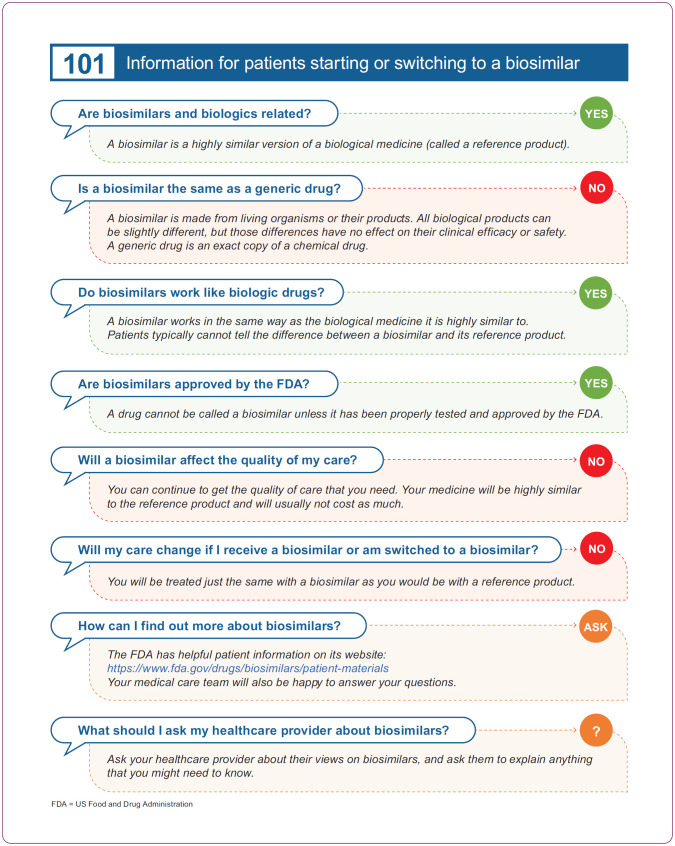
In oncology practices across the United States, biosimilars-highly similar versions of licensed, innovator (reference) biological medicines-are currently emerging as more affordable therapeutic options. Only after a rigorous product development program, during which a proposed biosimilar is analyzed and compared with its reference biologic to demonstrate comparable clinical efficacy, safety, and tolerability, is biosimilarity supported and licensure granted by the US Food and Drug Administration. Coincidentally, many advanced practitioners (APs) are finding themselves at the forefront of introducing monoclonal antibody (mAb) biosimilars in their oncology practice. Advanced practitioners are often tasked with building the confidence of colleagues and patients who may be unfamiliar with biosimilars, skeptical about integrating them, or have yet to consider mAb biosimilars as a viable and more sustainable cancer treatment option. With this responsibility comes a number of challenges that require APs to become knowledgeable about biosimilars and approaches to their implementation. This review aims to highlight the practical implications of streamlining the integration of biosimilar therapies in an oncology practice.
在美国各地的肿瘤学实践中,生物类似药(已获许可的创新型(参照)生物药物的高度相似版本)目前正成为更具价格优势的治疗选择。只有在经过严格的产品开发程序后,即对拟议的生物类似药进行分析并与参照生物制品进行比较,以证明其具有可比的临床疗效、安全性和耐受性,美国食品药品监督管理局才会支持生物相似性并授予许可。巧合的是,许多高级从业者(AP)发现自己处于在肿瘤学实践中引入单克隆抗体(mAb)生物类似药的前沿。高级从业者通常肩负着建立同事和患者信心的任务,这些同事和患者可能对生物类似药不熟悉、对整合它们持怀疑态度,或者尚未将mAb生物类似药视为一种可行且更具可持续性的癌症治疗选择。伴随着这项责任而来的是一些挑战,这些挑战要求AP了解生物类似药及其实施方法。本综述旨在强调在肿瘤学实践中简化生物类似药疗法整合的实际意义。