• 文献检索
  • 文档翻译
  • 深度研究
  • 学术资讯
  • Suppr Zotero 插件Zotero 插件
  • 邀请有礼
  • 套餐&价格
  • 历史记录
应用&插件
Suppr Zotero 插件Zotero 插件浏览器插件Mac 客户端Windows 客户端微信小程序
定价
高级版会员购买积分包购买API积分包
服务
文献检索文档翻译深度研究API 文档MCP 服务
关于我们
关于 Suppr公司介绍联系我们用户协议隐私条款
关注我们

Suppr 超能文献

核心技术专利:CN118964589B侵权必究
粤ICP备2023148730 号-1Suppr @ 2026

文献检索

告别复杂PubMed语法,用中文像聊天一样搜索,搜遍4000万医学文献。AI智能推荐,让科研检索更轻松。

立即免费搜索

文件翻译

保留排版,准确专业,支持PDF/Word/PPT等文件格式,支持 12+语言互译。

免费翻译文档

深度研究

AI帮你快速写综述,25分钟生成高质量综述,智能提取关键信息,辅助科研写作。

立即免费体验

基于基线4D血流衍生的血流动力学参数对主动脉扩张的降主动脉夹层患者进行分层。

Baseline 4D Flow-Derived Hemodynamic Parameters Stratify Descending Aortic Dissection Patients With Enlarging Aortas.

作者信息

Chu Stanley, Kilinc Ozden, Pradella Maurice, Weiss Elizabeth, Baraboo Justin, Maroun Anthony, Jarvis Kelly, Mehta Christopher K, Malaisrie S Chris, Hoel Andrew W, Carr James C, Markl Michael, Allen Bradley D

机构信息

Department of Radiology, Northwestern University, Chicago, IL, United States.

Department of Biomedical Engineering, Northwestern University, Chicago, IL, United States.

出版信息

Front Cardiovasc Med. 2022 Jun 9;9:905718. doi: 10.3389/fcvm.2022.905718. eCollection 2022.

DOI:10.3389/fcvm.2022.905718
PMID:35757320
原文链接:https://pmc.ncbi.nlm.nih.gov/articles/PMC9218246/
Abstract

PURPOSE

The purpose of our study was to assess the value of true lumen and false lumen hemodynamics compared to aortic morphological measurements for predicting adverse-aorta related outcomes (AARO) and aortic growth in patients with type B aortic dissection (TBAD).

MATERIALS AND METHODS

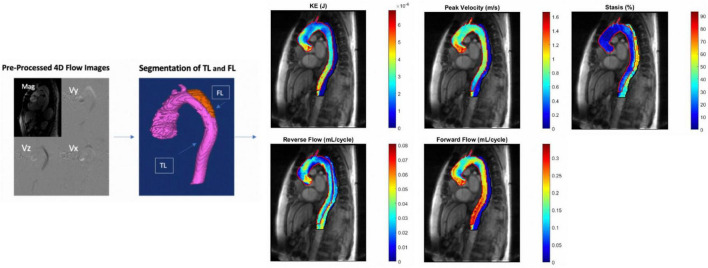
Using an IRB approved protocol, we retrospectively identified patients with descending aorta (DAo) dissection at a large tertiary center. Inclusion criteria includes known TBAD with ≥ 6 months of clinical follow-up after initial presentation for TBAD or after ascending aorta intervention for patients with repaired type A dissection with residual type B aortic dissection (rTAAD). Patients with prior descending aorta intervention were excluded. The FL and TL of each patient were manually segmented from 4D flow MRI data, and 3D parametric maps of aortic hemodynamics were generated. Groups were divided based on (1) presence vs. absence of AARO and (2) growth rate ≥ vs. < 3 mm/year. True and false lumen kinetic energy (KE), stasis, peak velocity (PV), reverse/forward flow (RF/FF), FL to TL KE ratio, as well as index aortic diameter were compared between groups using the Mann-Whitney or independent -test.

RESULTS

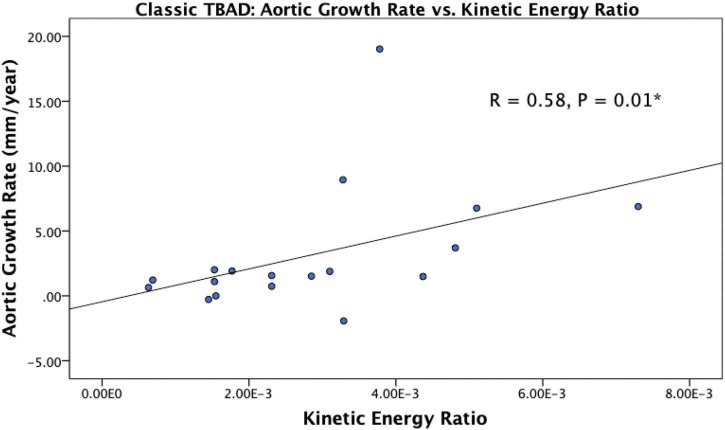
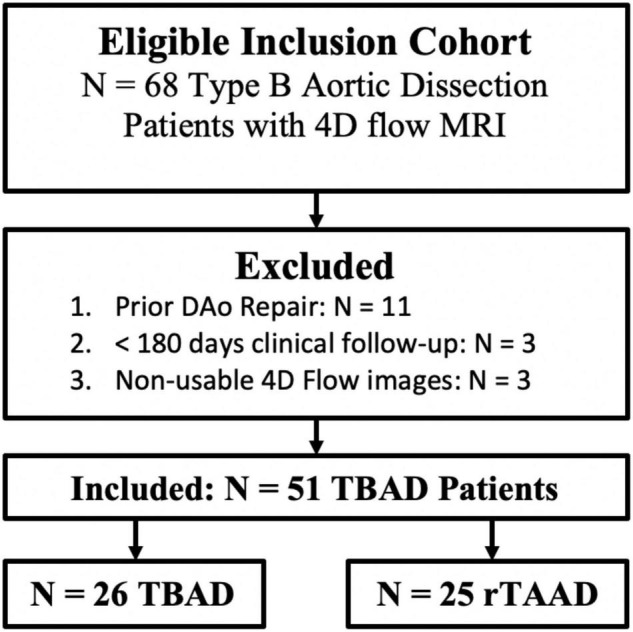
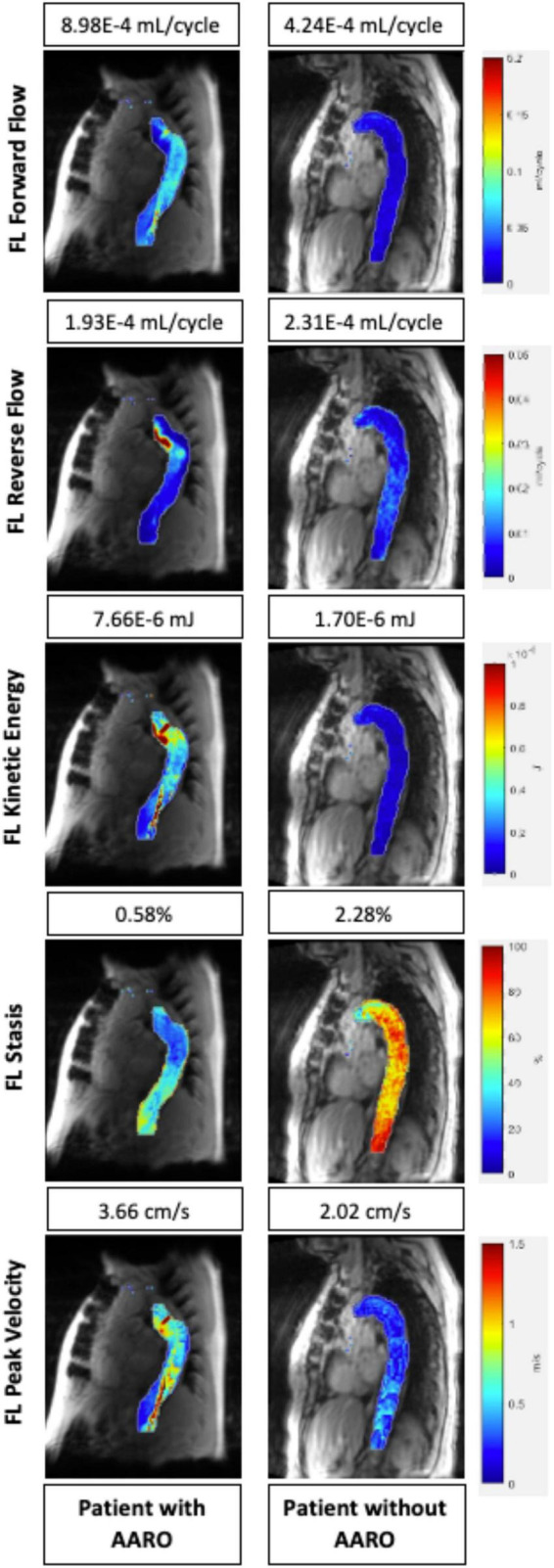
A total of = 51 patients (age: 58.4 ± 15.0 years, M/F: 31/20) were included for analysis of AARO. This group contained = 26 patients with TBAD and = 25 patients with rTAAD. In the overall cohort, AARO patients had larger baseline diameters, lower FL-RF, FL stasis, TL-KE, TL-FF and TL-PV. Among patients with TBAD, those with AAROs had larger baseline diameter, lower FL stasis and TL-PV. In both the overall cohort and in the subgroup of TBAD, subjects with aortic growth ≥ 3mm/year, patients had a higher KE ratio.

CONCLUSION

Our study suggests that 4D flow MRI is a promising tool for TBAD evaluation that can provide information beyond traditional MRA or CTA. 4D flow has the potential to become an integral aspect of TBAD work-up, as hemodynamic assessment may allow earlier identification of at-risk patients who could benefit from earlier intervention.

摘要

目的

我们研究的目的是评估与主动脉形态测量相比,真腔和假腔血流动力学对于预测B型主动脉夹层(TBAD)患者不良主动脉相关结局(AARO)和主动脉生长的价值。

材料与方法

使用经机构审查委员会批准的方案,我们在一家大型三级中心回顾性地识别降主动脉(DAo)夹层患者。纳入标准包括初次出现TBAD后或A型夹层修复且残留B型主动脉夹层(rTAAD)的患者进行升主动脉干预后有≥6个月临床随访的已知TBAD。排除先前有降主动脉干预的患者。从4D流动磁共振成像(MRI)数据中手动分割出每位患者的假腔(FL)和真腔(TL),并生成主动脉血流动力学的3D参数图。根据(1)是否存在AARO和(2)生长速率≥与<3毫米/年进行分组。使用Mann-Whitney检验或独立t检验比较组间真腔和假腔的动能(KE)、血流淤滞、峰值速度(PV)、反向/正向血流(RF/FF)、FL与TL的KE比值以及主动脉直径指数。

结果

共有51例患者(年龄:58.4±15.0岁,男/女:31/20)纳入AARO分析。该组包括26例TBAD患者和25例rTAAD患者。在整个队列中,发生AARO的患者基线直径更大,FL-RF、FL血流淤滞、TL-KE、TL-FF和TL-PV更低。在TBAD患者中,发生AARO的患者基线直径更大,FL血流淤滞和TL-PV更低。在整个队列和TBAD亚组中,主动脉生长≥3毫米/年的患者KE比值更高。

结论

我们的研究表明,4D流动MRI是一种有前景的TBAD评估工具,可提供超越传统磁共振血管造影(MRA)或计算机断层血管造影(CTA)的信息。4D流动有潜力成为TBAD检查的一个组成部分,因为血流动力学评估可能允许更早识别可从早期干预中获益的高危患者。
https://cdn.ncbi.nlm.nih.gov/pmc/blobs/8f17/9218246/053bfd5d9de5/fcvm-09-905718-g004.jpg
https://cdn.ncbi.nlm.nih.gov/pmc/blobs/8f17/9218246/b13526ae905d/fcvm-09-905718-g001.jpg
https://cdn.ncbi.nlm.nih.gov/pmc/blobs/8f17/9218246/b0c4012b4f07/fcvm-09-905718-g002.jpg
https://cdn.ncbi.nlm.nih.gov/pmc/blobs/8f17/9218246/627fe333669b/fcvm-09-905718-g003.jpg
https://cdn.ncbi.nlm.nih.gov/pmc/blobs/8f17/9218246/053bfd5d9de5/fcvm-09-905718-g004.jpg
https://cdn.ncbi.nlm.nih.gov/pmc/blobs/8f17/9218246/b13526ae905d/fcvm-09-905718-g001.jpg
https://cdn.ncbi.nlm.nih.gov/pmc/blobs/8f17/9218246/b0c4012b4f07/fcvm-09-905718-g002.jpg
https://cdn.ncbi.nlm.nih.gov/pmc/blobs/8f17/9218246/627fe333669b/fcvm-09-905718-g003.jpg
https://cdn.ncbi.nlm.nih.gov/pmc/blobs/8f17/9218246/053bfd5d9de5/fcvm-09-905718-g004.jpg

相似文献

1
Baseline 4D Flow-Derived Hemodynamic Parameters Stratify Descending Aortic Dissection Patients With Enlarging Aortas.基于基线4D血流衍生的血流动力学参数对主动脉扩张的降主动脉夹层患者进行分层。
Front Cardiovasc Med. 2022 Jun 9;9:905718. doi: 10.3389/fcvm.2022.905718. eCollection 2022.
2
Interval changes in four-dimensional flow-derived in vivo hemodynamics stratify aortic growth in type B aortic dissection patients.B型主动脉夹层患者体内基于四维血流的血流动力学的间期变化对主动脉生长进行分层。
J Cardiovasc Magn Reson. 2024;26(2):101078. doi: 10.1016/j.jocmr.2024.101078. Epub 2024 Aug 2.
3
Parametric Hemodynamic 4D Flow MRI Maps for the Characterization of Chronic Thoracic Descending Aortic Dissection.用于慢性胸降主动脉夹层特征描述的参数血流 4D 流 MRI 图谱。
J Magn Reson Imaging. 2020 May;51(5):1357-1368. doi: 10.1002/jmri.26986. Epub 2019 Nov 12.
4
Hemodynamic Evaluation of Type B Aortic Dissection Using Compressed Sensing Accelerated 4D Flow MRI.使用压缩感知加速 4D 流 MRI 对 B 型主动脉夹层的血流动力学评估。
J Magn Reson Imaging. 2023 Jun;57(6):1752-1763. doi: 10.1002/jmri.28432. Epub 2022 Sep 23.
5
False lumen pressure estimation in type B aortic dissection using 4D flow cardiovascular magnetic resonance: comparisons with aortic growth.使用 4D 流心血管磁共振技术评估 B 型主动脉夹层的假腔压力:与主动脉生长的比较。
J Cardiovasc Magn Reson. 2021 May 13;23(1):51. doi: 10.1186/s12968-021-00741-4.
6
Entry tear hemodynamics using 4D flow MRI in a patient with acute type B aortic dissection.在一名急性B型主动脉夹层患者中使用四维血流磁共振成像评估入口撕裂处血流动力学。
Radiol Case Rep. 2023 Jan 6;18(3):1037-1040. doi: 10.1016/j.radcr.2022.12.033. eCollection 2023 Mar.
7
The Role of Multiple Re-Entry Tears in Type B Aortic Dissection Progression: A Longitudinal Study Using a Controlled Swine Model.多部位再破口在 B 型主动脉夹层进展中的作用:应用可控猪模型的纵向研究。
J Endovasc Ther. 2024 Feb;31(1):104-114. doi: 10.1177/15266028221111295. Epub 2022 Jul 19.
8
Hemodynamic Changes Before and After Endovascular Treatment of Type B Aortic Dissection by 4D Flow MRI.4D 血流磁共振成像评估 B 型主动脉夹层血管腔内治疗前后的血流动力学变化
Front Cardiovasc Med. 2022 May 25;9:873144. doi: 10.3389/fcvm.2022.873144. eCollection 2022.
9
False lumen hemodynamics and partial thrombosis in chronic aortic dissection of the descending aorta.慢性降主动脉夹层中假腔的血流动力学和部分血栓形成。
Eur Radiol. 2024 Aug;34(8):5190-5200. doi: 10.1007/s00330-023-10513-6. Epub 2024 Jan 6.
10
Association of variant arch anatomy with type B aortic dissection and hemodynamic mechanisms.变异主动脉弓解剖结构与B型主动脉夹层及血流动力学机制的关联
J Vasc Surg. 2018 Dec;68(6):1640-1648. doi: 10.1016/j.jvs.2018.03.409. Epub 2018 May 24.

引用本文的文献

1
Aortic Hemodynamics with Accelerated Dual-Venc 4D Flow MRI in Type B Aortic Dissection.B型主动脉夹层中使用加速双容积4D血流MRI的主动脉血流动力学
Appl Sci (Basel). 2023 May 2;13(10):6202. doi: 10.3390/app13106202. Epub 2023 May 18.
2
4D Flow MRI derived aortic pulse wave velocity and wall shear stress in Covid-19.基于4D流磁共振成像的新型冠状病毒肺炎患者主动脉脉搏波速度和壁面剪应力
Clin Imaging. 2025 Aug;124:110524. doi: 10.1016/j.clinimag.2025.110524. Epub 2025 May 29.
3
Questions and Certainty in Diagnosis and Management of Acute Type B Aortic Dissection.

本文引用的文献

1
Distal Aortic Remodeling after Type A Dissection Repair: An Ongoing Mirage.A型主动脉夹层修复术后的远端主动脉重塑:海市蜃楼仍在持续。
J Chest Surg. 2021 Dec 5;54(6):439-448. doi: 10.5090/jcs.21.027.
2
Noninvasive Morphologic and Hemodynamic Evaluation of Type B Aortic Dissection: State of the Art and Future Perspectives.B型主动脉夹层的无创形态学和血流动力学评估:现状与未来展望
Radiol Cardiothorac Imaging. 2021 Jun 24;3(3):e200456. doi: 10.1148/ryct.2021200456. eCollection 2021 Jun.
3
False lumen pressure estimation in type B aortic dissection using 4D flow cardiovascular magnetic resonance: comparisons with aortic growth.
急性B型主动脉夹层诊断与治疗中的问题与确定性
Rev Cardiovasc Med. 2025 Feb 20;26(2):26807. doi: 10.31083/RCM26807. eCollection 2025 Feb.
4
Mechanisms of aortic dissection: From pathological changes to experimental and models.主动脉夹层的机制:从病理变化到实验与模型
Prog Mater Sci. 2025 Apr;150. doi: 10.1016/j.pmatsci.2024.101363. Epub 2024 Sep 12.
5
Performance of respiratory gated 4D flow MRI with adaptive k-space reordering in healthy controls and aortic dissection: reproducibility and agreement with 2D phase contrast MRI.在健康对照者和主动脉夹层患者中采用自适应k空间重排的呼吸门控4D流动MRI的性能:可重复性及与二维相位对比MRI的一致性
Int J Cardiovasc Imaging. 2025 Feb;41(2):211-223. doi: 10.1007/s10554-024-03298-2. Epub 2024 Dec 15.
6
Respiratory-resolved five-dimensional flow cardiovascular magnetic resonance : In-vivo validation and respiratory-dependent flow changes in healthy volunteers and patients with congenital heart disease.呼吸分辨五维血流心血管磁共振成像:健康志愿者和先天性心脏病患者的体内验证及呼吸依赖性血流变化
J Cardiovasc Magn Reson. 2024;26(2):101077. doi: 10.1016/j.jocmr.2024.101077. Epub 2024 Aug 2.
7
Interval changes in four-dimensional flow-derived in vivo hemodynamics stratify aortic growth in type B aortic dissection patients.B型主动脉夹层患者体内基于四维血流的血流动力学的间期变化对主动脉生长进行分层。
J Cardiovasc Magn Reson. 2024;26(2):101078. doi: 10.1016/j.jocmr.2024.101078. Epub 2024 Aug 2.
8
False lumen hemodynamics and partial thrombosis in chronic aortic dissection of the descending aorta.慢性降主动脉夹层中假腔的血流动力学和部分血栓形成。
Eur Radiol. 2024 Aug;34(8):5190-5200. doi: 10.1007/s00330-023-10513-6. Epub 2024 Jan 6.
9
Mitral valve regurgitation assessed by intraventricular CMR 4D-flow: a systematic review on the technological aspects and potential clinical applications.通过心室内CMR 4D血流评估二尖瓣反流:关于技术方面和潜在临床应用的系统评价
Int J Cardiovasc Imaging. 2023 Oct;39(10):1963-1977. doi: 10.1007/s10554-023-02893-z. Epub 2023 Jun 16.
10
The Influence of Minor Aortic Branches in Patient-Specific Flow Simulations of Type-B Aortic Dissection.患者特定的 B 型主动脉夹层血流模拟中小分支动脉的影响。
Ann Biomed Eng. 2023 Jul;51(7):1627-1644. doi: 10.1007/s10439-023-03175-4. Epub 2023 Mar 26.
使用 4D 流心血管磁共振技术评估 B 型主动脉夹层的假腔压力:与主动脉生长的比较。
J Cardiovasc Magn Reson. 2021 May 13;23(1):51. doi: 10.1186/s12968-021-00741-4.
4
Using 5D flow MRI to decode the effects of rhythm on left atrial 3D flow dynamics in patients with atrial fibrillation.利用5D流动磁共振成像技术解码节律对心房颤动患者左心房三维流动动力学的影响。
Magn Reson Med. 2021 Jun;85(6):3125-3139. doi: 10.1002/mrm.28642. Epub 2021 Jan 5.
5
Highly accelerated aortic 4D flow MRI using compressed sensing: Performance at different acceleration factors in patients with aortic disease.采用压缩感知技术的高速主动脉 4D 流 MRI:不同加速因子在主动脉疾病患者中的性能。
Magn Reson Med. 2021 Apr;85(4):2174-2187. doi: 10.1002/mrm.28561. Epub 2020 Oct 26.
6
4D Flow with MRI.磁共振成像的四维血流技术
Annu Rev Biomed Eng. 2020 Jun 4;22:103-126. doi: 10.1146/annurev-bioeng-100219-110055. Epub 2020 Mar 10.
7
False lumen ejection fraction predicts growth in type B aortic dissection: preliminary results.真假腔射血分数预测 B 型主动脉夹层的生长:初步结果。
Eur J Cardiothorac Surg. 2020 May 1;57(5):896-903. doi: 10.1093/ejcts/ezz343.
8
Parametric Hemodynamic 4D Flow MRI Maps for the Characterization of Chronic Thoracic Descending Aortic Dissection.用于慢性胸降主动脉夹层特征描述的参数血流 4D 流 MRI 图谱。
J Magn Reson Imaging. 2020 May;51(5):1357-1368. doi: 10.1002/jmri.26986. Epub 2019 Nov 12.
9
Quantitative Study of Abdominal Blood Flow Patterns in Patients with Aortic Dissection by 4-Dimensional Flow MRI.4D 血流 MRI 对主动脉夹层患者腹部血流模式的定量研究。
Sci Rep. 2018 Jun 14;8(1):9111. doi: 10.1038/s41598-018-27249-9.
10
Type B Aortic Dissections: Current Guidelines for Treatment.B型主动脉夹层:当前治疗指南
Cardiol Clin. 2017 Aug;35(3):387-410. doi: 10.1016/j.ccl.2017.03.007. Epub 2017 May 26.