Department of Health Care Policy, Harvard Medical School, Boston, Massachusetts.
Stanford University, Stanford, California.
JAMA Netw Open. 2022 Jun 1;5(6):e2218730. doi: 10.1001/jamanetworkopen.2022.18730.
Access to specialty mental health care remains challenging for people with serious mental illnesses, such as schizophrenia and bipolar disorder. Whether expansion of telemedicine is associated with improved access and quality of care for these patients is unclear.
To assess whether greater telemedicine use in a nonmetropolitan county is associated with quality measures, including use of specialty mental health care and medication adherence.
DESIGN, SETTING, AND PARTICIPANTS: In this cohort study, the variable uptake of telemental health visits was examined across a national sample of fee-for-service claims from Medicare beneficiaries in 2916 nonmetropolitan counties between January 1, 2010, and December 31, 2018. Beneficiaries with schizophrenia and related psychotic disorders and/or bipolar I disorder during the study period were included. For each year of the study, each county was categorized based on per capita telemental health service use (none, low, moderate, and high). The association between telemental health service use in the county and quality measures was tested using a multivariate model controlling for both patient characteristics and county fixed effects. Analyses were conducted from January 1 to April 11, 2022. Before the COVID-19 pandemic, telemedicine reimbursement was limited to nonmetropolitan beneficiaries.
Receipt of a minimum of 2 specialty mental health service visits (telemedicine or in-person) in the year, number of months per year with medication, hospitalization rate, and outpatient follow-up visits after a mental health hospitalization in a year.
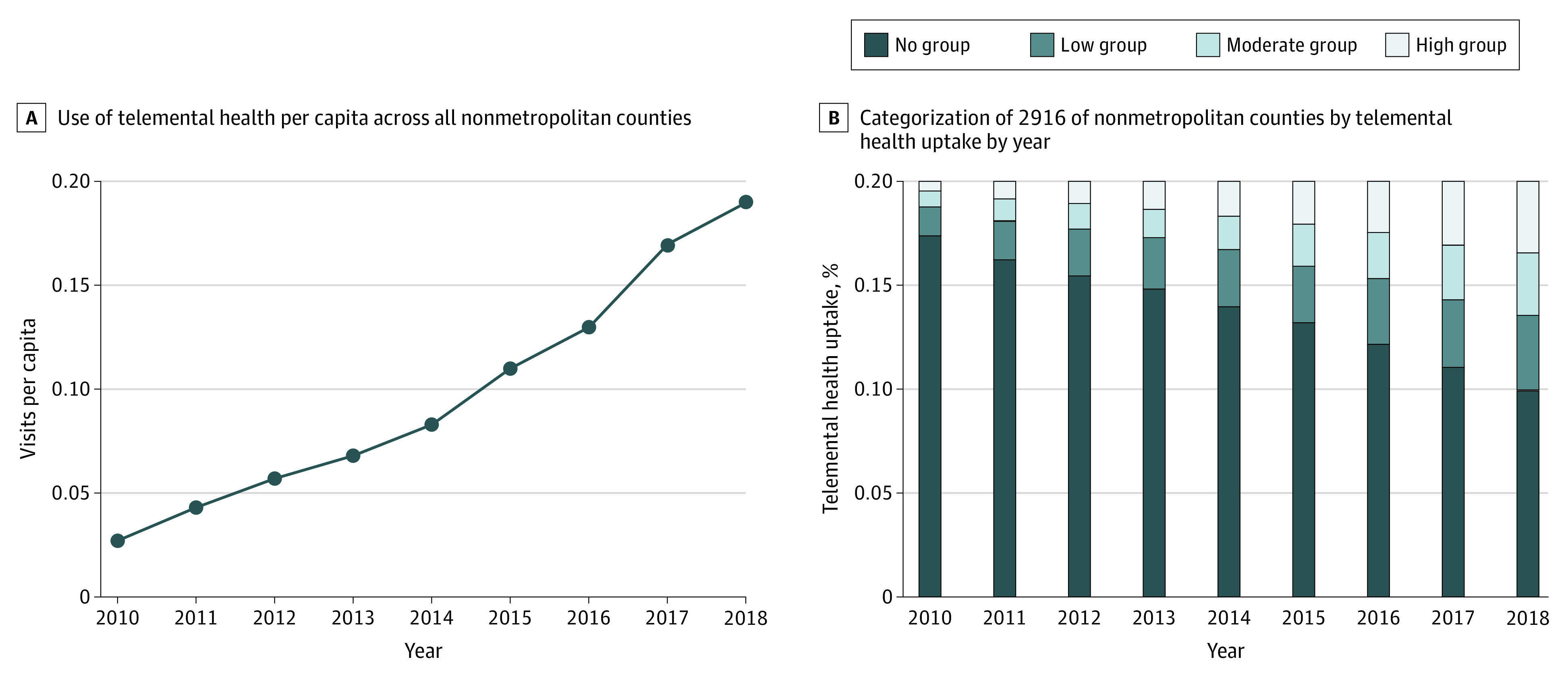
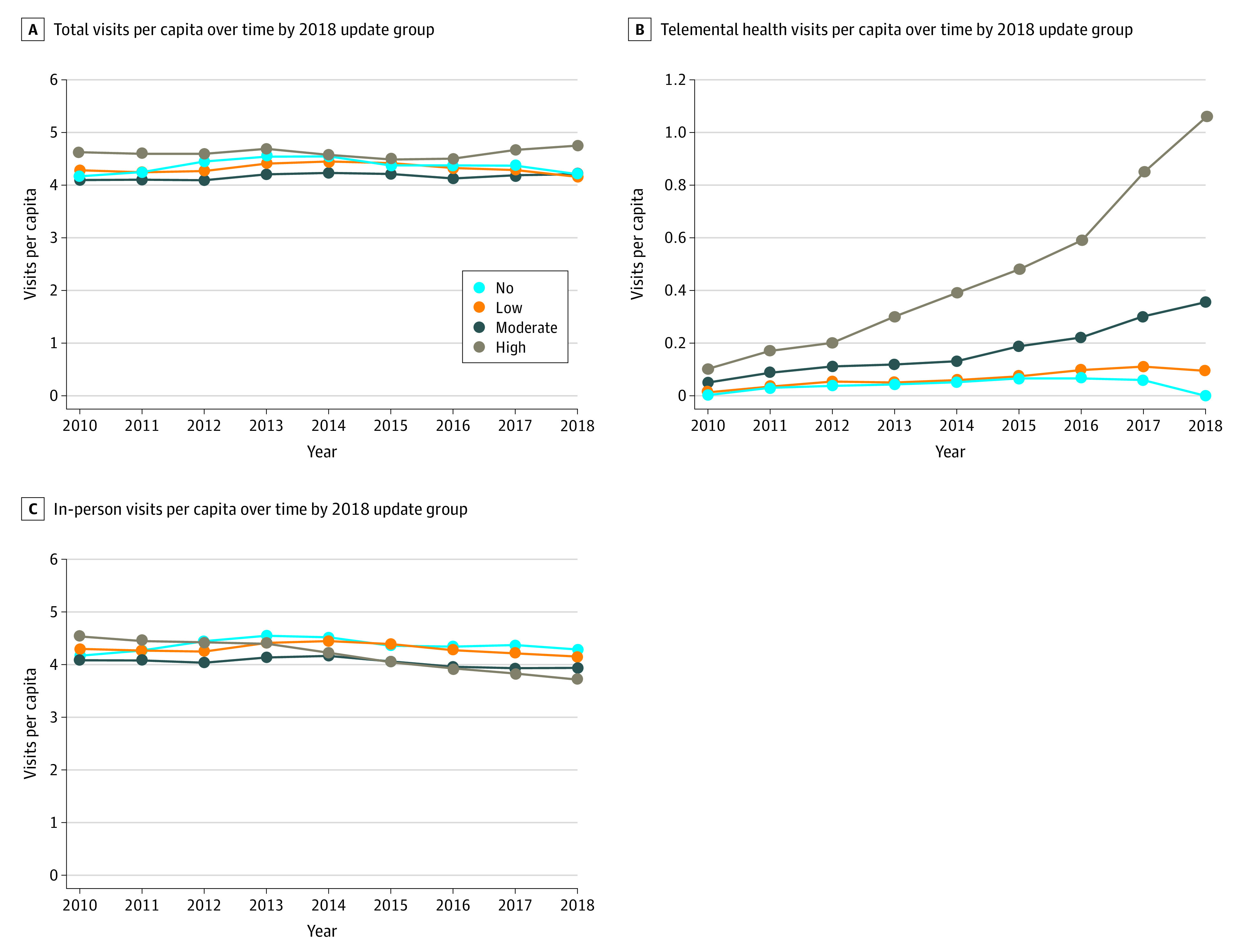
In 2018, there were 2916 counties with 118 170 patients (77 068 [65.2%] men; mean [SD] age, 58.3 [15.6] years) in the sample. The fraction of counties that had high telemental health service use increased from 2% in 2010 to 17% in 2018. In 2018 there were 1.08 telemental health service visits per patient in the high telemental health counties. Compared with no telemental health care in the county, patients in high-use counties were 1.2 percentage points (95% CI, 0.81-1.60 percentage points) (8.0% relative increase) more likely to have a minimum number of specialty mental health service visits, 13.7 percentage points (95% CI, 5.1-22.3 percentage points) (6.5% relative increase) more likely to have outpatient follow-up within 7 days of a mental health hospitalization, and 0.47 percentage points (95% CI, 0.25-0.69 percentage points) (7.6% relative increase) more likely to be hospitalized in a year. Telemental health service use was not associated with changes in medication adherence.
The findings of this study suggest that greater use of telemental health visits in a county was associated with modest increases in contact with outpatient specialty mental health care professionals and greater likelihood of follow-up after hospitalization. No substantive changes in medication adherence were noted and an increase in mental health hospitalizations occurred.
重要性:对于患有严重精神疾病(如精神分裂症和双相情感障碍)的人来说,获得专业的精神健康护理仍然具有挑战性。扩大远程医疗的使用是否与这些患者的护理可及性和质量的提高有关尚不清楚。
目的:评估非大都市县的远程医疗使用量增加是否与质量指标相关,包括使用专业精神卫生保健和药物依从性。
设计、设置和参与者:在这项队列研究中,在 2010 年 1 月 1 日至 2018 年 12 月 31 日期间,从全国范围内接受按服务收费的医疗保险受益人的全国样本中,研究了精神卫生虚拟就诊量的变化。包括在研究期间患有精神分裂症和相关精神病及/或 I 型双相情感障碍的患者。对于研究期间的每一年,每个县都根据人均远程医疗服务使用情况(无、低、中、高)进行分类。使用多变量模型控制患者特征和县级固定效应,测试了县内远程医疗服务使用与质量指标之间的关联。分析于 2022 年 1 月 1 日至 4 月 11 日进行。在 COVID-19 大流行之前,远程医疗报销仅限于非大都市地区的受益人。
主要结果和措施:在一年内接受至少 2 次精神卫生专业服务就诊(远程医疗或面对面就诊)、每年药物使用月数、住院率以及精神卫生住院后一年内的门诊随访次数。
结果:2018 年,样本中有 2916 个县,118710 名患者(77068[65.2%]名男性;平均[标准差]年龄为 58.3[15.6]岁)。高远程医疗服务使用率的县的比例从 2010 年的 2%增加到 2018 年的 17%。在 2018 年,高远程医疗服务使用率的县每位患者有 1.08 次远程医疗服务就诊。与该县没有远程医疗护理相比,在高使用率的县中,患者接受最低数量的精神卫生服务就诊的可能性高 1.2 个百分点(95%CI,0.81-1.60 个百分点)(8.0%的相对增加),在精神卫生住院后 7 天内进行门诊随访的可能性高 13.7 个百分点(95%CI,5.1-22.3 个百分点)(6.5%的相对增加),并且在一年内住院的可能性高 0.47 个百分点(95%CI,0.25-0.69 个百分点)(7.6%的相对增加)。远程医疗服务的使用与药物依从性的变化无关。
结论和相关性:这项研究的结果表明,该县远程医疗就诊量的增加与与精神科专业人员进行门诊接触以及住院后随访的可能性适度增加有关。没有注意到药物依从性的实质性变化,并且精神卫生住院率增加。