Guangxi Key Laboratory of AIDS Prevention and Treatment, School of Public Health, Guangxi Medical University, Nanning, 530021, Guangxi, China.
Chongzuo Center for Disease Control and Prevention, Chongzuo, 532200, Guangxi, China.
AIDS Res Ther. 2022 Jun 27;19(1):31. doi: 10.1186/s12981-022-00450-7.
This study investigated prevalence trends and identified the associated factors of HIV, syphilis and hepatitis C virus (HCV) among pregnant women in the Guangxi Zhuang Autonomous Region (Guangxi), Southwest China.
Serial cross-sectional surveys were performed annually among pregnant women in Guangxi from 2009 to 2018. Blood specimens were collected to test the prevalence of HIV, syphilis and HCV. Cochran-Armitage analysis was used to assess the trends of HIV, syphilis and HCV prevalence, as well as the sociodemographic and behavioural data. In this study, we used zero-inflated negative binomial (ZINB) regression models to identify factors associated with HIV, syphilis and HCV infection.
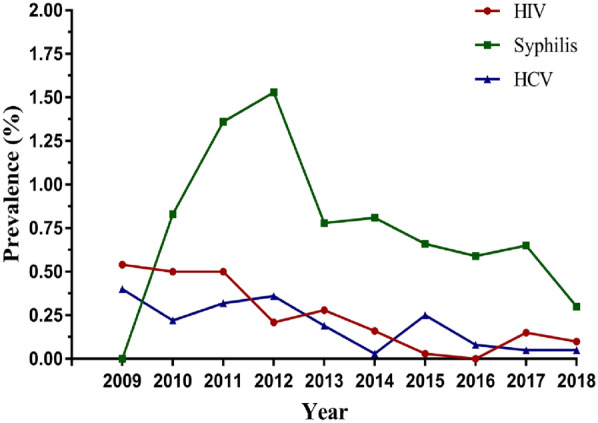
A total of 23,879 pregnant women were included in the study. The prevalence of HIV, syphilis and HCV was 0.24%, 0.85% and 0.19%, respectively. There was a decrease in HIV prevalence from 0.54% to 0.10%, a decrease in HCV prevalence from 0.40% to 0.05% and a decrease in syphilis prevalence from 1.53% to 0.30%. The findings based on the ZINB model revealed that pregnant women who had a history of STI had significantly increased risks of HIV (OR 6.63; 95% CI 1.33-32.90) and syphilis (OR 9.06; 95% CI 3.85-21.30) infection, while pregnant women who were unmarried/widowed/divorced were more likely to have HIV (OR 2.81; 95% CI 1.20-6.54) and HCV (OR 58.12; 95% CI, 3.14-1076.99) infection. Furthermore, pregnant women whose husband had a history of STI (OR 5.62; 95% CI 1.24-25.38) or drug use (OR 7.36; 95% CI 1.25-43.43) showed an increased risk of HIV infection.
There was a relatively low prevalence of HIV, syphilis and HCV among pregnant women. Although decreasing trends in HIV, syphilis and HCV infections were observed, effort is needed to promote STI testing in both premarital medical check-ups and antenatal care, especially targeting couples with a history of STI or drug use.
本研究旨在调查中国西南部广西壮族自治区(广西)孕妇中 HIV、梅毒和丙型肝炎病毒(HCV)的流行趋势,并确定其相关因素。
2009 年至 2018 年,每年对广西孕妇进行系列横断面调查。采集血样检测 HIV、梅毒和 HCV 的流行率。采用 Cochran-Armitage 分析评估 HIV、梅毒和 HCV 流行率的趋势以及社会人口学和行为数据。本研究采用零膨胀负二项(ZINB)回归模型确定与 HIV、梅毒和 HCV 感染相关的因素。
共纳入 23879 名孕妇。HIV、梅毒和 HCV 的流行率分别为 0.24%、0.85%和 0.19%。HIV 流行率从 0.54%降至 0.10%,HCV 流行率从 0.40%降至 0.05%,梅毒流行率从 1.53%降至 0.30%。基于 ZINB 模型的结果显示,有性传播感染史的孕妇感染 HIV(OR 6.63;95%CI 1.33-32.90)和梅毒(OR 9.06;95%CI 3.85-21.30)的风险显著增加,而未婚/丧偶/离异的孕妇感染 HIV(OR 2.81;95%CI 1.20-6.54)和 HCV(OR 58.12;95%CI,3.14-1076.99)的风险也增加。此外,丈夫有性传播感染史(OR 5.62;95%CI 1.24-25.38)或药物使用史(OR 7.36;95%CI 1.25-43.43)的孕妇感染 HIV 的风险增加。
孕妇中 HIV、梅毒和 HCV 的流行率相对较低。尽管 HIV、梅毒和 HCV 感染呈下降趋势,但仍需努力促进婚前体检和产前保健中的性传播感染检测,特别是针对有性传播感染或药物使用史的夫妇。