Department of Psychiatry, Faculty of Medicine, The University of British Columbia, Vancouver, BC, Canada.
School of Population and Public Health, Faculty of Medicine, The University of British Columbia, Vancouver, BC, Canada.
Can J Anaesth. 2022 Aug;69(8):997-1006. doi: 10.1007/s12630-022-02271-8. Epub 2022 Jun 28.
To describe postdischarge opioid dispensing after Cesarean delivery (CD) in 49 hospitals in British Columbia (BC) and assess opportunities for opioid stewardship.
Using the BC Ministry of Health's Hospital Discharge Abstract Database, we linked 135,725 CDs performed in 2004-2016 and 30,919 CDs performed in 2017-2019 (length of stay ≤ four days) by deidentified Personal Health Numbers to data on medications dispensed from all BC community pharmacies (PharmaNet). We excluded patients with cancer and those to whom opioids have been dispensed in the year before. We measured trends in annual percentages of patients dispensed opioids within seven days (opioid rate), with 95% confidence intervals (CIs), stratified by hospital and opioid type, adjusted for length of stay, and for autocorrelation within hospital using generalized linear modeling.
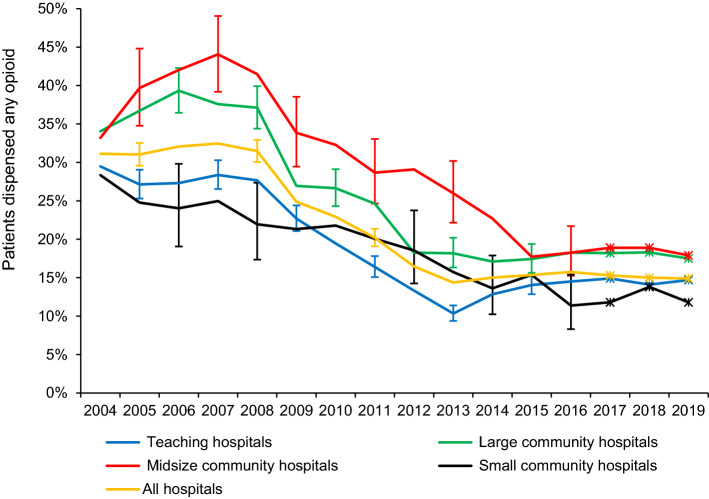
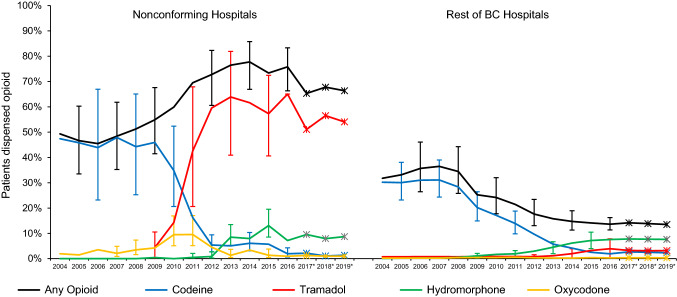
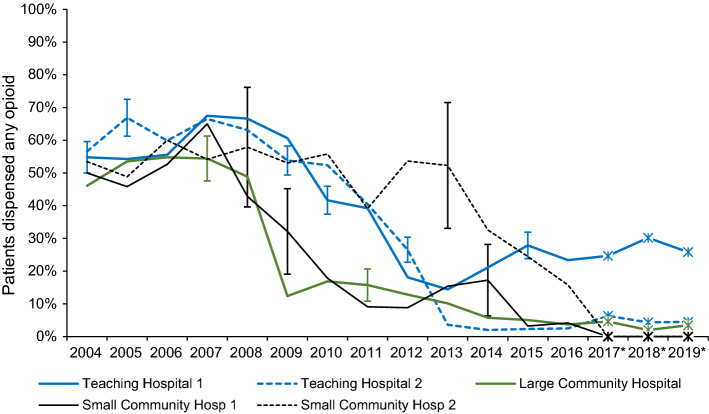
The opioid dispensation rate dropped from 31% (95% CI, 30 to 33) in 2004 to 16% (95% CI, 15 to 17) in 2016, where it remained through 2019. Five hospitals showed steep reductions from over 40% to under 10% within two to three years, but in most hospitals the opioid dispensation rate decreased slowly-11 had little reduction and three showed increases. Codeine dispensing dropped from 31% in 2004-2008 by 4% per year, while tramadol and hydromorphone dispensing rose. After 2015, rates were stable (hydromorphone, 8%; tramadol, 6%; codeine, 3%; and oxycodone, 0.5%).
After Health Canada's 2008 warning against codeine use by breastfeeding mothers, post-CD opioid dispensing declined disjointedly across BC hospitals. Rates did not decrease further after the opioid overdose epidemic was declared a public health emergency in BC in 2016. The present study highlights opportunities for quality improvement and opioid stewardship through monitoring using administrative databases.
描述不列颠哥伦比亚省(BC)49 家医院剖宫产(CD)出院后阿片类药物的配给情况,并评估阿片类药物管理的机会。
我们使用不列颠哥伦比亚省卫生部的医院出院摘要数据库,将 2004 年至 2016 年期间进行的 135725 例 CD 和 2017 年至 2019 年期间进行的 30919 例住院时间≤4 天的 CD 病例(通过匿名个人健康号码链接)与不列颠哥伦比亚省所有社区药房(PharmaNet)配药数据相关联。我们排除了患有癌症的患者和在过去一年中已经开了阿片类药物的患者。我们测量了每年出院后七天内(阿片类药物使用率)患者接受阿片类药物配给的比例,用 95%置信区间(CI)表示,按医院和阿片类药物类型分层,根据住院时间和医院内的自相关进行调整,采用广义线性模型进行分析。
阿片类药物配给率从 2004 年的 31%(95%CI,30 至 33)降至 2016 年的 16%(95%CI,15 至 17),此后一直保持到 2019 年。5 家医院在两到三年内从超过 40%急剧下降到低于 10%,但在大多数医院,阿片类药物配给率缓慢下降-11 家医院几乎没有下降,3 家医院有所上升。2004 年至 2008 年,可待因的配给量每年下降 4%,而曲马多和氢吗啡酮的配给量则有所上升。2015 年后,这些药物的配给率保持稳定(氢吗啡酮 8%;曲马多 6%;可待因 3%;羟考酮 0.5%)。
在加拿大卫生部 2008 年警告母乳喂养的母亲不要使用可待因后,不列颠哥伦比亚省的医院对 CD 后阿片类药物的配给情况出现了不协调的下降。2016 年不列颠哥伦比亚省宣布阿片类药物过量流行成为公共卫生紧急事件后,这些药物的配给率并没有进一步下降。本研究通过使用行政数据库进行监测,突出了通过质量改进和阿片类药物管理来改善的机会。