Lo Cathy W T, Brodie Matthew A, Tsang William W N, Lord Stephen R, Yan Chun-Hoi, Wong Arnold Y L
Department of Rehabilitation Sciences, The Hong Kong Polytechnic University, Hong Kong SAR, China.
Neuroscience Research Australia, University of New South Wales, Sydney, Australia.
Pilot Feasibility Stud. 2022 Jun 28;8(1):131. doi: 10.1186/s40814-022-01094-0.
Total knee arthroplasty (TKA) is a common treatment for severe knee osteoarthritis. Medial-pivot TKA systems (MP-TKA) are theoretically better than posterior-stabilized TKA systems (PS-TKA) in improving static and dynamic balance of patients although it is difficult to objectively quantify these balance parameters in a clinical setting. Therefore, this pilot study aimed to evaluate the feasibility of using wearable devices in a clinical setting to examine whether people with MP-TKA have better postoperative outcomes than PS-TKA, and their balance control is more akin to age-matched asymptomatic controls.
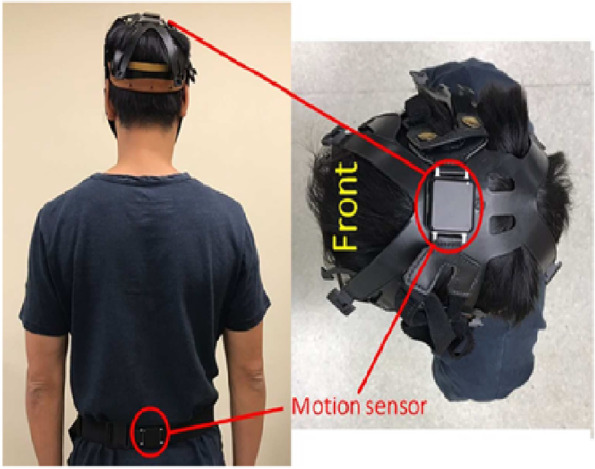
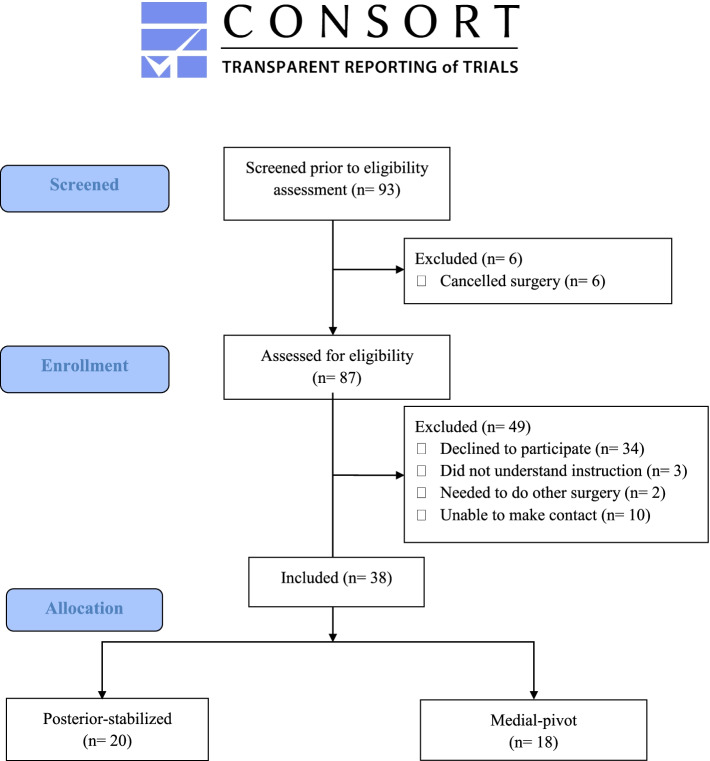
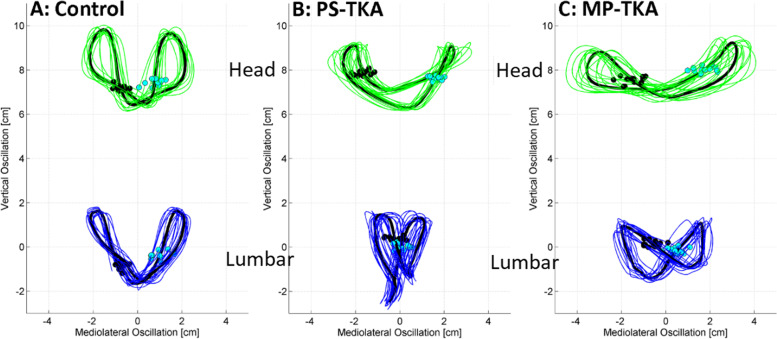
The current cross-sectional pilot study recruited 57 participants with 2 different prosthesis designs (20 PS-TKA, 18 MP-TKA) and 19 asymptomatic controls. At 1-year post-TKA, pain, knee stiffness, and physical function were assessed using the Western Ontario and McMaster Universities Osteoarthritis Index (WOMAC). Static balance, mobility, and gait stability of the participants were evaluated based on data collected from wearable motion sensors during the near tandem stance, timed-up-and-go, and 6-min walk tests.
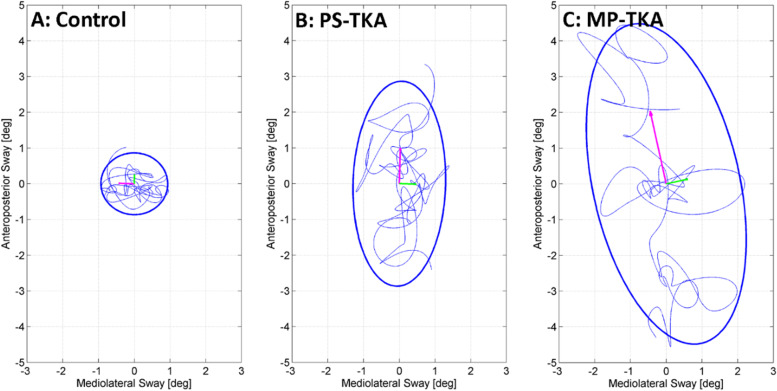
Compared to asymptomatic controls, both TKA groups reported significantly more pain and stiffness and demonstrated reduced functional mobility, increased stride-time-variability, and impaired balance. After Bonferroni adjustment, no significant differences in pain, balance, and mobility performance were observed between PS-TKA and MP-TKA participants 1 year after surgery. However, there was a trend for increased anteroposterior sway of the lumbar and head regions in the MP-TKA participants when undertaking the near tandem stance test. The wearable motion sensors were easy to use without any adverse effects.
It is feasible to use wearable motion sensors in a clinical setting to compare balance and mobility performance of patients with different TKA prothesis designs. Since this was a pilot study and no definite conclusions could be drawn, future clinical trials should determine the impacts of different TKA prosthesis designs on post-operative outcomes over a longer follow-up period.
全膝关节置换术(TKA)是治疗重度膝关节骨关节炎的常用方法。内侧旋转平台全膝关节置换系统(MP-TKA)在改善患者静态和动态平衡方面理论上优于后稳定型全膝关节置换系统(PS-TKA),尽管在临床环境中难以客观量化这些平衡参数。因此,这项初步研究旨在评估在临床环境中使用可穿戴设备的可行性,以检查接受MP-TKA的患者术后结果是否优于PS-TKA,以及他们的平衡控制是否更类似于年龄匹配的无症状对照者。
当前的横断面初步研究招募了57名参与者,包括2种不同假体设计的患者(20例PS-TKA,18例MP-TKA)和19名无症状对照者。在TKA术后1年,使用西安大略和麦克马斯特大学骨关节炎指数(WOMAC)评估疼痛、膝关节僵硬和身体功能。根据在近似串联站立、计时起立行走和6分钟步行测试期间从可穿戴运动传感器收集的数据,评估参与者的静态平衡、活动能力和步态稳定性。
与无症状对照者相比,两个TKA组均报告有明显更多的疼痛和僵硬,并且表现出功能活动能力下降、步幅时间变异性增加和平衡受损。经过Bonferroni校正后,术后1年PS-TKA和MP-TKA参与者在疼痛、平衡和活动能力表现方面未观察到显著差异。然而,在进行近似串联站立测试时,MP-TKA参与者的腰椎和头部区域前后摆动有增加的趋势。可穿戴运动传感器易于使用,且无任何不良影响。
在临床环境中使用可穿戴运动传感器来比较不同TKA假体设计患者的平衡和活动能力表现是可行的。由于这是一项初步研究,无法得出明确结论,未来的临床试验应在更长的随访期内确定不同TKA假体设计对术后结果的影响。