Megan McNicol Megan, Donegan Amy, Hawa Kate, Boutzoukas Angelique E, Drobnic Barb, Oates Melanie, Orraca-Tetteh Maudie, Michel Hilary K, Maltz Ross M, Dotson Jennifer L, Buckingham Don, Boyle Brendan, Ardura Monica I
Department of Pharmacy, Department of Pediatrics, Nationwide Children's Hospital and The Ohio State University, Columbus, Ohio.
Division of Gastroenterology, Hepatology, and Nutrition, Nationwide Children's Hospital and The Ohio State University, Columbus, Ohio.
Pediatr Qual Saf. 2022 Jun 23;7(4):e570. doi: 10.1097/pq9.0000000000000570. eCollection 2022 Jul-Aug.
Patients with inflammatory bowel disease (IBD) receiving tumor necrosis factor alpha inhibitors (TNFai) may be at higher risk for hepatitis B virus (HBV) infection. We conducted a quality improvement (QI) initiative to improve HBV vaccination rates in seronegative children with IBD.
This QI initiative implemented an HBV vaccination strategy from September 2018 to March 2020 in patients with newly diagnosed IBD with hepatitis B surface antibody (HBsAb) <10 mIU/mL. The project aimed to (1) increase HBV vaccination rates in seronegative patients and (2) document immunogenicity after completing a three-dose vaccine series. Outcome measures included the percentage of seronegative patients who received HBV vaccines (dose 1 and three-dose series). Interventions included applying a standardized vaccination protocol, and creating a vaccine workflow in two clinical areas, previsit planning and stakeholder engagement.
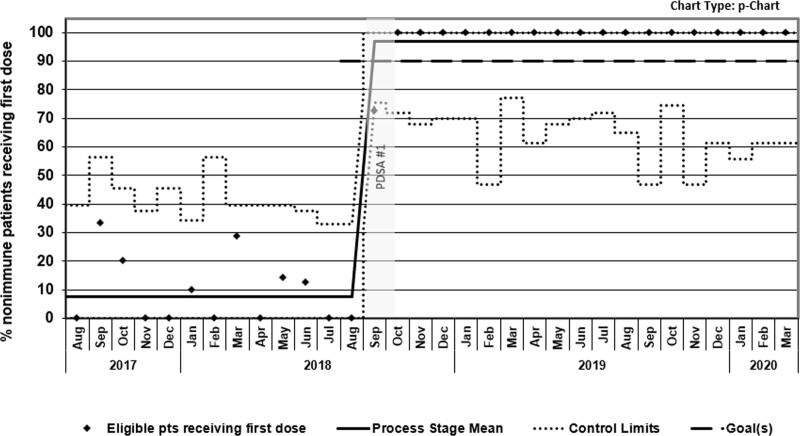
One hundred seventy-four children and adolescents with IBD were evaluated during the study period, and 132 (76%) were HBsAb negative. After plan-do-study-act (PDSA) 1, the proportion of eligible patients who received HBV vaccine dose 1 increased from a baseline of 7% to 100% and was sustained for over 12 months. During PDSA 2, the proportion of patients completing the three-dose vaccine series improved from a baseline of 0% to 82% (n = 100); among 93 children in this subgroup who had repeat serology performed, 86 (92%) demonstrated serologic evidence of HBV protection.
A multidisciplinary approach applying QI methodology allowed for improved and sustained HBV vaccination rates in at-risk seronegative children and adolescents with IBD. A three-dose HBV vaccine series proved immunogenic in 92% of eligible patients.
接受肿瘤坏死因子α抑制剂(TNFai)治疗的炎症性肠病(IBD)患者感染乙型肝炎病毒(HBV)的风险可能更高。我们开展了一项质量改进(QI)计划,以提高血清学阴性的IBD儿童的HBV疫苗接种率。
该QI计划于2018年9月至2020年3月对新诊断的IBD且乙型肝炎表面抗体(HBsAb)<10 mIU/mL的患者实施了HBV疫苗接种策略。该项目旨在(1)提高血清学阴性患者的HBV疫苗接种率,以及(2)记录完成三剂疫苗接种系列后的免疫原性。结果指标包括接受HBV疫苗接种的血清学阴性患者的百分比(第1剂和三剂接种系列)。干预措施包括应用标准化的疫苗接种方案,并在两个临床领域创建疫苗工作流程,即访前规划和利益相关者参与。
在研究期间评估了174例IBD儿童和青少年,其中132例(76%)HBsAb阴性。在计划-实施-研究-改进(PDSA)1之后,接受第1剂HBV疫苗接种的符合条件患者的比例从基线的7%增加到100%,并持续了超过12个月。在PDSA 2期间,完成三剂疫苗接种系列的患者比例从基线的0%提高到82%(n = 100);在该亚组中进行重复血清学检测的93名儿童中,86名(92%)显示出HBV保护的血清学证据。
采用QI方法的多学科方法可提高有风险的血清学阴性的IBD儿童和青少年的HBV疫苗接种率并使其持续保持。三剂HBV疫苗接种系列在92%的符合条件患者中证明具有免疫原性。