Department of Neurology, Dokkyo Medical University Saitama Medical Center, Japan.
Department of Neurology, Center of Sleep Medicine, Dokkyo Medical University, Japan.
Ann Clin Transl Neurol. 2022 Aug;9(8):1177-1185. doi: 10.1002/acn3.51615. Epub 2022 Jun 29.
To determine if the severity of olfactory dysfunction in isolated REM sleep behavior disorder (IRBD) predicts conversion to Parkinson's disease (PD) or dementia with Lewy bodies (DLB).
Olfaction was tested using the Japanese version of the University of Pennsylvania Smell Identification Test (UPSIT-J) in 155 consecutive patients with polysomnography-confirmed IRBD and 34 healthy controls. IRBD patients were followed up for 5.8 ± 3.2 (range 0.2-11) years. Thirty-eight patients underwent repeat UPSIT-J evaluation at 2.7 ± 1.3 years after the baseline test.
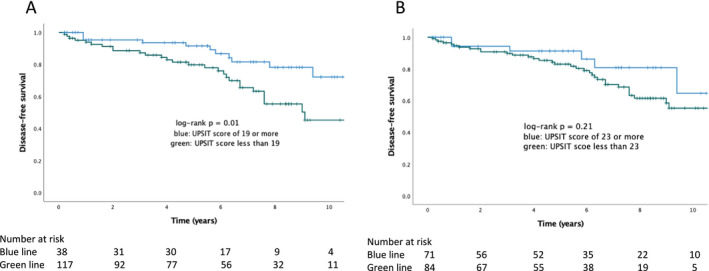
UPSIT-J score was lower in IRBD patients than in age- and sex-matched controls. The receiver operating characteristic curve analysis showed that the optimal cutoff score of 22.5 in UPSIT-J discriminated between IRBD patients and controls with a sensitivity of 94.3% and specificity of 81.8%. Anosmia (UPSIT-J score < 19) was present in 54.2% of IRBD patients. In total, 42 patients developed a neurodegenerative disease, of whom 17 had PD, 22 DLB, and 3 MSA. Kaplan-Meier analysis showed that the short-term risk of Lewy body disease (LBD) was higher in patients with anosmia than in those without anosmia. At baseline, the UPSIT-J score was similar between patients who developed PD and DLB (p = 0.136). All three IRBD patients (100%) who developed MSA did not have anosmia.
In IRBD patients, anosmia predicts a higher short-term risk of transition to LBD but cannot distinguish between PD and DLB. At baseline, preserved odor identification may occur in latent MSA. Future IRBD neuroprotective trials should evaluate anosmia as a marker of prodromal LBD.
本研究旨在确定孤立性快速眼动睡眠行为障碍(IRBD)患者中嗅觉功能障碍的严重程度是否可预测其向帕金森病(PD)或路易体痴呆(DLB)转化。
使用经过验证的宾夕法尼亚嗅觉识别测试(UPSIT-J)的日本版对 155 例经多导睡眠图(PSG)证实的 IRBD 患者和 34 例健康对照者进行嗅觉测试。对 IRBD 患者进行了 5.8±3.2(范围 0.2-11)年的随访。38 例患者在基线测试后 2.7±1.3 年接受了重复 UPSIT-J 评估。
IRBD 患者的 UPSIT-J 评分低于年龄和性别匹配的对照组。ROC 曲线分析显示,UPSIT-J 评分 22.5 为最佳截断值,可区分 IRBD 患者和对照组,其敏感性为 94.3%,特异性为 81.8%。54.2%的 IRBD 患者存在嗅觉障碍(UPSIT-J 评分<19)。共有 42 例患者发展为神经退行性疾病,其中 17 例为 PD,22 例为 DLB,3 例为 MSA。Kaplan-Meier 分析显示,嗅觉障碍患者的短期发生 Lewy 体病(LBD)的风险较高。在基线时,发展为 PD 和 DLB 的患者 UPSIT-J 评分相似(p=0.136)。所有 3 例(100%)发展为 MSA 的 IRBD 患者均无嗅觉障碍。
在 IRBD 患者中,嗅觉障碍预测短期发生 LBD 的风险更高,但不能区分 PD 和 DLB。在基线时,潜伏性 MSA 可能存在嗅觉识别功能保留。未来的 IRBD 神经保护试验应将嗅觉障碍评估为前驱 LBD 的标志物。