State Key Laboratory of NBC Protection for Civilian, Beijing, 102205, China.
Sci Rep. 2022 Jun 29;12(1):10979. doi: 10.1038/s41598-022-15198-3.
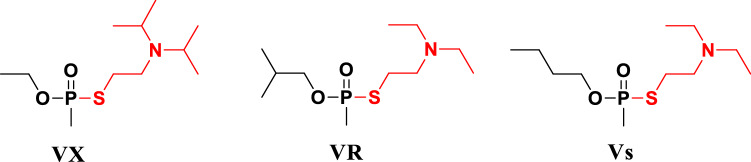
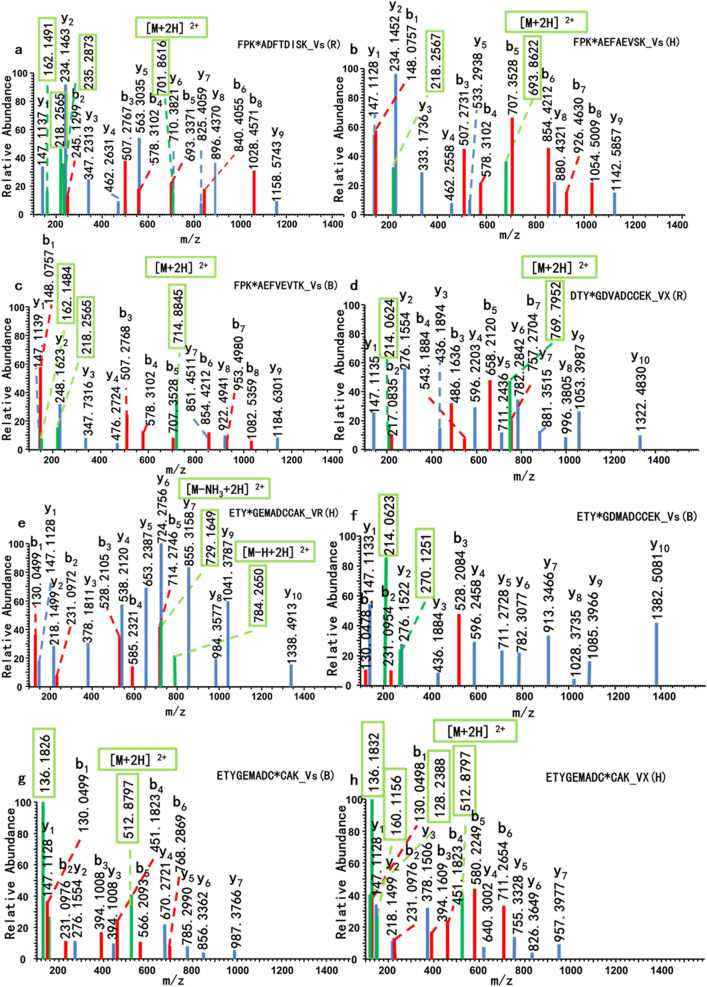
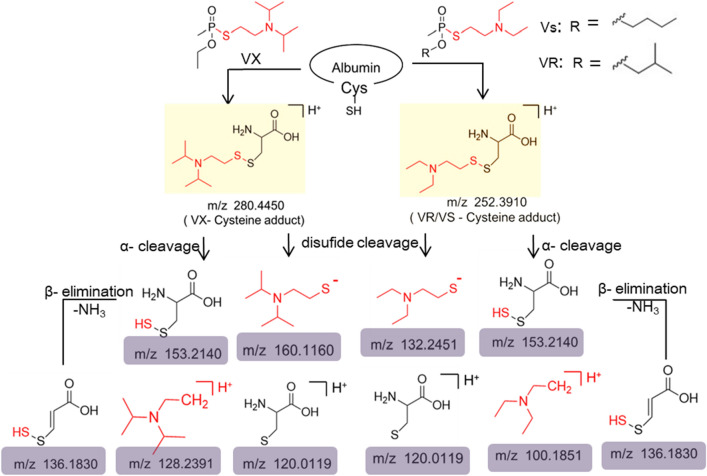
Organophosphorus nerve agents (OPNAs) that damage the central nervous system by inhibiting acetylcholinesterase activity, pose severe threats to human health and life security. Reliable biomarkers that quickly and accurately detect OPNAs exposure are urgently needed to help diagnose quickly and treat in time. Albumins that covalently bind to OPNAs could serve as important targets for retrospective verification of OPNAs exposure. The goal of this study is to explore the potential biomarkers in albumins with high reactivity and good stability and expand the group of potential biomarkers in different species for detecting the exposure of V-type OPNAs including O-ethyl S-(2-(diisopropylamino)ethyl) methylphosphonothioate (VX), O-isobutyl S-(2(diethylamino)ethyl) methylphosphonothioate (VR), and O-butyl S-(2-(diethylamino)ethyl) methylphosphonothioate (Vs). Taking human serum albumin (HSA), bovine serum albumin (BSA) and rabbit serum albumin (RSA) as the research objectives, multiple active sites including phosphonylation and disulfide adduct sites were observed in albumins from different species. Numerous phosphonylation sites labeled by all agents in one type of albumin were found. Among the different species, four shared phosphonylation sites with high reactivity include K499, K549, K249, and Y108. In addition, Y108 on ETYGEMADCCAK, Y287 on YICENQDSISSK, Y377 on TYETTLEK and Y164 on YLYEIAR in HSA were stably phosphonylated by all agents in gradient concentration, making them stable and suitable potential biomarkers for V-type OPNAs exposure. Notably, Y108 on ETYGEMADCCAK in HSA, on DTYGDVADCCEK in RSA, and on ETY*GDMADCCEK in BSA were highly reactive to all V-type agents, regardless of species. It was also successfully labeled in HSA exposed to class V agents in gradient concentration. Y108 is expected to be used to screen and identify the exposure of V-type agents in the retrospective research. Disulfide adducts sites, consisted of four sites in HSA and two sites in BSA were also successfully labeled by V-type agents, and characteristic ion fragments from these disulfide adducts were also identified by secondary mass spectrometry. Molecular simulation of the stably modified sites were conducted to discover the promoting factors of covalent adduct formation, which help further clarify formation mechanism of albumin adducts at active sites.
有机磷神经毒剂(OPNAs)通过抑制乙酰胆碱酯酶活性对中枢神经系统造成损害,对人类健康和生命安全构成严重威胁。需要可靠的生物标志物来快速准确地检测 OPNAs 暴露情况,以帮助快速诊断和及时治疗。与 OPNAs 共价结合的白蛋白可以作为 OPNAs 暴露回溯验证的重要靶标。本研究旨在探索具有高反应性和良好稳定性的白蛋白中的潜在生物标志物,并扩展不同物种中潜在生物标志物的范围,以检测 V 型 OPNAs(包括 O-乙基 S-(2-(二异丙基氨基)乙基)甲基膦酸硫酯(VX)、O-异丁基 S-(2(二乙基氨基)乙基)甲基膦酸硫酯(VR)和 O-丁基 S-(2-(二乙基氨基)乙基)甲基膦酸硫酯(Vs)的暴露情况。本研究以人血清白蛋白(HSA)、牛血清白蛋白(BSA)和兔血清白蛋白(RSA)为研究对象,在不同物种的白蛋白中观察到包括膦酰化和二硫键加合物在内的多个活性位点。在一种白蛋白中发现了所有试剂标记的许多膦酰化位点。在不同物种中,有四个具有高反应性的共同膦酰化位点,包括 K499、K549、K249 和 Y108。此外,在 HSA 中,ETYGEMADCCAK 上的 Y108、YICENQDSISSK 上的 Y287、TYETTLEK 上的 Y377 和 YLYEIAR 上的 Y164 被所有试剂在梯度浓度下稳定膦酰化,使其成为 V 型 OPNAs 暴露的稳定且合适的潜在生物标志物。值得注意的是,HSA 上的 ETYGEMADCCAK 上的 Y108、RSA 上的 DTYGDVADCCEK 上的 Y108 和 BSA 上的 ETY*GDMADCCEK 对所有 V 型试剂均具有高反应性,而与物种无关。它也成功地在 HSA 中被标记,用于梯度浓度暴露于 V 型试剂。Y108 有望用于筛选和鉴定 V 型试剂的暴露情况。由 HSA 中的四个位点和 BSA 中的两个位点组成的二硫键加合物位点也被 V 型试剂成功标记,并通过二级质谱鉴定了这些二硫键加合物的特征离子碎片。对稳定修饰位点进行分子模拟,以发现形成共价加合物的促进因素,这有助于进一步阐明活性位点白蛋白加合物的形成机制。