Department of Endocrinology and Metabolism, The National Health Committee (NHC) Key Laboratory of Diagnosis and Treatment of Thyroid Diseases, Institute of Endocrinology, The First Hospital of China Medical University, Shenyang, China.
Fuxin Central Hospital, Fuxin, China.
Front Endocrinol (Lausanne). 2022 Jun 13;13:923650. doi: 10.3389/fendo.2022.923650. eCollection 2022.
This study was a prospective assessment of the epidemiological characteristics of metabolic syndrome (MetS) in cities in Northeast China. We explored the factors that affect the occurrence and outcome of MetS according to sex.
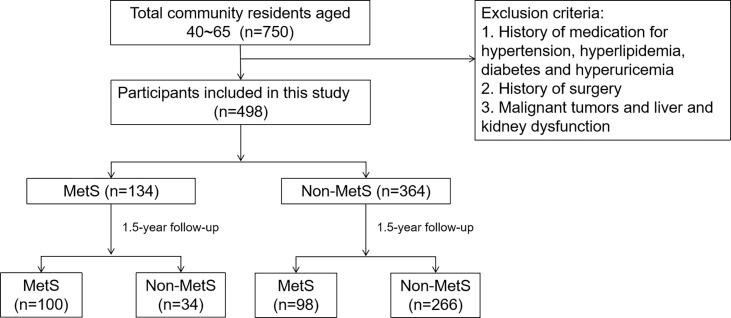
This was a longitudinal survey assessing MetS status among 750 urban community residents in China. At baseline, the intra-abdominal fat area was measured by MRI, simple anthropometric parameters (body mass index (BMI), waist circumference (WC), etc.) were used to evaluate fat distribution; blood pressure and blood lipid profile were measured; an oral glucose tolerance test (OGTT) was used to detect blood glucose; questionnaires were used to investigate lifestyles. Follow-up was conducted after 1.5 years (follow-up rate was 66.93%) to analyze the incidence of MetS and the influencing factors of MetS outcomes according to sex.
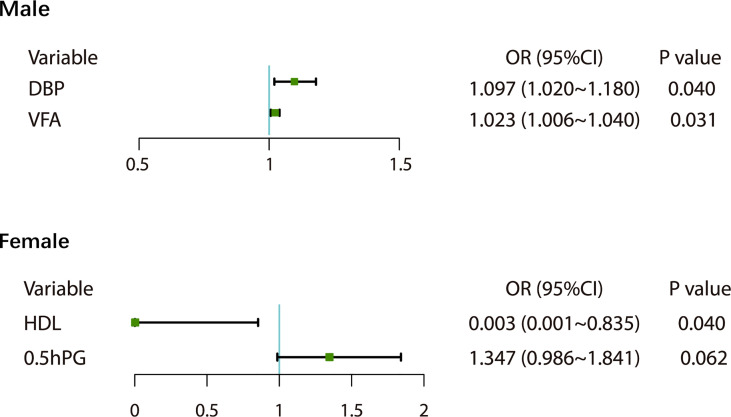
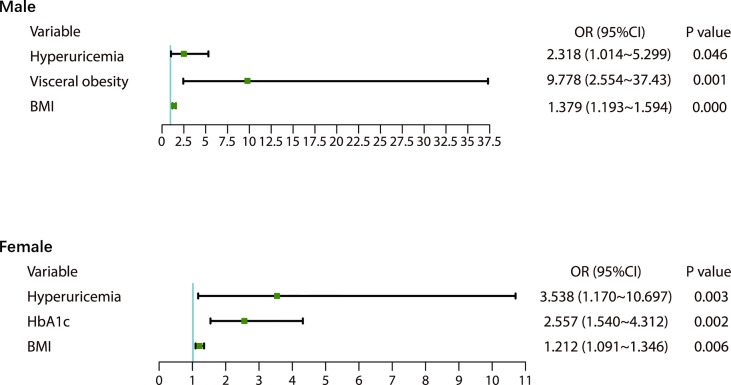
The 1.5-year cumulative incidence of MetS in the survey area was 25.40%. Men with visceral obesity were more likely to develop MetS than those with subcutaneous obesity (OR=9.778, p<0.05). Increased BMI (OR=1.379) and blood uric acid (BUA)>416 mmol/L (OR=2.318) were associated with the occurrence of MetS in men (all p<0.05). At the initial visit, BUA>356.9 mmol/L (OR=3.538), increased BMI (OR=1.212), and increased HbA1c (OR=2.577) were associated with the occurrence of MetS in women (all p<0.05). After 1.5 years, 25.37% of MetS patients no longer had MetS. Elevated diastolic blood pressure (DBP) (OR=1.097) and increased visceral fat (OR=1.023) at the initial visit made men with MetS less likely to recover from MetS (all p<0.05). Higher High-density lipoprotein cholesterol (HDL-C) at the initial visit made women with MetS more likely to recover from MetS (β: -3.509, OR=0.003, p<0.05).
There are different risk factors for MetS in different genders. Hyperuricemia is a risk factor for the onset of MetS in both men and women.
本研究对中国东北地区城市代谢综合征(MetS)的流行病学特征进行了前瞻性评估。我们根据性别探讨了影响 MetS 发生和结局的因素。
这是一项在中国 750 名城市社区居民中进行的纵向调查,评估 MetS 状况。在基线时,通过 MRI 测量腹内脂肪面积,使用简单的人体测量参数(体重指数(BMI)、腰围(WC)等)评估脂肪分布;测量血压和血脂谱;进行口服葡萄糖耐量试验(OGTT)以检测血糖;使用问卷调查生活方式。在 1.5 年后进行随访(随访率为 66.93%),根据性别分析 MetS 的发生率和 MetS 结局的影响因素。
在调查区域,MetS 的 1.5 年累积发生率为 25.40%。与皮下肥胖者相比,内脏肥胖者发生 MetS 的可能性更高(OR=9.778,p<0.05)。BMI 增加(OR=1.379)和血尿酸(BUA)>416 mmol/L(OR=2.318)与男性 MetS 的发生相关(均 p<0.05)。在初诊时,BUA>356.9 mmol/L(OR=3.538)、BMI 增加(OR=1.212)和 HbA1c 增加(OR=2.577)与女性 MetS 的发生相关(均 p<0.05)。1.5 年后,25.37%的 MetS 患者不再患有 MetS。初诊时舒张压(DBP)升高(OR=1.097)和内脏脂肪增加(OR=1.023)使男性 MetS 患者更不易从中恢复(均 p<0.05)。初诊时高密度脂蛋白胆固醇(HDL-C)升高使女性 MetS 患者更易从中恢复(β:-3.509,OR=0.003,p<0.05)。
不同性别发生 MetS 的危险因素不同。高尿酸血症是男性和女性 MetS 发病的危险因素。