
特异性雄激素调节基因(SARG)通过血管内皮生长因子C(VEGF-C)和血管内皮生长因子受体3(VEGFR-3)轴促进甲状腺乳头状癌(PTC)的淋巴转移。
The Specifically Androgen-Regulated Gene (SARG) Promotes Papillary Thyroid Carcinoma (PTC) Lymphatic Metastasis Through Vascular Endothelial Growth Factor C (VEGF-C) and VEGF Receptor 3 (VEGFR-3) Axis.
作者信息
Xu Shuai-Jun, Jin Bin, Zhao Wei-Jun, Chen Xue-Xian, Tong Ying-Ying, Ding Xiao-Fei, Chen Ying-Yuan, Wang Dong-Hao, Wang Zhi-Ming, Dai Bing-Qing, Chen Sai, Liang Yong, Chen Guang, Pan Su-Jiao, Xu Ling-Long
机构信息
Department of Hematology, Taizhou Central Hospital (Taizhou University Hospital), Taizhou University, Taizhou, China.
Graduate School of Medicine, Hebei North University, Zhangjiakou, China.
出版信息
Front Oncol. 2022 Jun 13;12:817660. doi: 10.3389/fonc.2022.817660. eCollection 2022.
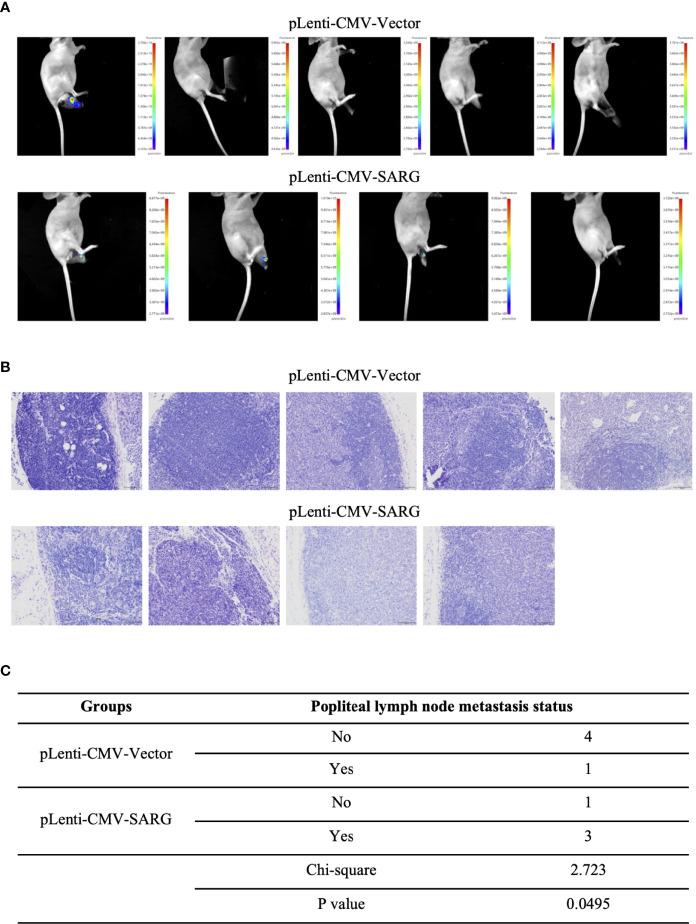
The papillary thyroid carcinoma (PTC) metastasizes through lymphatic spread, but the follicular thyroid cancer (FTC) metastasis occurs by following hematogenous spread. To date, the molecular mechanism underlying different metastatic routes between PTC and FTC is still unclear. Here, we showed that specifically androgen-regulated gene (SARG) was significantly up-regulated in PTC, while obviously down-regulated in FTC through analyzing the Gene Expression Omnibus (GEO) database. Immunohistochemistry assay verified that the PTC lymph node metastasis was associated with higher levels of SARG protein in clinical PTC patient samples. SARG-knockdown decreased TPC-1 and CGTH-W3 cells viability and migration significantly. On the contrary, SARG-overexpressed PTC cells possessed more aggressive migratory ability and viability. , SARG overexpression dramatically promoted popliteal lymph node metastasis of xenografts from TPC-1 cells mouse footpad transplanting. Mechanistically, SARG overexpression and knockdown significantly increased and decreased the expression of vascular endothelial growth factor C (VEGF-C) and VEGF receptor 3 (VEGFR-3), respectively, thereby facilitating or inhibiting the tube formation in HUVECs. The tube formation experiment showed that SARG overexpression and knockdown promoted or inhibited the number of tube formations in HUVEC cells, respectively. Taken together, we showed for the first time the differential expression profile of SARG between PTC and FTC, and SARG promotes PTC lymphatic metastasis VEGF-C/VEGFR-3 signal. It indicates that SARG may represent a target for clinical intervention in lymphatic metastasis of PTC.
甲状腺乳头状癌(PTC)通过淋巴转移,而甲状腺滤泡癌(FTC)则通过血行转移。迄今为止,PTC和FTC之间不同转移途径的分子机制仍不清楚。在这里,我们通过分析基因表达综合数据库(GEO)发现,特异性雄激素调节基因(SARG)在PTC中显著上调,而在FTC中明显下调。免疫组织化学分析证实,临床PTC患者样本中PTC淋巴结转移与较高水平的SARG蛋白相关。敲低SARG可显著降低TPC-1和CGTH-W3细胞的活力和迁移能力。相反,过表达SARG的PTC细胞具有更强的迁移能力和活力。此外,SARG过表达显著促进了TPC-1细胞小鼠足垫移植异种移植物的腘窝淋巴结转移。机制上,SARG过表达和敲低分别显著增加和降低了血管内皮生长因子C(VEGF-C)和血管内皮生长因子受体3(VEGFR-3)的表达,从而促进或抑制了人脐静脉内皮细胞(HUVECs)的管腔形成。管腔形成实验表明,SARG过表达和敲低分别促进或抑制了HUVEC细胞中的管腔形成数量。综上所述,我们首次展示了PTC和FTC之间SARG的差异表达谱,并且SARG通过VEGF-C/VEGFR-3信号促进PTC淋巴转移。这表明SARG可能是PTC淋巴转移临床干预的一个靶点。




 Zotero 插件