Dai Harrison, Chen Shirui, Kowalewska Jolanta
Department of Pathology and Anatomy, Eastern Virginia Medical School, Norfolk, VA, USA.
Department of Internal Medicine, Division of Nephrology, Eastern Virginia Medical School, Norfolk, VA, USA.
Acad Pathol. 2022 Jun 21;9(1):100013. doi: 10.1016/j.acpath.2022.100013. eCollection 2022.
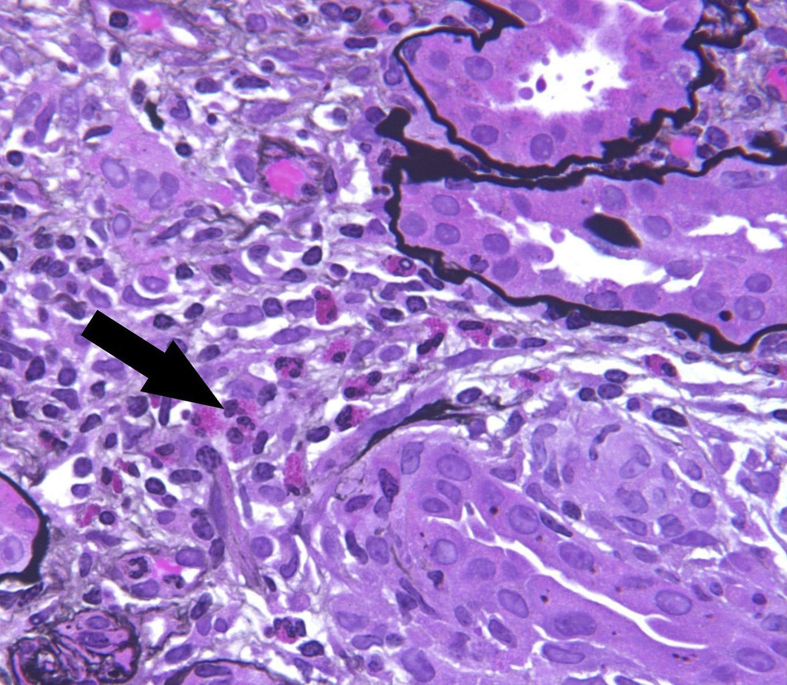
Chronic rejection, the slowest presenting form of transplant rejection, typically manifests in the timespan of months to years. The pathogenesis of chronic rejection involves either cell- or humoral-mediated processes that involve memory cells, plasma cells, and antibody production against donor antigens. The findings of chronic rejection are nonspecific and include interstitial fibrosis and tubular atrophy with associated interstitial inflammation, vascular changes characterized by thickened intima containing macrophages and lymphocytes, and transplant glomerulopathy with mesangial matrix expansion and double contour of capillary walls..
慢性排斥反应是移植排斥反应中出现最慢的形式,通常在数月至数年的时间范围内显现。慢性排斥反应的发病机制涉及细胞介导或体液介导的过程,这些过程涉及记忆细胞、浆细胞以及针对供体抗原产生的抗体。慢性排斥反应的表现是非特异性的,包括间质纤维化和肾小管萎缩以及相关的间质炎症、以内膜增厚伴巨噬细胞和淋巴细胞浸润为特征的血管变化,以及伴有系膜基质扩张和毛细血管壁双轨征的移植肾肾小球病。