Fermin Alan S R, Friston Karl, Yamawaki Shigeto
Center for Brain, Mind and Kansei Sciences Research, Hiroshima University, Hiroshima, Japan.
The Wellcome Centre for Human Neuroimaging, UCL Queen Square Institute of Neurology, London, England.
R Soc Open Sci. 2022 Jun 29;9(6):220226. doi: 10.1098/rsos.220226. eCollection 2022 Jun.
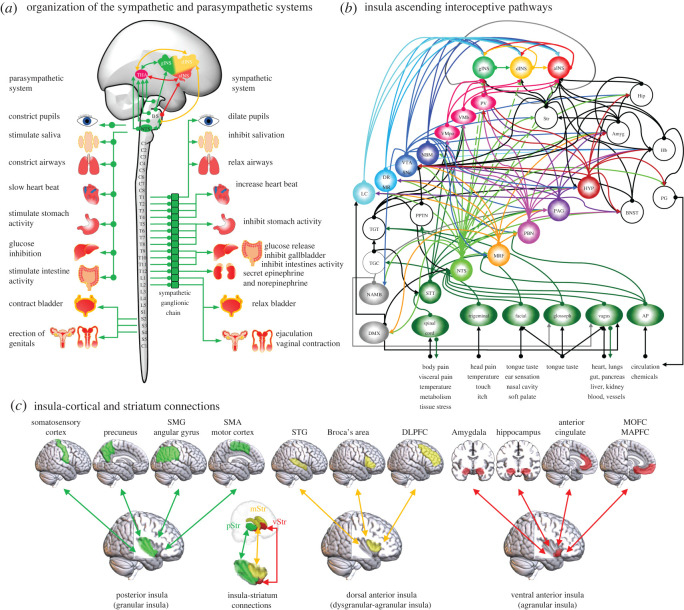
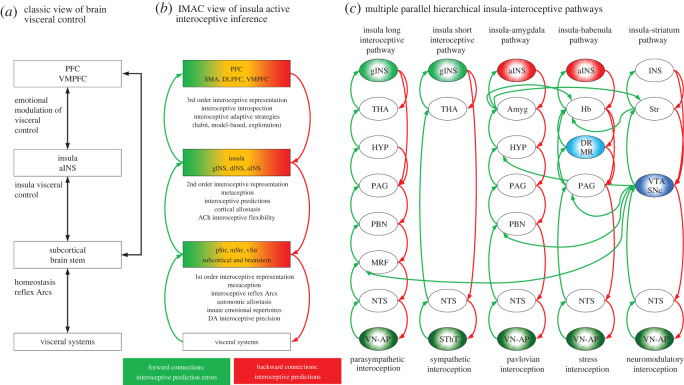
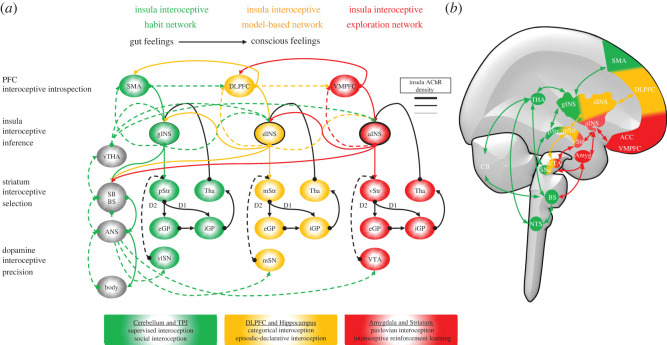
In the brain, the insular cortex receives a vast amount of interoceptive information, ascending through deep brain structures, from multiple visceral organs. The unique hierarchical and modular architecture of the insula suggests specialization for processing interoceptive afferents. Yet, the biological significance of the insula's neuroanatomical architecture, in relation to deep brain structures, remains obscure. In this opinion piece, we propose the Insula Hierarchical Modular Adaptive Interoception Control (IMAC) model to suggest that insula modules (granular, dysgranular and agranular), forming parallel networks with the prefrontal cortex and striatum, are specialized to form higher order interoceptive representations. These interoceptive representations are recruited in a context-dependent manner to support habitual, model-based and exploratory control of visceral organs and physiological processes. We discuss how insula interoceptive representations may give rise to conscious feelings that best explain lower order deep brain interoceptive representations, and how the insula may serve to defend the body and mind against pathological depression.
在大脑中,岛叶皮质接收大量通过深部脑结构从多个内脏器官传来的内感受信息。岛叶独特的层级和模块化结构表明其在处理内感受传入信息方面具有特异性。然而,岛叶与深部脑结构相关的神经解剖结构的生物学意义仍不明确。在这篇观点文章中,我们提出岛叶层级模块化适应性内感受控制(IMAC)模型,认为岛叶模块(颗粒状、亚颗粒状和无颗粒状)与前额叶皮质和纹状体形成平行网络,专门用于形成更高阶的内感受表征。这些内感受表征以上下文依赖的方式被调用,以支持对内脏器官和生理过程的习惯性、基于模型的和探索性控制。我们讨论了岛叶内感受表征如何可能产生能最好解释较低阶深部脑内感受表征的有意识感觉,以及岛叶如何可能有助于保护身体和心灵免受病理性抑郁的影响。