Sharypova E B, Drachkova I A, Chadaeva I V, Ponomarenko M P, Savinkova M P
Institute of Cytology and Genetics of the Siberian Branch of the Russian Academy of Sciences, Novosibirsk, Russia.
Vavilovskii Zhurnal Genet Selektsii. 2022 May;26(3):227-233. doi: 10.18699/VJGB-22-29.
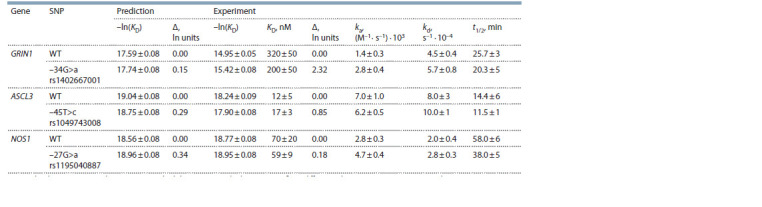
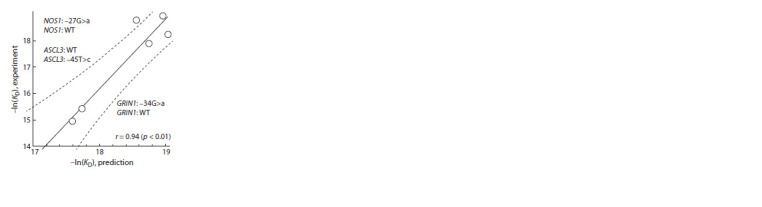
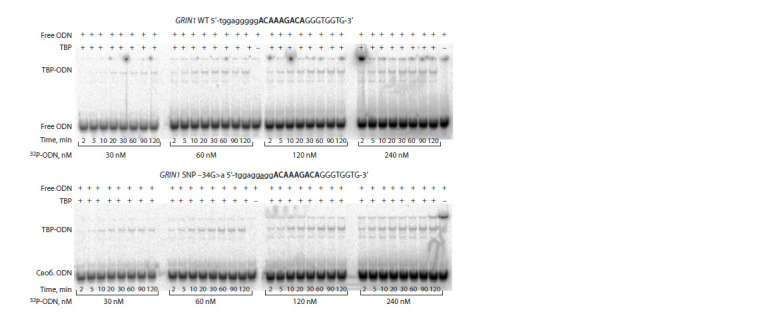
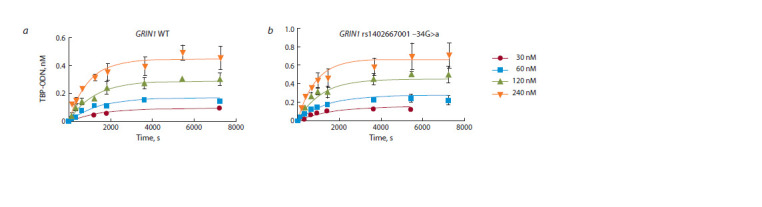
The GRIN1, ASCL3, and NOS1 genes are associated with various phenotypes of neuropsychiatric disorders. For instance, these genes contribute to the development of schizophrenia, Alzheimer's and Parkinson's diseases, and epilepsy. These genes are also associated with various cancers. For example, ASCL3 is overexpressed in breast cancer, and NOS1, in ovarian cancer cell lines. Based on our findings and literature data, we had previously obtained results suggesting that the single-nucleotide polymorphisms (SNPs) that disrupt erythropoiesis are highly likely to be associated with cognitive and neuropsychiatric disorders in humans. In the present work, using SNP_TATA_Z-tester, we investigated the influence of unannotated SNPs in the TATA boxes of the promoters of the GRIN1, ASCL3, and NOS1 genes (which are involved in neuropsychiatric disorders and cancers) on the interaction of the TATA boxes with the TATA-binding protein (TBP). Double-stranded oligodeoxyribonucleotides identical to the TATA-containing promoter regions of the GRIN1, ASCL3, and NOS1 genes (reference and minor alleles) and recombinant human TBP were employed to study in vitro (by an electrophoretic mobility shift assay) kinetic characteristics of the formation of TBP-TATA complexes and their affinity. It was found, for example, that allele A of rs1402667001 in the GRIN1 promoter increases TBP-TATA affinity 1.4-fold, whereas allele C in the TATA box of the ASCL3 promoter decreases the affinity 1.4-fold. The lifetime of the complexes in both cases decreased by ~20 % due to changes in the rates of association and dissociation of the complexes (ka and kd, respectively). Our experimental results are consistent with the literature showing GRIN1 underexpression in schizophrenic disorders as well as an increased risk of cervical, bladder, and kidney cancers and lymphoma during ASCL3 underexpression. The effect of allele A of the -27G>A SNP (rs1195040887) in the NOS1 promoter is suggestive of an increased risk of ischemic damage to the brain in carriers. A comparison of experimental TBP-TATA affinity values (KD) of wild-type and minor alleles with predicted ones showed that the data correlate well (linear correlation coefficient r = 0.94, p <0.01).
GRIN1、ASCL3和NOS1基因与神经精神疾病的多种表型相关。例如,这些基因在精神分裂症、阿尔茨海默病和帕金森病以及癫痫的发展中起作用。这些基因也与多种癌症相关。例如,ASCL3在乳腺癌中过度表达,而NOS1在卵巢癌细胞系中过度表达。基于我们的研究结果和文献数据,我们之前获得的结果表明,破坏红细胞生成的单核苷酸多态性(SNP)极有可能与人类的认知和神经精神疾病相关。在本研究中,我们使用SNP_TATA_Z-tester,研究了GRIN1、ASCL3和NOS1基因(涉及神经精神疾病和癌症)启动子TATA框中未注释的SNP对TATA框与TATA结合蛋白(TBP)相互作用的影响。使用与GRIN1、ASCL3和NOS1基因含TATA的启动子区域相同的双链寡脱氧核糖核苷酸(参考等位基因和次要等位基因)以及重组人TBP,通过电泳迁移率变动分析在体外研究TBP-TATA复合物形成的动力学特征及其亲和力。例如,发现GRIN1启动子中rs1402667001的A等位基因使TBP-TATA亲和力增加1.4倍,而ASCL3启动子TATA框中的C等位基因使亲和力降低1.4倍。由于复合物结合和解离速率(分别为ka和kd)的变化,两种情况下复合物的寿命均降低了约20%。我们的实验结果与文献一致,文献显示精神分裂症患者中GRIN1表达不足,以及ASCL3表达不足时患宫颈癌、膀胱癌、肾癌和淋巴瘤的风险增加。NOS1启动子中-27G>A SNP(rs1195040887)的A等位基因的作用表明,携带者发生脑缺血损伤的风险增加。野生型和次要等位基因的实验TBP-TATA亲和力值(KD)与预测值的比较表明,数据相关性良好(线性相关系数r = 0.94,p <0.01)。