Mullins Roger, Kapogiannis Dimitrios
Laboratory of Neurosciences, National Institute on Aging, Baltimore, MD, United States.
Front Neurosci. 2022 Jun 14;16:908650. doi: 10.3389/fnins.2022.908650. eCollection 2022.
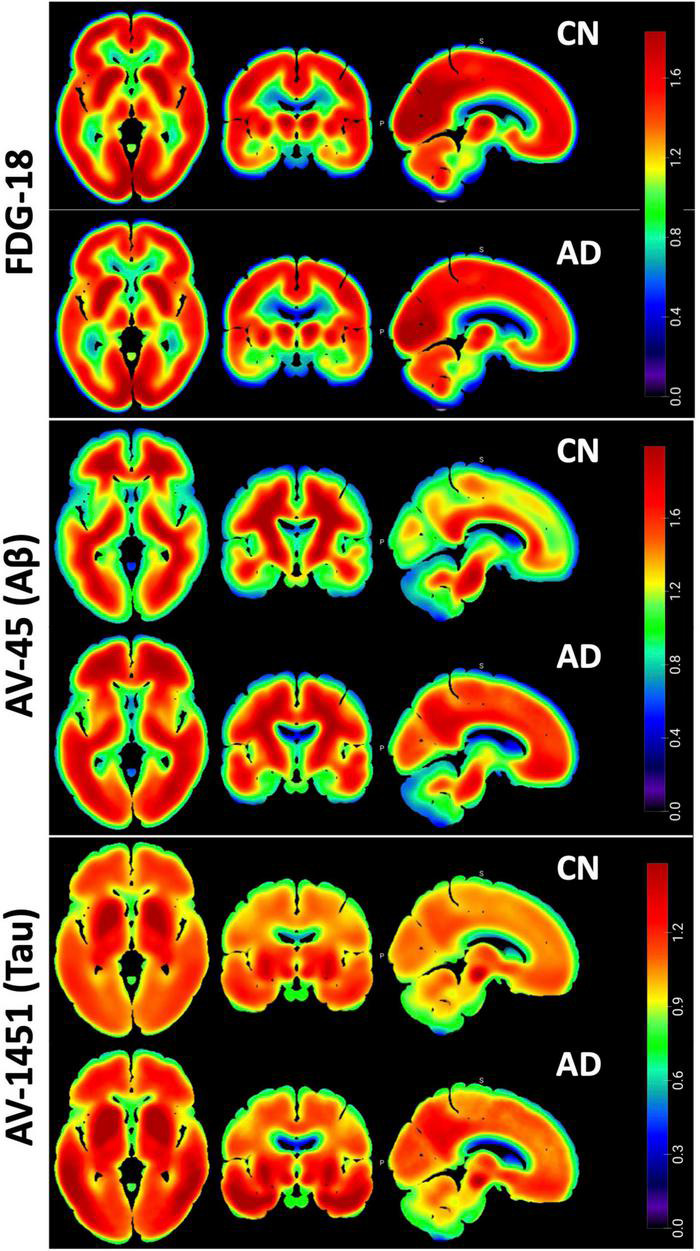
Alzheimer's Disease (AD) is an age-related neurodegenerative disease with a poorly understood etiology, shown to be partly genetic. Glucose hypometabolism, extracellular Amyloid-beta (Aβ) deposition, and intracellular Tau deposition are cardinal features of AD and display characteristic spatial patterns in the brain. We hypothesize that regional differences in underlying gene expression confer either resistance or susceptibility to AD pathogenic processes and are associated with these spatial patterns. Data-driven methods for the identification of genes involved in AD pathogenesis complement hypothesis-driven approaches that reflect current theories about the disease. Here we present a data driven method for the identification of genes involved in AD pathogenesis based on comparing spatial patterns of normal gene expression to Positron Emission Tomography (PET) images of glucose hypometabolism, Aβ deposition, and Tau deposition.
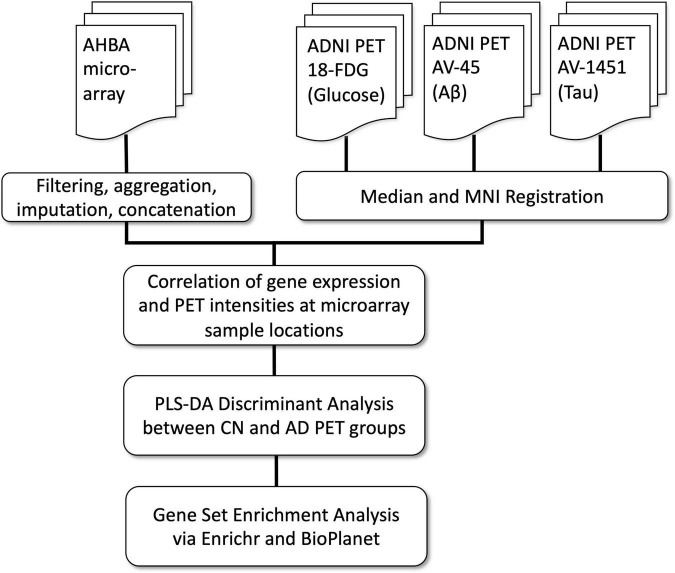
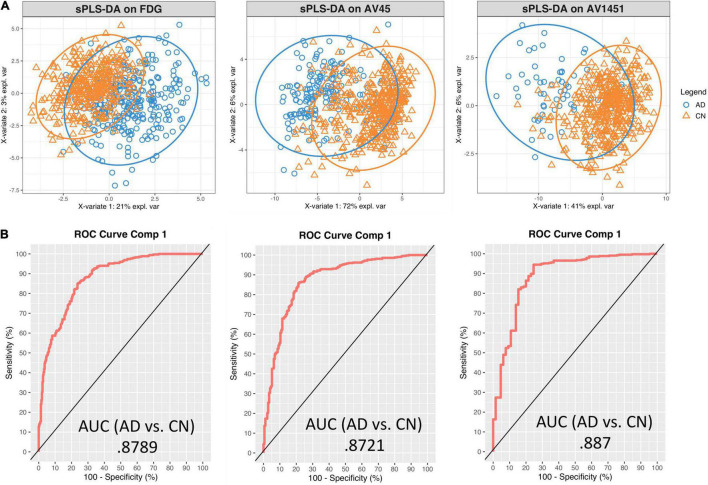
We performed correlations between the cerebral cortex microarray samples from the six cognitively normal (CN) post-mortem Allen Human Brain Atlas (AHBA) specimens and PET FDG-18, AV-45, and AV-1451 tracer images from AD and CN participants in the Alzheimer's Disease and Neuroimaging Initiative (ADNI) database. Correlation coefficients for each gene by each ADNI subject were then entered into a partial least squares discriminant analysis (PLS-DA) to determine sets that best classified the AD and CN groups. Pathway analysis BioPlanet 2019 was then used to infer the function of implicated genes.
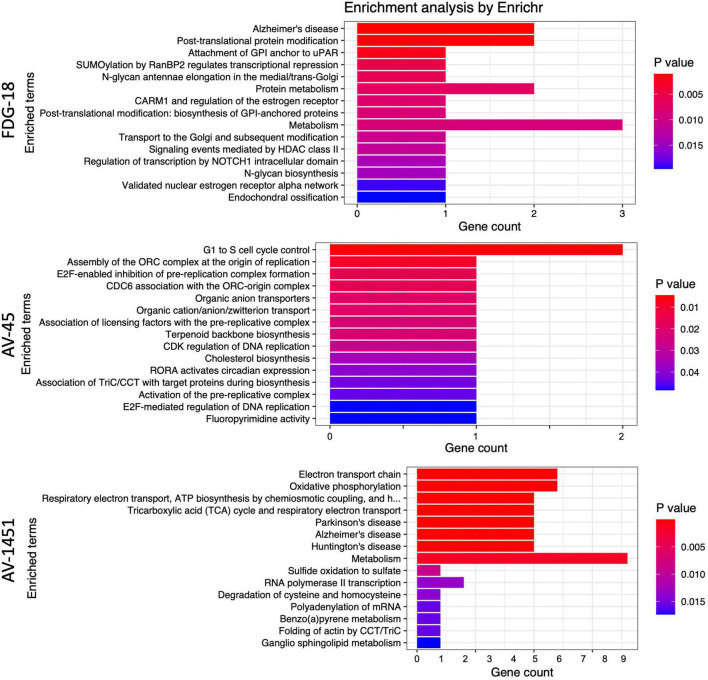
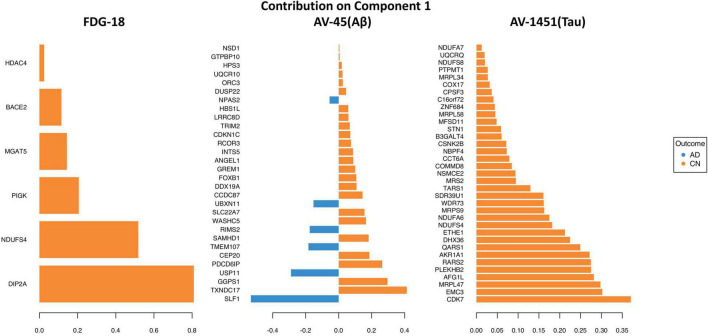
We identified distinct sets of genes strongly associated with each PET modality. Pathway analyses implicated novel genes involved in mitochondrial function, and Notch signaling, as well as genes previously associated with AD.
Using an unbiased approach, we derived sets of genes with expression patterns spatially associated with FDG hypometabolism, Aβ deposition, and Tau deposition in AD. This methodology may complement population-based approaches for identifying the genetic underpinnings of AD.
阿尔茨海默病(AD)是一种与年龄相关的神经退行性疾病,其病因尚不清楚,但部分显示为遗传性。葡萄糖代谢减退、细胞外β淀粉样蛋白(Aβ)沉积和细胞内 Tau 蛋白沉积是 AD 的主要特征,并在大脑中呈现出特征性的空间模式。我们假设潜在基因表达的区域差异赋予了对 AD 致病过程的抗性或易感性,并与这些空间模式相关。用于识别参与 AD 发病机制的基因的数据驱动方法补充了反映当前疾病理论的假设驱动方法。在此,我们提出一种数据驱动方法,通过将正常基因表达的空间模式与葡萄糖代谢减退、Aβ 沉积和 Tau 沉积的正电子发射断层扫描(PET)图像进行比较,来识别参与 AD 发病机制的基因。
我们对来自六个认知正常(CN)的死后艾伦人类大脑图谱(AHBA)标本的大脑皮质微阵列样本,与阿尔茨海默病和神经影像学倡议(ADNI)数据库中 AD 和 CN 参与者的 PET FDG - 18、AV - 45 和 AV - 1451 示踪剂图像进行了相关性分析。然后将每个 ADNI 受试者的每个基因的相关系数输入到偏最小二乘判别分析(PLS - DA)中,以确定最能区分 AD 和 CN 组的基因集。随后使用 BioPlanet 2019 通路分析来推断相关基因的功能。
我们确定了与每种 PET 模式密切相关的不同基因集。通路分析表明,涉及线粒体功能、Notch 信号传导的新基因以及先前与 AD 相关的基因。
通过一种无偏倚的方法,我们得出了在 AD 中其表达模式在空间上与 FDG 代谢减退、Aβ 沉积和 Tau 沉积相关的基因集。这种方法可能补充基于人群的方法来确定 AD 的遗传基础。