Fogelkvist Maria, Aila Gustafsson Sanna, Kjellin Lars, Parling Thomas
University Health Care Research Center, Faculty of Medicine and Health, Örebro University, 701 82, Örebro, Sweden.
Centre for Psychiatry Research, Department of Clinical Neuroscience, Karolinska Institutet, and Stockholm Health Care Services, Region Stockholm, The Centre for Psychotherapy, Education and Research, Liljeholmstorget 7, 117 63, Stockholm, Sweden.
J Eat Disord. 2022 Jul 1;10(1):90. doi: 10.1186/s40337-022-00615-9.
It is important to target body image in individuals with an eating disorder (ED). Acceptance and commitment therapy (ACT) has been trialed in a few studies for individuals with an ED. Although ACT outcomes in ED patients hold promise, studies of predictors are scarce. The aim of the present study was to explore differences in ED symptom outcome at two-year follow-up in subgroups of participants attending either treatment as usual (TAU), or a group intervention based on ACT targeting body image. Additionally, we aimed to compare subjective recovery experiences between groups.
The study took place at a specialized ED outpatient clinic, and included patients diagnosed with an ED that had received prior treatment and achieved a somewhat regular eating pattern. Study participants were randomly assigned to continue TAU or to participate in a group intervention based on ACT for body image issues. Only participants that completed the assigned intervention and had completed follow up assessment by two-years were included. The total sample consisted of 77 women.
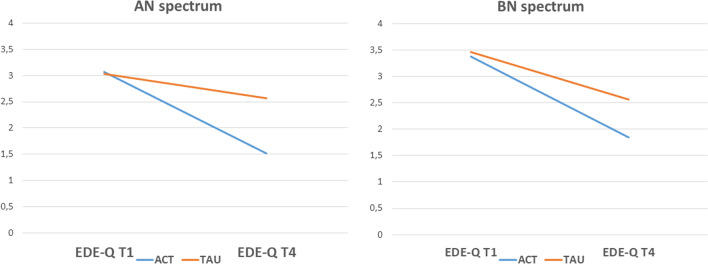
In general, ACT participants showed more favorable outcomes compared to TAU, and results were more pronounced in younger participants with shorter prior treatment duration and lower baseline depression ratings. Participants with restrictive ED psychopathology had three times higher ED symptom score change if participating in ACT in comparison to TAU.
An ACT group intervention targeting body image after initial ED treatment may further enhance treatment effects. There is a need for further investigation of patient characteristics that might predict response to body image treatment, particularly regarding ED subtypes and depression ratings.
针对饮食失调(ED)患者的身体意象进行干预很重要。接纳与承诺疗法(ACT)已在一些针对饮食失调患者的研究中进行了试验。尽管ACT在饮食失调患者中的治疗效果很有前景,但关于预测因素的研究却很少。本研究的目的是探讨在接受常规治疗(TAU)或基于ACT针对身体意象的团体干预的参与者亚组中,两年随访时饮食失调症状结果的差异。此外,我们旨在比较两组之间的主观康复体验。
该研究在一家专门的饮食失调门诊进行,纳入了被诊断为饮食失调且之前接受过治疗并形成了一定规律饮食模式的患者。研究参与者被随机分配继续接受常规治疗或参加基于ACT针对身体意象问题的团体干预。仅纳入完成了指定干预并在两年时完成随访评估的参与者。总样本包括77名女性。
总体而言,与常规治疗组相比,接受ACT干预的参与者显示出更有利的结果,且在先前治疗时间较短、基线抑郁评分较低的年轻参与者中结果更为明显。与常规治疗组相比,患有限制性饮食失调精神病理学的参与者若参加ACT,其饮食失调症状评分变化高出三倍。
在最初的饮食失调治疗后,针对身体意象的ACT团体干预可能会进一步提高治疗效果。有必要进一步研究可能预测对身体意象治疗反应的患者特征,特别是关于饮食失调亚型和抑郁评分方面。