Department of Vascular Surgery, Ambroise Paré University Hospital, Assistance Publique-Hôpitaux de Paris, 92104 Boulogne-Billancourt, France; UMR 1018, Inserm-Paris11 - CESP, Versailles Saint-Quentin-en-Yvelines University, Paris-Saclay University, Paul Brousse Hospital, 94807 Villejuif, France.
Department of Vascular Surgery, Ambroise Paré University Hospital, Assistance Publique-Hôpitaux de Paris, 92104 Boulogne-Billancourt, France; UMR 1018, Inserm-Paris11 - CESP, Versailles Saint-Quentin-en-Yvelines University, Paris-Saclay University, Paul Brousse Hospital, 94807 Villejuif, France.
Ann Vasc Surg. 2022 Oct;86:35-42. doi: 10.1016/j.avsg.2022.04.055. Epub 2022 Jun 30.
COVID-19 infection is associated not only with venous thromboses but also with arterial thromboses (COV-ATs) in relation with an endothelial dysfunction, a coagulopathy and rhythm disorders. The incidence, the topography, and the prognosis of COV-ATs remain poorly known. The objective of this study was to report the overall experience of the Greater Paris University Hospitals (Assistance Publique - Hopitaux de Paris, AP-HP) during the first pandemic wave of COVID-19 infection.
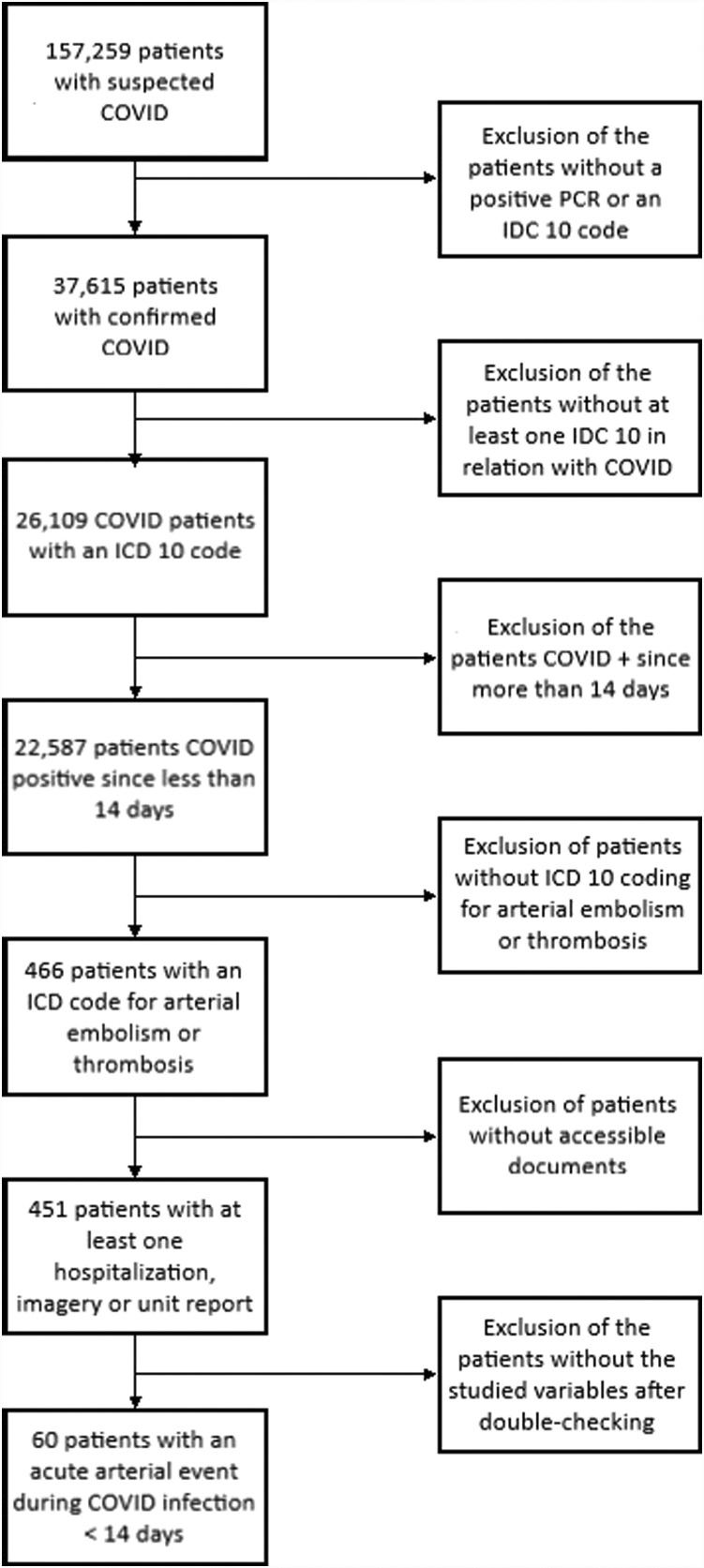
After approval by the ethics committee, a study using the AP-HP clinical data warehouse was carried out between March and May 2020. Overall, 124,609 patients had a polymerase chain reaction for COVID-19 in our hospitals, of which 25,345 were positive. From 20,710 exploitable stays, patients tested positive for COVID who presented an episode of acute COV-AT (except coronary and intracranial arteries) were selected on the basis of the French medical classification for clinical procedures codes. The data are presented as absolute values with percentages and/or means with standard deviation.
Over the studied period, 60 patients (aged 71±14 years, 42 men) presented a COV-AT at the time of their hospitalization, an incidence of 0.2%. The arterial complication occurred 3±7 days after the COVID infection and was inaugural in 30% of the cases (n = 18). The sites of COV-AT were the lower extremities (n = 35%, 58%), the abdominal aorta (n = 10%, 17%), the thoracic aorta (n = 7%, 12%), the upper limbs (n = 7%, 12%), the cerebral arteries (n = 7%, 12%), the digestive arteries (n = 6%, 10%), the renal arteries (n = 2%, 3%), and the ophthalmic artery (n = 1%, 2%). Multiple COV-ATs were observed in 13 patients (22%). At the time of diagnosis, 20 (33%) patients were in intensive care, including six (10%) patients who were intubated. On computed tomography angiography, COVID lesions were classified as moderate and severe in 25 (42%) and 21 (35%) cases, respectively. Revascularization was attempted in 27 patients (45%), by open surgery in 16 cases, using endovascular techniques in 8 cases and with a hybrid approach in three cases. Six patients (22%) required reinterventions. The duration of hospitalization was 12±9 days. Early mortality (in-hospital or at 30 days) was 30% (n = 18). Nine (15%) patients presented severe nonlethal ischemic complications.
Arterial involvement is rare during COVID-19 infection. The aorta and the arteries of the limbs are the privileged sites. The morbi-mortality of these patients is high. Future studies will have to determine if the systematization of anticoagulation therapy decreases the incidence and the severity of the condition.
COVID-19 感染不仅与静脉血栓形成有关,还与内皮功能障碍、凝血功能障碍和节律紊乱有关的动脉血栓形成(COV-ATs)有关。COV-ATs 的发生率、病变部位和预后仍知之甚少。本研究的目的是报告巴黎大区公立医院(巴黎公立医院集团,AP-HP)在 COVID-19 感染第一波大流行期间的总体经验。
在伦理委员会批准后,于 2020 年 3 月至 5 月期间使用 AP-HP 临床数据仓库进行了一项研究。在我们的医院中,共有 124609 名患者进行了 COVID-19 的聚合酶链反应检测,其中 25345 名呈阳性。从 20710 个可利用的住院患者中,根据法国医疗分类临床程序代码,选择了在 COVID 检测呈阳性并出现急性 COV-AT(不包括冠状动脉和颅内动脉)的患者。数据以绝对值和百分比表示,或平均值和标准差表示。
在研究期间,60 名患者(年龄 71±14 岁,42 名男性)在住院期间发生了 COV-AT,发病率为 0.2%。动脉并发症发生在 COVID 感染后 3±7 天,首发于 30%的病例(n=18)。COV-AT 的部位为下肢(n=35%,58%)、腹主动脉(n=10%,17%)、胸主动脉(n=7%,12%)、上肢(n=7%,12%)、脑动脉(n=7%,12%)、消化道动脉(n=6%,10%)、肾动脉(n=2%,3%)和眼动脉(n=1%,2%)。13 名患者(22%)有多处 COV-AT。诊断时,20 名(33%)患者在重症监护病房,包括 6 名(10%)需要插管的患者。在计算机断层血管造影(CTA)上,COVID 病变分别在 25 名(42%)和 21 名(35%)患者中被归类为中度和重度。对 27 名患者(45%)进行了血运重建,其中 16 名采用开放手术,8 名采用血管内技术,3 名采用混合方法。6 名患者(22%)需要再次介入。住院时间为 12±9 天。早期死亡率(住院或 30 天内)为 30%(n=18)。9 名(15%)患者出现严重非致死性缺血性并发症。
COVID-19 感染期间动脉受累罕见。主动脉和四肢动脉是其主要受累部位。这些患者的病死率较高。未来的研究将不得不确定抗凝治疗的系统化是否会降低疾病的发生率和严重程度。