Department of Orthodontics, University of Ferrara, Via Luigi Borsari, 46, 44121, Ferrara, Italy.
Faculty of Banking and Insurance, Catholic University of Milan, Largo Agostino Gemelli 1, 20123, Milan, Italy.
Prog Orthod. 2022 Jul 4;23(1):21. doi: 10.1186/s40510-022-00416-5.
The purpose of the present in vivo study was to compare the accuracy, in terms of trueness, between full-arch digital impressions of different intraoral scanning systems, using as a reference the ideality of the conventional impression technique.
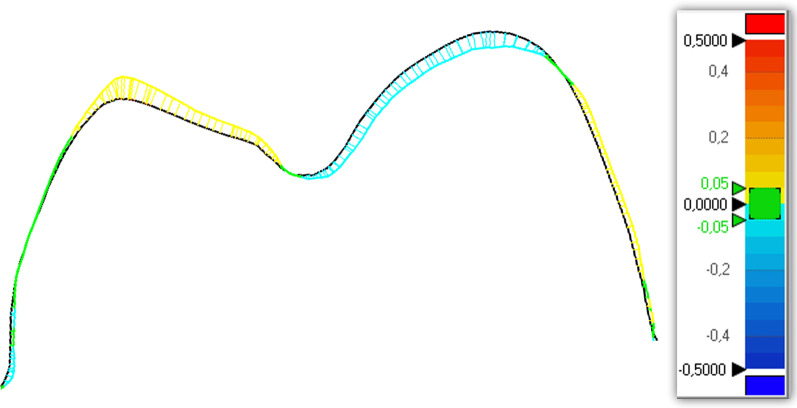
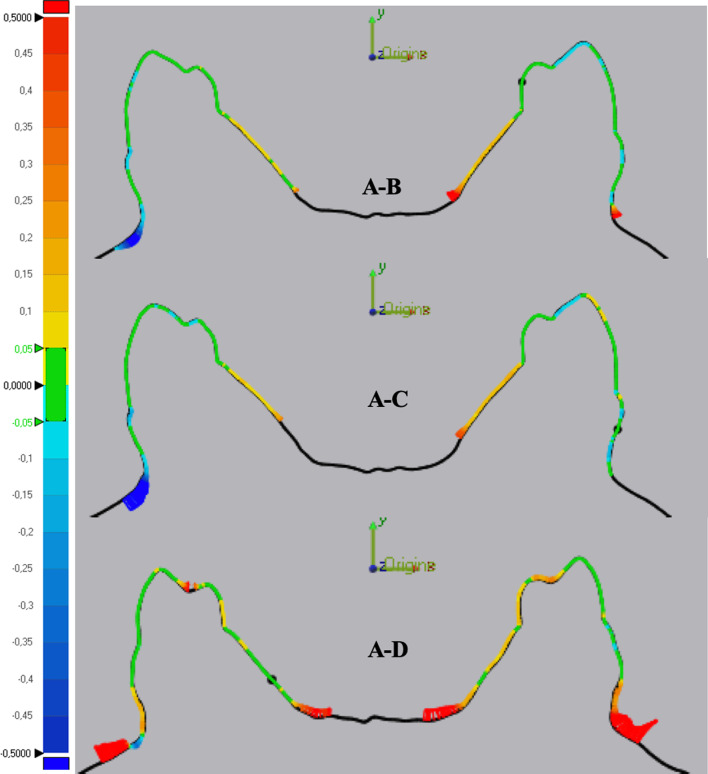
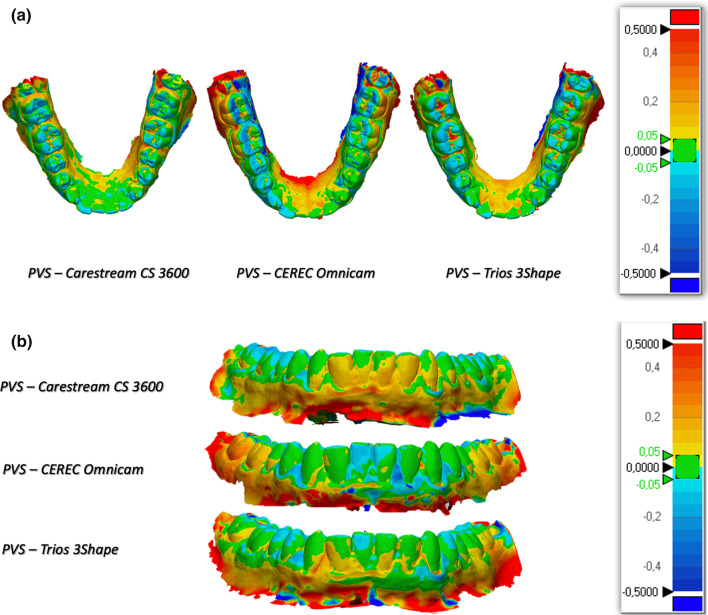
Polyvinyl siloxane (PVS) two-step technique impressions of 27 subjects were taken, and the stone casts were scanned using desktop scanners R500 3Shape. For each arch, in vivo scans were taken with intraoral scanners Carestream CS3600, CEREC Omnicam and Trios 3Shape. All the files were compared, superimposing them on the reference model to calculate the total 3D and 2D deviations. The efficiency of the digital and conventional workflows was evaluated by measuring the work time in minutes. Statistical analyses were performed using R software (R Core Team 2020) with a p-value < 0.05.
The three intraoral scanners differed from the PVS impression by differences of the order of 100-200 µm, and there was a trend of greater imprecision in the molar area in both dental arches. In comparison with PVS technique, CEREC tended to reduce the size of the impression, Trios presented the trend of greater precision, and Carestream showed minor differences the transversal distance. The areas of greatest discrepancy both in excess and in defect with respect to the PVS impression were the molar areas and incisal margins. Trios 3Shape recorded the shortest times and therefore with a more performing speed.
The Trios 3Shape was found to be the most accurate single-tooth scanner, while the Carestream CS 3600 showed better inter-arch diameter performance compared to PVS impressions. The 3D and 2D analyses showed a trend of greater distortion of the impressions compared to the conventional one in the molar region.
本体内研究的目的是比较不同口内扫描仪全口数字印模在准确性方面的差异,以传统印模技术的理想性为参考。
对 27 名受试者进行聚硅氧烷(PVS)两步法印模,使用桌面扫描仪 R500 3Shape 对石模型进行扫描。对于每个牙弓,使用口内扫描仪 Carestream CS3600、CEREC Omnicam 和 Trios 3Shape 进行活体扫描。将所有文件进行比较,将它们叠加在参考模型上以计算总 3D 和 2D 偏差。通过测量分钟数来评估数字和传统工作流程的效率。使用 R 软件(R Core Team 2020)进行统计分析,p 值<0.05。
三种口内扫描仪与 PVS 印模的差异在 100-200 μm 左右,两个牙弓的磨牙区存在较大不精确的趋势。与 PVS 技术相比,CEREC 倾向于减小印模的尺寸,Trios 呈现出更精确的趋势,而 Carestream 则显示出横向距离的微小差异。与 PVS 印模相比,过度和缺陷区域差异最大的是磨牙区和切缘。Trios 3Shape 记录的时间最短,因此速度更快。
Trios 3Shape 被认为是最准确的单牙扫描仪,而 Carestream CS 3600 与 PVS 印模相比,在跨牙弓直径性能方面表现更好。3D 和 2D 分析显示,与传统印模相比,在磨牙区域印模的变形趋势更大。