
寒冷地区某医院妇产科自然光环境非视觉效应研究
A Study on Nonvisual Effects of Natural Light Environment in a Maternity Ward of a Hospital in Cold Area.
机构信息
School of Landscape Architecture, Northeast Forestry University, Harbin 150040, China.
出版信息
Biomed Res Int. 2022 Jun 22;2022:8608892. doi: 10.1155/2022/8608892. eCollection 2022.
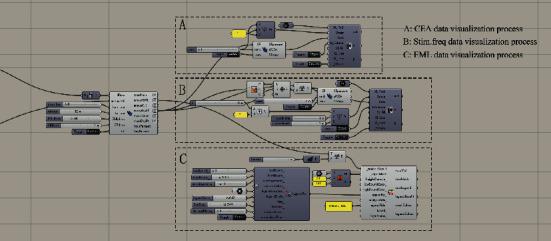
Thanks to the discovery of human eye photoreceptor cells, ipGRC and human nonvisual channels, the nonvisual effects of light have gradually come to our vision and been rationally utilized. Along with this trend, people have expanded their demand for the light environment to both visual and nonvisual needs from only visual needs. With a good natural daylighting, parturients will find their psychological pressure and physiological pain relieved, their rehabilitation rate increased, and they get rehabilitated more quickly. This study was carried out in a representative maternity ward in Harbin based on the latest research results on nonvisual effects at home and abroad. Specifically, the nonvisual effects on the natural light environment in the ward throughout the year were simulated and analyzed from the aspects of equivalent melanopic lux (EML), stimulus frequency (Stim.freq), and circadian effective area (CEA). During the study, natural light in the ward was measured on site, and the evaluation tool and workflow of nonvisual effects were created with the aid of Grasshopper modeling platform, Ladybug+Honeybee, and VB script editor. The results show that the nonvisual effects of natural light on the body of parturients gradually weaken as they further go inside the ward. What is worse, in the most unfavorable all-overcast condition, daylighting on beds far away from the window does not meet the stimulus of human circadian rhythm from April to August. Therefore, additional light is required. The wards have the best nonvisual natural light environment when they are south facing and have a window to floor ratio of 0.3.
由于人类眼感光细胞、ipGRC 和人类非视觉通道的发现,光的非视觉效应逐渐引起了我们的关注,并得到了合理的利用。随着这一趋势的发展,人们对光环境的需求从单纯的视觉需求扩展到了视觉和非视觉需求。良好的自然采光可以缓解产妇的心理压力和生理疼痛,提高康复率,使她们更快地康复。本研究以国内外非视觉效应的最新研究成果为基础,在哈尔滨的一家有代表性的妇产科病房进行。具体来说,从等效视黑素勒克斯(EML)、刺激频率(Stim.freq)和昼夜有效面积(CEA)等方面对全年病房自然光环境的非视觉效应进行了模拟和分析。研究过程中,对病房内的自然光进行了现场测量,并借助 Grasshopper 建模平台、Ladybug+Honeybee 和 VB 脚本编辑器创建了非视觉效应的评价工具和工作流程。结果表明,自然光对产妇身体的非视觉效应随着其在病房内的深入而逐渐减弱。更糟糕的是,在最不利的全阴天条件下,从 4 月到 8 月,远离窗户的床位采光无法满足人体昼夜节律的刺激需求,因此需要额外的光照。当病房朝南且窗户与地板的比例为 0.3 时,具有最佳的非视觉自然光环境。




 Zotero 插件