Wang Ying, Xiong Fei, Song Zhaobin
Hubei Engineering Research Center for Protection and Utilization of Special Biological Resources in the Hanjiang River Basin, College of Life Sciences, Jianghan University, Wuhan, China.
Sichuan Key Laboratory of Conservation Biology on Endangered Wildlife, College of Life Sciences, Sichuan University, Chengdu, China.
Front Genet. 2022 Jun 17;13:903240. doi: 10.3389/fgene.2022.903240. eCollection 2022.
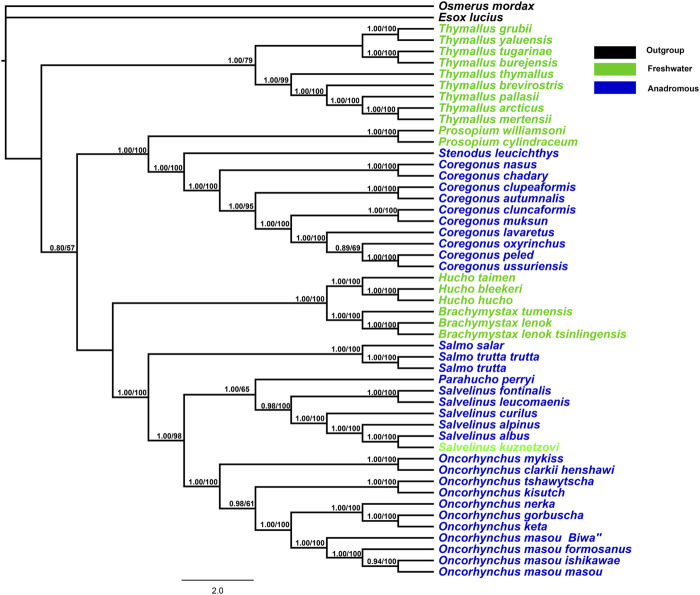
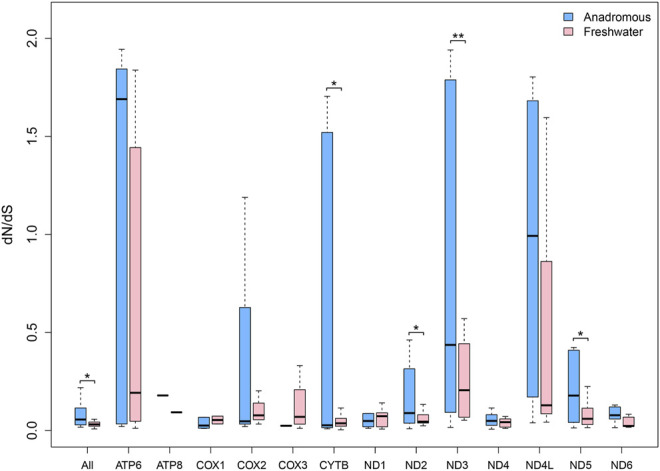
Salmonids are composed of anadromous and freshwater fishes, which is an important model for studying adaptive evolution. Herein, 49 salmonid complete mitochondrial genomes and those of two outgroups were used to infer a robust phylogeny for the family Salmonidae. The BI and RAxML phylogenetic trees based on 13 concatenated mitochondrial protein-coding genes showed well-supported nodes, and topologies were highly congruent. The concatenated 13 mitochondrial protein-coding genes, , , and genes were shown to have significantly larger ratios in anadromous species than in freshwater species of Salmonidae, but the gene had significantly smaller in anadromous species. The FEL analysis identified positively selected sites and negatively selected sites in each mitochondrial protein-coding gene separately. The RELAX program revealed that the and genes supported intensified selection of the anadromous lineages. Our results demonstrated the phylogeny of Salmonidae and explored the mitochondrial DNA evolution pattern between anadromous and freshwater salmonids.
鲑科鱼类由溯河产卵鱼类和淡水鱼类组成,是研究适应性进化的重要模型。在此,使用49个鲑科鱼类的完整线粒体基因组以及两个外类群的基因组来推断鲑科的稳健系统发育。基于13个串联线粒体蛋白编码基因构建的贝叶斯推断(BI)和最大似然法(RAxML)系统发育树显示出得到充分支持的节点,并且拓扑结构高度一致。串联的13个线粒体蛋白编码基因、、和基因在鲑科溯河产卵物种中的比值显著大于淡水物种,但基因在溯河产卵物种中的比值显著较小。FEL分析分别在每个线粒体蛋白编码基因中鉴定出正选择位点和负选择位点。RELAX程序显示,和基因支持溯河产卵谱系的强化选择。我们的结果展示了鲑科的系统发育,并探索了溯河产卵和淡水鲑科鱼类之间的线粒体DNA进化模式。