Roy-Vallejo Emilia, Cardeñoso Laura, Triguero-Martínez Ana, Chicot Llano Marta, Zurita Nelly, Ávalos Elena, Barrios Ana, Hernando Julia, Ortiz Javier, Rodríguez-García Sebastián C, Ciudad Sañudo Marianela, Marcos Celeste, García Castillo Elena, Fontán García-Rodrigo Leticia, González Begoña, Méndez Rosa, Iturrate Isabel, Sanz-García Ancor, Villa Almudena, Sánchez-Azofra Ana, Quicios Begoña, Arribas David, Álvarez Rodríguez Jesús, Patiño Pablo, Trigueros Marina, Uriarte Miren, Martín-Ramírez Alexandra, Arévalo Román Cristina, Galván-Román José María, García-Vicuña Rosario, Ancochea Julio, Muñoz-Calleja Cecilia, Fernández-Ruiz Elena, de la Cámara Rafael, Suárez Fernández Carmen, González-Álvaro Isidoro, Rodríguez-Serrano Diego A
Department of Internal Medicine, Hospital Universitario La Princesa, Madrid, Spain.
Department of Microbiology, Hospital Universitario La Princesa, Madrid, Spain.
Front Med (Lausanne). 2022 Jun 15;9:855639. doi: 10.3389/fmed.2022.855639. eCollection 2022.
Interleukin 6 (IL6) levels and SARS-CoV-2 viremia have been correlated with COVID-19 severity. The association over time between them has not been assessed in a prospective cohort. Our aim was to evaluate the relationship between SARS-CoV-2 viremia and time evolution of IL6 levels in a COVID-19 prospective cohort.
Secondary analysis from a prospective cohort including COVID-19 hospitalized patients from Hospital Universitario La Princesa between November 2020 and January 2021. Serial plasma samples were collected from admission until discharge. Viral load was quantified by Real-Time Polymerase Chain Reaction and IL6 levels with an enzyme immunoassay. To represent the evolution over time of both variables we used the graphic command of Stata.
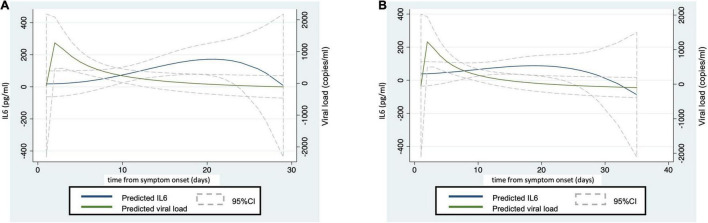
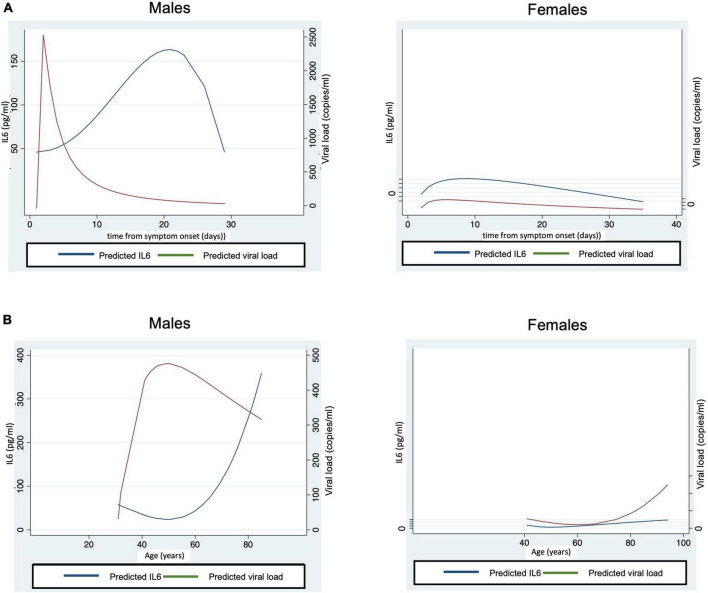
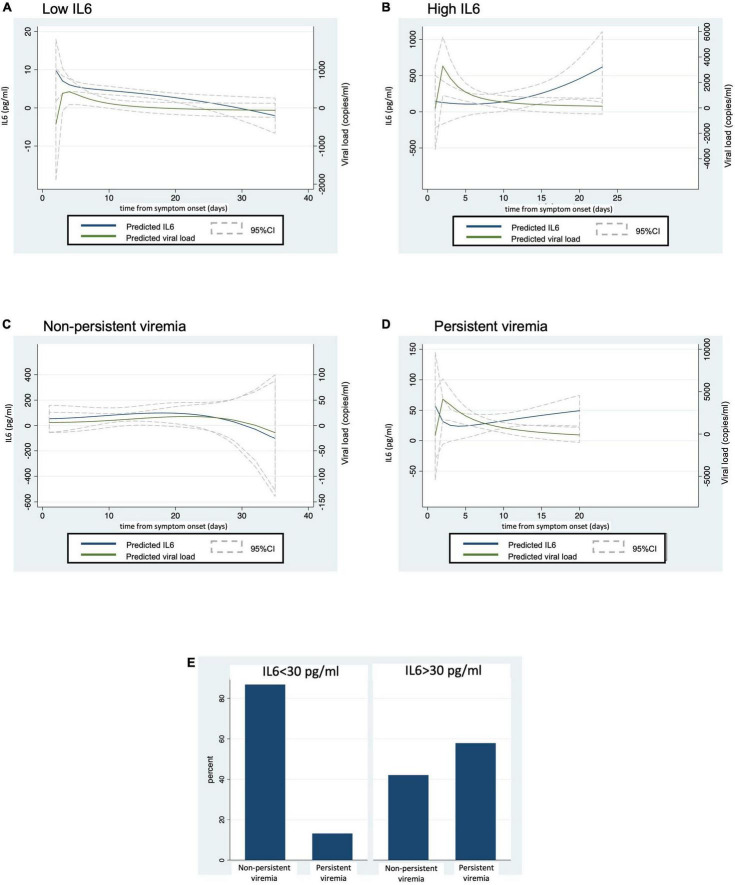
A total of 57 patients were recruited, with median age of 63 years (IQR [53-81]), 61.4% male and 68.4% Caucasian. The peak of viremia appeared shortly after symptom onset in patients with persistent viremia (more than 1 sample with > 1.3 log10 copies/ml) and also in those with at least one IL6 > 30 pg/ml, followed by a progressive increase in IL6 around 10 days later. Persistent viremia in the first week of hospitalization was associated with higher levels of IL6. Both IL6 and SARS-CoV-2 viral load were higher in males, with a quicker increase with age.
In those patients with worse outcomes, an early peak of SARS-CoV-2 viral load precedes an increase in IL6 levels. Monitoring SARS-CoV-2 viral load during the first week after symptom onset may be helpful to predict disease severity in COVID-19 patients.
白细胞介素6(IL6)水平和严重急性呼吸综合征冠状病毒2(SARS-CoV-2)病毒血症与2019冠状病毒病(COVID-19)的严重程度相关。尚未在前瞻性队列中评估它们随时间的关联。我们的目的是评估COVID-19前瞻性队列中SARS-CoV-2病毒血症与IL6水平随时间变化的关系。
对一个前瞻性队列进行二次分析,该队列包括2020年11月至2021年1月期间在拉普林塞萨大学医院住院的COVID-19患者。从入院到出院采集系列血浆样本。通过实时聚合酶链反应定量病毒载量,并用酶免疫测定法检测IL6水平。为了表示两个变量随时间的变化,我们使用了Stata的图形命令。
共招募了57名患者,中位年龄为63岁(四分位间距[53 - 81]),61.4%为男性,68.4%为白种人。持续性病毒血症患者(超过1份样本病毒载量>1.3 log10拷贝/ml)以及至少有一次IL6>30 pg/ml的患者,病毒血症峰值在症状出现后不久出现,随后约10天后IL6逐渐升高。住院第一周的持续性病毒血症与较高的IL6水平相关。男性的IL6和SARS-CoV-2病毒载量均较高,且随年龄增长升高更快。
在那些预后较差的患者中,SARS-CoV-2病毒载量的早期峰值先于IL6水平升高。在症状出现后的第一周监测SARS-CoV-2病毒载量可能有助于预测COVID-19患者的疾病严重程度。