Institute of Bioanalytical Chemistry, Faculty of Chemistry and Mineralogy, Universität Leipzig, Leipzig, Germany.
Center for Biotechnology and Biomedicine, Universität Leipzig, Leipzig, Germany.
Front Immunol. 2022 Jun 15;13:915034. doi: 10.3389/fimmu.2022.915034. eCollection 2022.
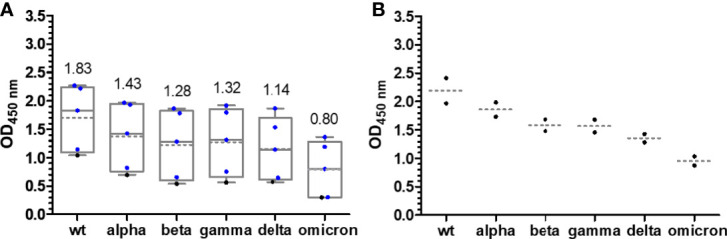
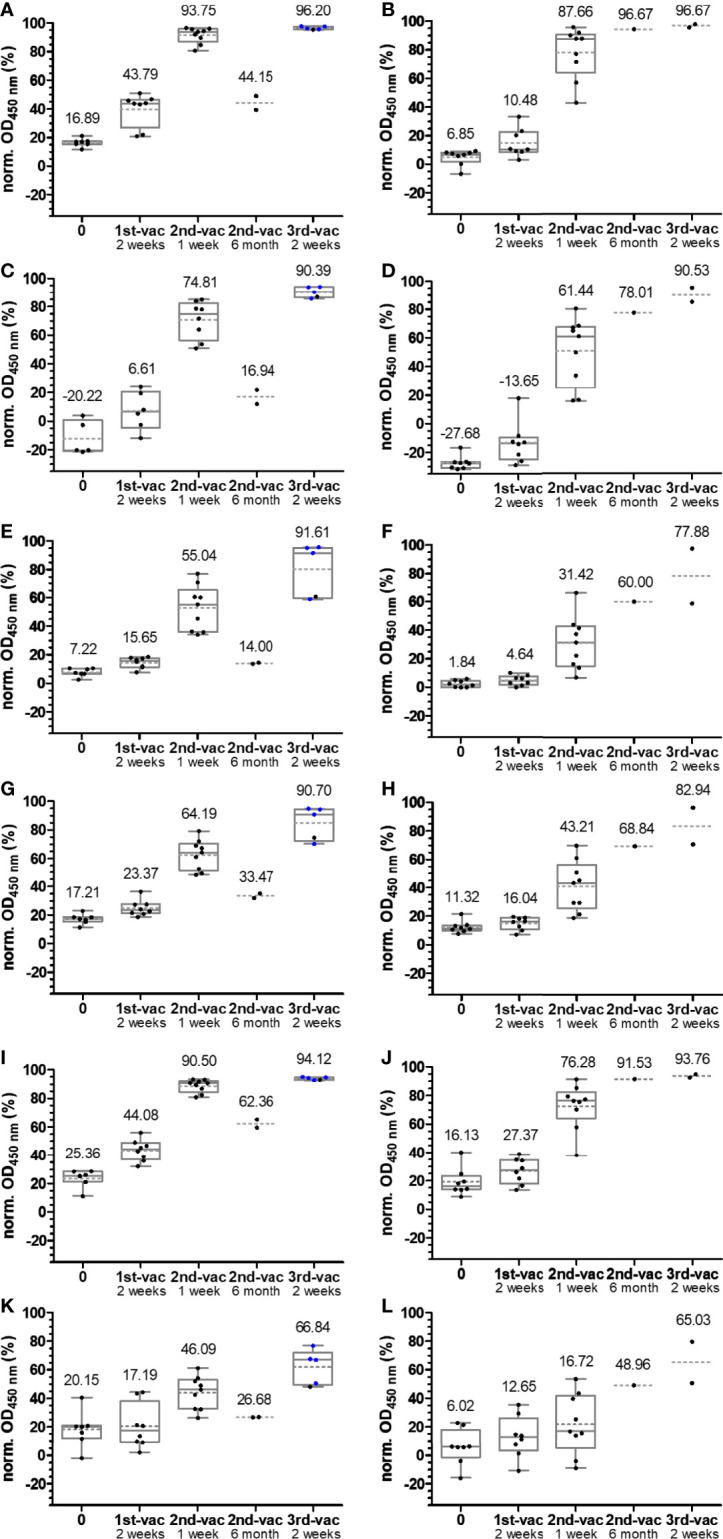
The rapid development, approval, and production of vaccines against the severe acute respiratory syndrome coronavirus 2 (SARS-CoV-2) in less than 1 year after the first reports of a new infectious disease was a real game changer, providing 80%-90% efficacy in preventing severe etiopathologies of the coronavirus disease 2019 (COVID-19). These vaccines induce an immune response against the SARS-CoV-2 spike (S) protein located on the surface of the virus particle. Antibodies (Abs) recognizing the S-protein can inhibit binding of the virus the S-protein to the angiotensin-converting enzyme-2 (ACE-2) receptor expressed on different human cells, especially when these Abs bind to the interaction site, the so-called receptor-binding domain (RBD). We have expressed the RBDs of wild-type SARS-CoV-2 and five variants of concern (VOCs) to test the immune response in people before vaccination with mRNA vaccines BNT162b2 and mRNA-1273 and after up to three vaccinations using in-house ELISA and inhibition assays. The methods of both assays are provided. Both vaccines initiated similarly high IgG titers after two vaccinations against the wild-type and even two VOC-RBDs (alpha and delta) and strongly inhibited the corresponding RBD-ACE-2 binding. The IgG titers and inhibition of ACE-2 binding were lower for beta and gamma RBDs and much lower for omicron RBD. The third vaccination after 6 months strongly increased both the IgG titers and the neutralizing effect against all variants, especially for omicron, leading to 63% ± 13% neutralization potential. Importantly, neutralization linearly increased with the IgG titers.
在首例新发传染病报告不到 1 年后,针对严重急性呼吸综合征冠状病毒 2 (SARS-CoV-2) 的疫苗迅速开发、获得批准并投入生产,这确实是一个重大的改变,其在预防 2019 年冠状病毒病 (COVID-19) 的严重病因方面的有效性达到 80%-90%。这些疫苗诱导针对病毒表面刺突 (S) 蛋白的免疫反应。识别 S-蛋白的抗体 (Abs) 可以抑制病毒与血管紧张素转换酶-2 (ACE-2) 受体的结合,该受体表达在不同的人体细胞上,特别是当这些 Abs 结合到相互作用位点,即所谓的受体结合域 (RBD) 时。我们已经表达了野生型 SARS-CoV-2 和五种关注变体 (VOCs) 的 RBDs,以在接种 mRNA 疫苗 BNT162b2 和 mRNA-1273 之前和接种三剂后测试人们的免疫反应,使用的方法是内部 ELISA 和抑制测定法。提供了这两种测定法的方法。两种疫苗在接种两剂后针对野生型和甚至两种 VOC-RBDs(alpha 和 delta)均引发了相似高的 IgG 滴度,并强烈抑制了相应的 RBD-ACE-2 结合。对于 beta 和 gamma RBDs,IgG 滴度和 ACE-2 结合抑制作用较低,对于 omicron RBD 则更低。6 个月后接种第三剂后,均强烈增加了 IgG 滴度和对所有变体的中和作用,特别是对 omicron,导致 63%±13%的中和潜力。重要的是,中和作用与 IgG 滴度呈线性相关。