D'Adamo Idiano, Colasante Annarita
Department of Computer, Control and Management Engineering, Sapienza University of Rome, Via Ariosto 25, Rome 00185, Italy.
Department of Law and Economics, UnitelmaSapienza - University of Rome, Piazza Sassari 4, Roma 00161, Italy.
Data Brief. 2022 Jun 14;43:108385. doi: 10.1016/j.dib.2022.108385. eCollection 2022 Aug.
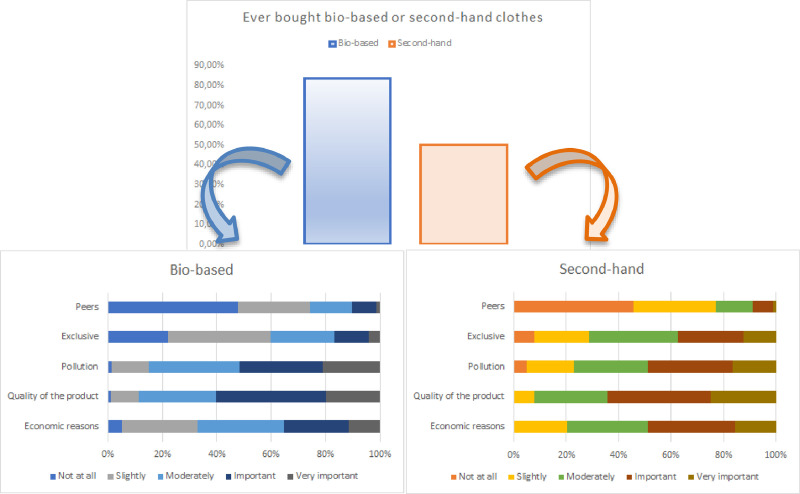
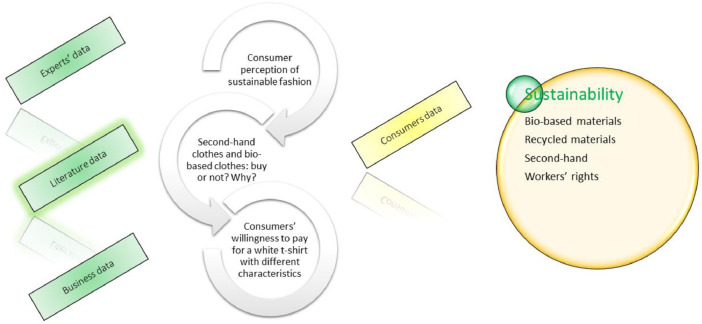
This data article presents data collected through a survey with the aim of understanding consumers' behavior in the fashion industry. The analyses of these data are elaborated in the article "The circular economy and bioeconomy in the fashion sector: Emergence of a "sustainability bias"" (Colasante and Adamo 2021). As highlighted in the literature, the fashion industry contributes significantly to environmental pollution in all steps, from the production to the delivery. Often, consumers are not aware of the impact of their fashion habits on the environment and this led to the emergence of the well-known fast fashion phenomenon. Even though there is a lack of evidence on this topic, shifting consumers to embrace bioeconomy as well as circular economy principles constitutes a possible solution to reduce the impact of the fashion sector on the environment. We collected these data on consumers' habits and preferences regarding both bioeconomy and circular economy by means of a questionnaire in which a total of 402 Italian people took part by using Amazon Mechanical Turk (MTurk) platform. This paper aims at presenting the data split in the three main blocks: (i) consumer perception; (ii) purchasing habits; and (iii) consumers' willingness to pay (WTP). The results obtained are of interest to citizens, business, academics and policy makers to understand consumers' perception of sustainability in the fashion industry. The proposed dataset can be replicated on a global scale, on specific market segments of the fashion industry and can be used to compare the perception of the circular bioeconomy in other sectors.
本数据文章展示了通过一项调查收集的数据,目的是了解消费者在时尚产业中的行为。这些数据的分析在文章《时尚领域的循环经济和生物经济:“可持续性偏差”的出现》(科拉桑特和阿达莫,2021年)中有详细阐述。正如文献中所强调的,时尚产业在从生产到交付的所有环节都对环境污染有重大贡献。通常,消费者并未意识到他们的时尚习惯对环境的影响,这导致了著名的快时尚现象的出现。尽管在这个话题上缺乏证据,但促使消费者接受生物经济以及循环经济原则可能是减少时尚产业对环境影响的一种解决方案。我们通过一份问卷收集了这些关于消费者对生物经济和循环经济的习惯及偏好的数据,共有402名意大利人通过亚马逊土耳其机器人(MTurk)平台参与了该问卷。本文旨在展示分为三个主要板块的数据:(i)消费者认知;(ii)购买习惯;以及(iii)消费者支付意愿(WTP)。所获得的结果对于公民、企业、学者和政策制定者了解消费者对时尚产业可持续性的认知具有重要意义。所提议的数据集可以在全球范围内、时尚产业的特定细分市场上进行复制,并可用于比较其他行业对循环生物经济的认知。