Department of Pharmaceutics and Biopharmaceutics, University of Marburg, Robert-Koch-Str. 4, 35037 Marburg, Germany.
Department of Pharmaceutics and Industrial Pharmacy, Faculty of Pharmacy, Al-Azhar University, Assiut 71524, Egypt.
ACS Appl Mater Interfaces. 2022 Jul 20;14(28):31525-31540. doi: 10.1021/acsami.2c02741. Epub 2022 Jul 5.
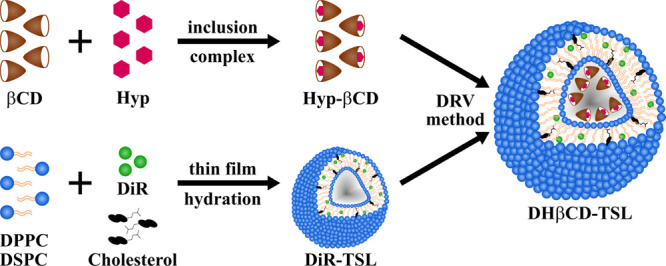
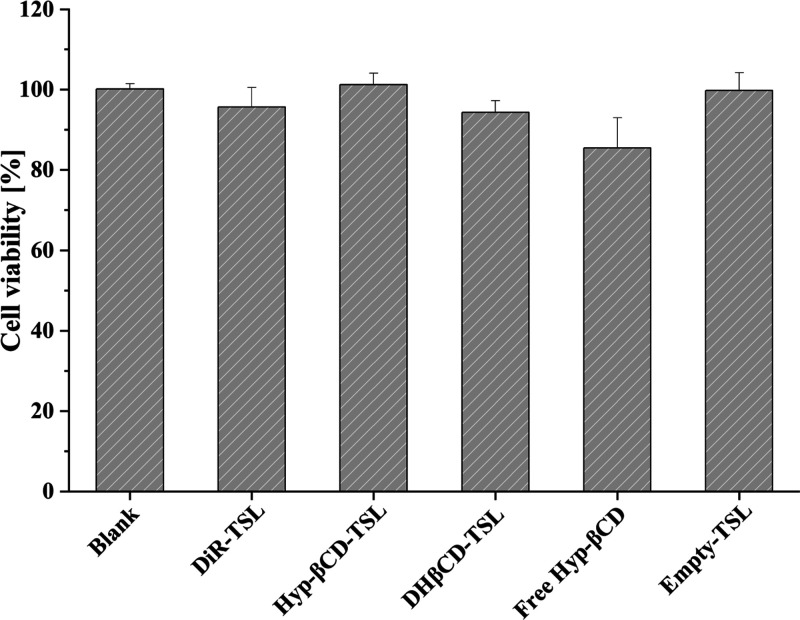
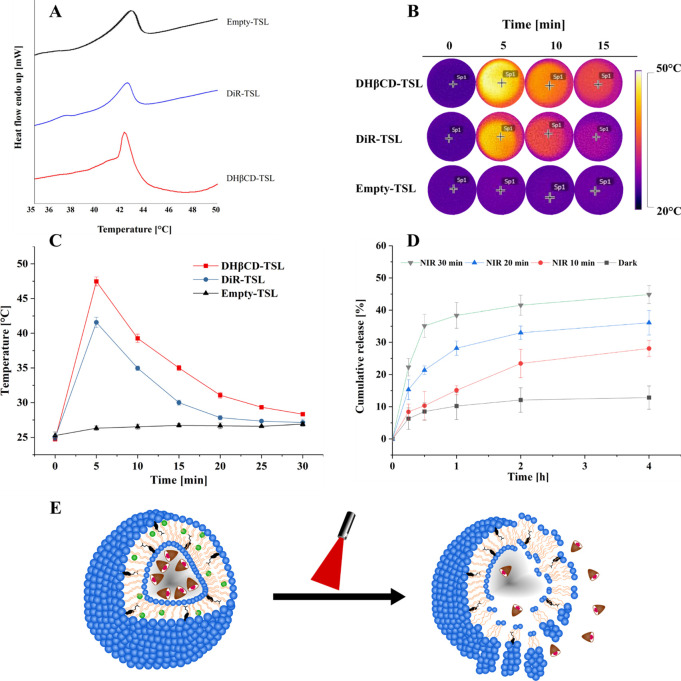
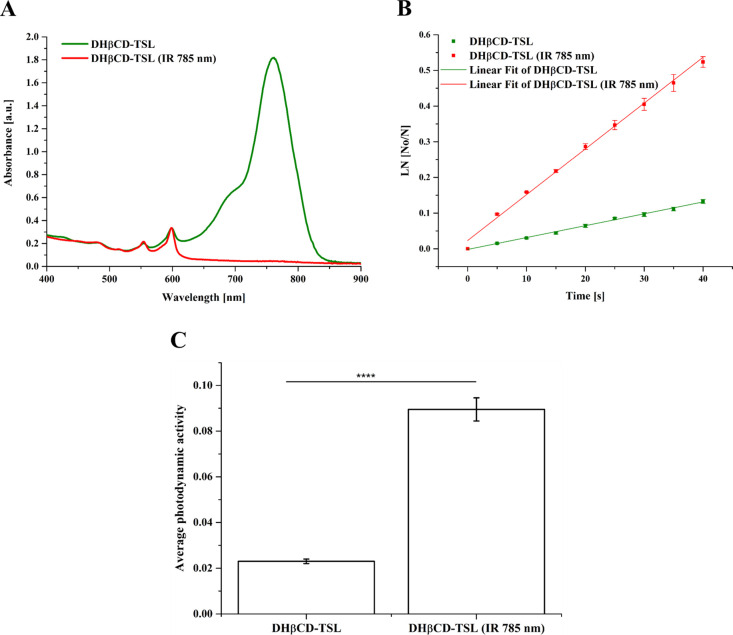
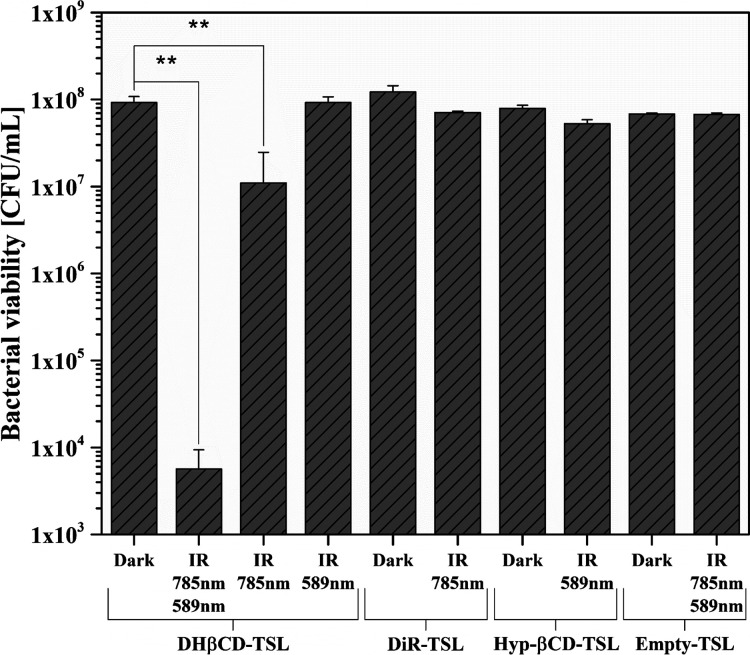
Antimicrobial strategies with high efficacy against bacterial infections are urgently needed. The development of effective therapies to control bacterial infections is still a challenge. Herein, near-infrared (NIR)-activated thermosensitive liposomes (TSL) were loaded with the NIR-dye 1,1-dioctadecyl-3,3,3,3-tetramethylindotricarbocyanine iodide (DiR) and the water-soluble hypericin (Hyp) β-cyclodextrin inclusion complex (Hyp-βCD). DiR and Hyp-βCD loaded thermosensitive liposomes (DHβCD-TSL) are functionalized for photothermal triggered release and synergistic photodynamic therapy to eliminate the gram-positive . The dually active liposomes allow the production of heat and singlet oxygen species with the help of DiR and Hyp, respectively. The elevated temperature, generated by the NIR irradiation, irreversibly damages the bacterial membrane, increases the permeation, and melts the liposomes via a phase-transition mechanism, which allows the release of the Hyp-βCD complex. The photodynamic effect of Hyp-βCD eradicates the bacterial cells owing to its toxic oxygen species production. DHβCD-TSL measured the size of 130 nm with an adequate encapsulation efficiency of 81.3% of Hyp-βCD. They exhibited a phase transition temperature of 42.3 °C, while they remained stable at 37 °C, and 44% of Hyp-βCD was released after NIR irradiation ( > 47 °C). The bacterial viability dropped significantly after the synergistic treatment (>4 log), indicating that the NIR-activated TSL have immense therapeutic potential to enhance the antibacterial efficacy. The liposomes showed good biocompatibility, which was confirmed by the cellular viability of mouse fibroblasts (L929).
抗菌策略对细菌感染具有高效的作用,因此迫切需要开发。开发有效的疗法来控制细菌感染仍然是一个挑战。在此,近红外(NIR)激活热敏脂质体(TSL)负载 NIR 染料 1,1-二辛基-3,3,3,3-四甲基吲哚三碳菁碘化物(DiR)和水溶性金丝桃素(Hyp)β-环糊精包合物(Hyp-βCD)。负载 DiR 和 Hyp-βCD 的热敏脂质体(DHβCD-TSL)被功能化为光热触发释放和协同光动力疗法,以消除革兰氏阳性菌。双活性脂质体允许分别使用 DiR 和 Hyp 产生热量和单线态氧物质。在 NIR 照射的帮助下,升高的温度不可逆地破坏细菌膜,增加渗透,并通过相转变机制使脂质体融化,从而允许 Hyp-βCD 复合物的释放。Hyp-βCD 的光动力效应通过其产生的有毒氧物质消灭细菌细胞。DHβCD-TSL 的尺寸为 130nm,Hyp-βCD 的包封效率为 81.3%。它们表现出 42.3°C 的相变温度,而在 37°C 时保持稳定,并且在 NIR 照射后释放 44%的 Hyp-βCD(>47°C)。协同处理后细菌活力明显下降(>4log),表明 NIR 激活的 TSL 具有巨大的治疗潜力,可增强抗菌功效。脂质体表现出良好的生物相容性,这通过小鼠成纤维细胞(L929)的细胞活力得到证实。