Laboratory of Biophysics of Synaptic Processes, Kazan Institute of Biochemistry and Biophysics, Federal Research Center "Kazan Scientific Center of Russian Academy of Sciences", Kazan, 420111, Russia.
Kazan State Medical University, Kazan, 420012, Russia.
Biochemistry (Mosc). 2022 Jun;87(6):524-537. doi: 10.1134/S0006297922060049.
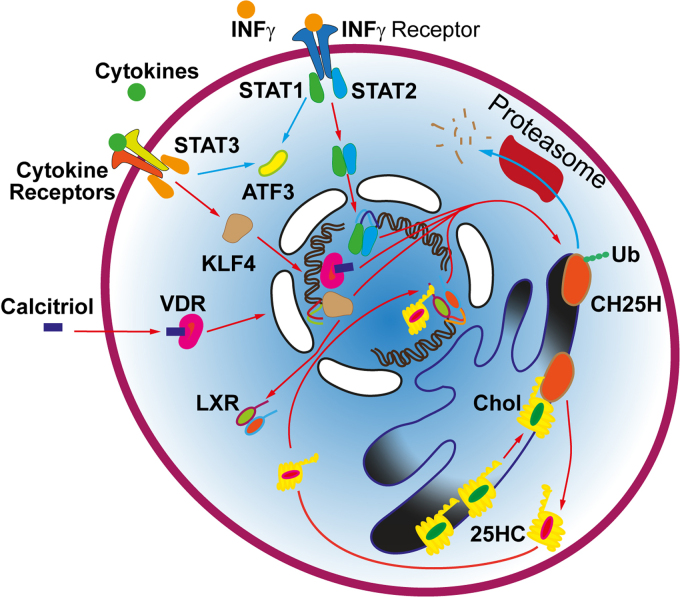
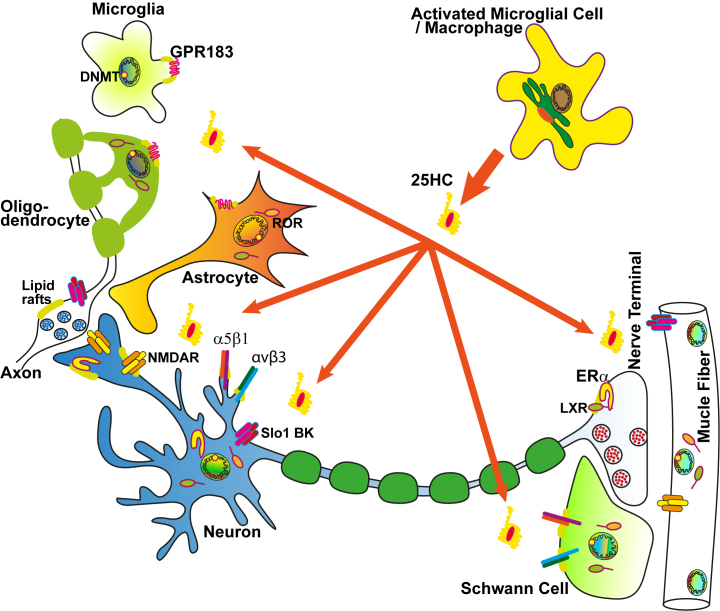
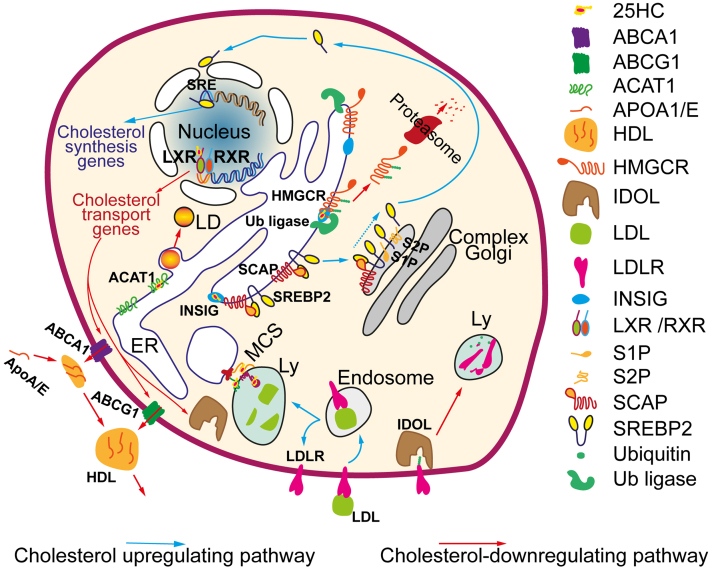
Cholesterol is an essential component of plasma membrane and precursor of biological active compounds, including hydroxycholesterols (HCs). HCs regulate cellular homeostasis of cholesterol; they can pass across the membrane and vascular barriers and act distantly as para- and endocrine agents. A small amount of 25-hydroxycholesterol (25-HC) is produced in the endoplasmic reticulum of most cells, where it serves as a potent regulator of the synthesis, intracellular transport, and storage of cholesterol. Production of 25-HC is strongly increased in the macrophages, dendrite cells, and microglia at the inflammatory response. The synthesis of 25-HC can be also upregulated in some neurological disorders, such as Alzheimer's disease, amyotrophic lateral sclerosis, spastic paraplegia type 5, and X-linked adrenoleukodystrophy. However, it is unclear whether 25-HC aggravates these pathologies or has the protective properties. The molecular targets for 25-HC are transcriptional factors (LX receptors, SREBP2, ROR), G protein-coupled receptor (GPR183), ion channels (NMDA receptors, SLO1), adhesive molecules (α5β1 and ανβ3 integrins), and oxysterol-binding proteins. The diversity of 25-HC-binding proteins points to the ability of HC to affect many physiological and pathological processes. In this review, we focused on the regulation of 25-HC production and its universal role in the control of cellular cholesterol homeostasis, as well as the effects of 25-HC as a signaling molecule mediating the influence of inflammation on the processes in the neuromuscular system and brain. Based on the evidence collected, it can be suggested that 25-HC prevents accumulation of cellular cholesterol and serves as a potent modulator of neuroinflammation, synaptic transmission, and myelinization. An increased production of 25-HC in response to a various type of damage can have a protective role and reduce neuronal loss. At the same time, an excess of 25-HC may exert the neurotoxic effects.
胆固醇是质膜的重要组成部分,也是生物活性化合物的前体,包括羟基胆固醇(HCs)。HCs 调节胆固醇的细胞内稳态;它们可以穿过膜和血管屏障,并作为旁分泌和内分泌物质远距离作用。少量 25-羟胆固醇(25-HC)在大多数细胞的内质网中产生,在那里它作为胆固醇合成、细胞内运输和储存的有效调节剂。在炎症反应中,巨噬细胞、树突细胞和小胶质细胞中 25-HC 的产生强烈增加。25-HC 的合成也可以在一些神经疾病中上调,如阿尔茨海默病、肌萎缩性侧索硬化症、痉挛性截瘫 5 型和 X 连锁肾上腺脑白质营养不良。然而,目前尚不清楚 25-HC 是否会加重这些病变,或者是否具有保护特性。25-HC 的分子靶标是转录因子(LX 受体、SREBP2、ROR)、G 蛋白偶联受体(GPR183)、离子通道(NMDA 受体、SLO1)、黏附分子(α5β1 和 ανβ3 整合素)和氧化固醇结合蛋白。25-HC 结合蛋白的多样性表明 HC 能够影响许多生理和病理过程。在这篇综述中,我们重点介绍了 25-HC 产生的调节及其在控制细胞胆固醇内稳态中的普遍作用,以及 25-HC 作为一种信号分子在炎症对神经肌肉系统和大脑中过程的影响的作用。基于收集到的证据,可以提出 25-HC 可防止细胞内胆固醇积累,并作为神经炎症、突触传递和髓鞘形成的有效调节剂。各种类型的损伤引起的 25-HC 产量增加可能具有保护作用并减少神经元丢失。同时,25-HC 过量可能会产生神经毒性作用。