Department of Neurosurgery, RWTH Aachen University Hospital, Aachen, Germany.
Department of Neurosurgery, Kantonsspital Aarau, Aarau, Switzerland.
Neurocrit Care. 2022 Dec;37(3):735-743. doi: 10.1007/s12028-022-01545-9. Epub 2022 Jul 6.
Delayed cerebral ischemia (DCI) is one of the main determinants of clinical outcome after aneurysmal subarachnoid hemorrhage (SAH). The classical description of risk for DCI over time is currently based on the outdated concept of angiographic vasospasm. The goal of this study was to assess the temporal risk profile of DCI, defined by extended clinical and radiological criteria, as well as the impact the time point of DCI onset has on clinical outcome.
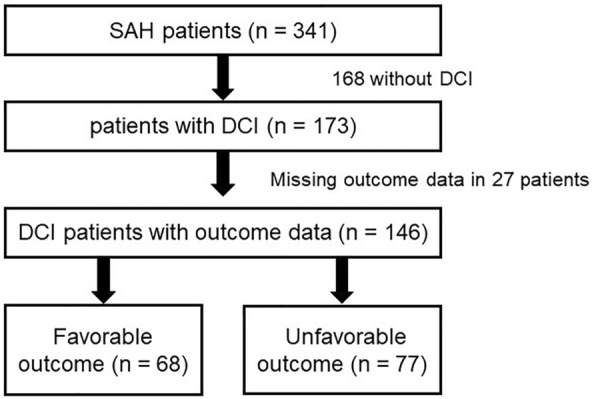
All patients with aneurysmal SAH referred to a single tertiary care center between 2010 and 2018 were considered for inclusion. This study was designed as a retrospective cohort analysis and data were extracted from existing patient files. In conscious patients, DCI was diagnosed clinically, and in unconscious patients, diagnosis was based on perfusion computed tomography imaging and multimodal neuromonitoring. Extended Glasgow Outcome Scale scores were assessed after 12 months and compared between patients with early (< day 7) and late (≥ day 7) DCI onset.
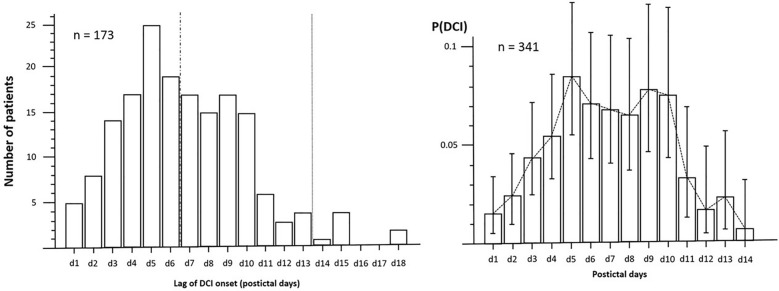
The median delay from day of the hemorrhage (day 0) until detection of the first DCI event was 7.0 days, with an interquartile range of 5 days. The probability of DCI development over time demonstrated a bimodal distribution with a peak risk on day 5 (0.084; confidence interval 0.05.5-0.122) and a second peak on day 9 (0.077; confidence interval 0.045-0.120). A total of 27 patients (15.6%) suffered dominant hemispheric or severe bilateral DCI-related infarctions, resulting in the withdrawal of technical life support. Of those, the majority (20 patients, 22.2%) presented with early DCI onset (vs. late onset: 7 patients, 8.4%; p = 0.013).
The risk profile of DCI over time mirrors the description of angiographic vasospasm; however, it comes with an added timely delay of 1 to 2 days. Early occurrence of DCI (before day 7) is associated with a higher infarct load and DCI-related mortality. Although the exact causal relationship remains to be determined, the time point of DCI onset may serve as an independent prognostic criterion in decision-making.
迟发性脑缺血(DCI)是蛛网膜下腔出血(SAH)后临床转归的主要决定因素之一。目前,DCI 风险的经典描述是基于过时的血管痉挛的概念。本研究的目的是评估 DCI 的时间风险特征,定义为扩展的临床和影像学标准,以及 DCI 发作时间对临床转归的影响。
所有于 2010 年至 2018 年期间被转诊至单中心的动脉瘤性 SAH 患者均被纳入研究。该研究设计为回顾性队列分析,数据从现有的患者档案中提取。在意识清醒的患者中,DCI 通过临床诊断,在无意识的患者中,根据灌注 CT 成像和多模态神经监测进行诊断。在 12 个月后评估扩展的格拉斯哥预后量表评分,并比较早期(<第 7 天)和晚期(≥第 7 天)DCI 发作患者的评分。
从出血日(第 0 天)到首次 DCI 事件的中位时间为 7.0 天,四分位距为 5 天。随时间推移 DCI 发展的概率呈双峰分布,峰值风险出现在第 5 天(0.084;置信区间 0.055-0.122)和第 9 天(0.077;置信区间 0.045-0.120)。共有 27 名患者(15.6%)出现主要半球或严重双侧 DCI 相关梗死,导致技术生命支持撤出。其中,大多数患者(20 名,22.2%)出现早期 DCI 发作(晚期发作:7 名,8.4%;p=0.013)。
随时间推移 DCI 的风险特征与血管造影血管痉挛的描述相符;然而,它的发生时间要延迟 1 至 2 天。DCI 的早期发作(<第 7 天)与更大的梗死负荷和 DCI 相关死亡率相关。尽管确切的因果关系仍有待确定,但 DCI 发作时间可能作为决策中的独立预后标准。