Faculty of Life and Environmental Science, University of Yamanashi, Kofu, 400-8510, Japan.
Advanced Biotechnology Center, University of Yamanashi, Kofu, 400-8510, Japan.
Nat Commun. 2022 Jul 5;13(1):3666. doi: 10.1038/s41467-022-31216-4.
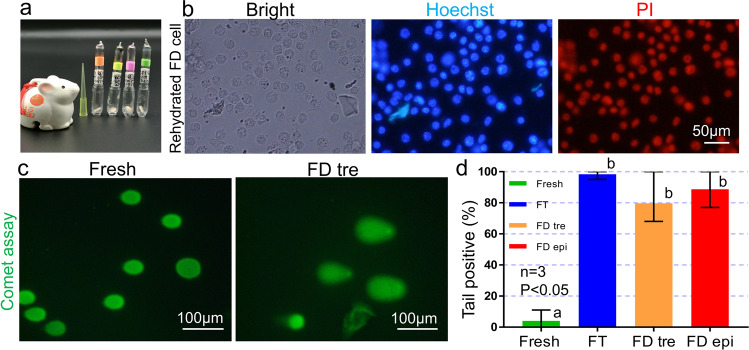
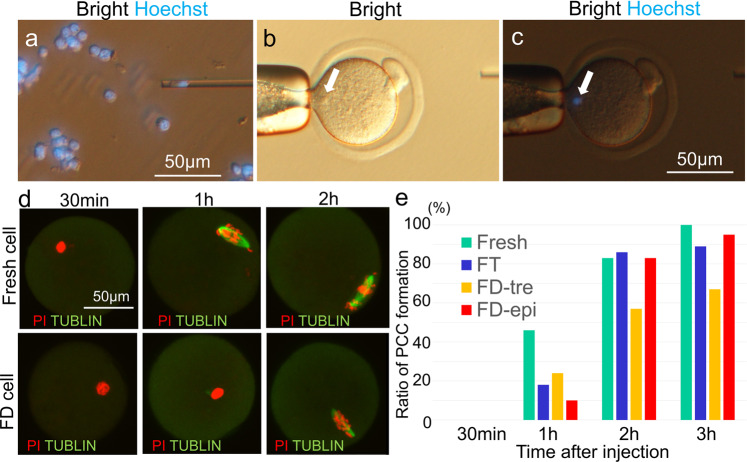
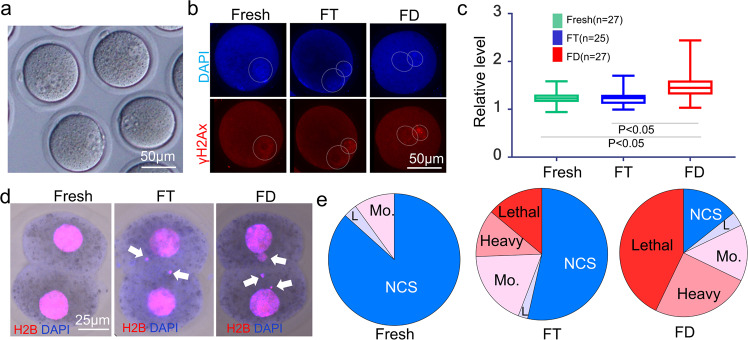
Maintaining biodiversity is an essential task, but storing germ cells as genetic resources using liquid nitrogen is difficult, expensive, and easily disrupted during disasters. Our aim is to generate cloned mice from freeze-dried somatic cell nuclei, preserved at -30 °C for up to 9 months after freeze drying treatment. All somatic cells died after freeze drying, and nucleic DNA damage significantly increased. However, after nuclear transfer, we produced cloned blastocysts from freeze-dried somatic cells, and established nuclear transfer embryonic stem cell lines. Using these cells as nuclear donors for re-cloning, we obtained healthy cloned female and male mice with a success rate of 0.2-5.4%. Here, we show that freeze-dried somatic cells can produce healthy, fertile clones, suggesting that this technique may be important for the establishment of alternative, cheaper, and safer liquid nitrogen-free bio-banking solutions.
维持生物多样性是一项至关重要的任务,但使用液氮储存生殖细胞作为遗传资源既困难又昂贵,而且在灾害期间容易受到干扰。我们的目的是从冻干的体细胞核中产生克隆鼠,这些细胞核在冻干处理后保存在-30°C 下长达 9 个月。所有的体细胞核在冻干后死亡,核酸 DNA 损伤显著增加。然而,经过核移植后,我们从冻干的体细胞核中产生了克隆囊胚,并建立了核移植胚胎干细胞系。使用这些细胞作为核供体进行再克隆,我们获得了健康的克隆雌性和雄性小鼠,成功率为 0.2-5.4%。在这里,我们表明冻干的体细胞核可以产生健康、可育的克隆,这表明该技术可能对建立替代的、更便宜、更安全的无液氮生物库解决方案具有重要意义。