Department of Anatomy and Neurobiology, 6889Virginia Commonwealth University, Richmond, VA, USA.
Research Service, 20125HH McGuire VA Medical Center, Richmond, VA, USA.
ASN Neuro. 2022 Jan-Dec;14:17590914221112352. doi: 10.1177/17590914221112352.
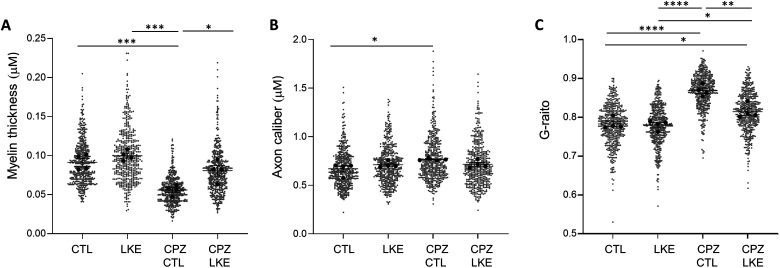
Although over 20 disease modifying therapies are approved to treat Multiple Sclerosis (MS), these do not increase remyelination of demyelinated axons or mitigate axon damage. Previous studies showed that lanthionine ketenamine ethyl ester (LKE) reduces clinical signs in the experimental autoimmune encephalomyelitis (EAE) mouse model of MS and increased maturation of oligodendrocyte (OL) progenitor cells (OPCs) . In the current study, we used the cuprizone (CPZ) demyelination model of MS to test if LKE could increase remyelination. The corpus callosum (CC) and somatosensory cortex was examined by immunohistochemistry (IHC), electron microscopy and for mRNA expression changes in mice provided 5 weeks of CPZ diet followed by 2 weeks of normal diet in the presence of LKE or vehicle. A significant increase in the number of myelinated axons, and increased myelin thickness was observed in the CC of LKE-treated groups compared to vehicle-treated groups. LKE also increased myelin basic protein and proteolipid protein expression in the CC and cortex, and increased the number of mature OLs in the cortex. In contrast, LKE did not increase the percentage of proliferating OPCs suggesting effects on OPC survival and differentiation but not proliferation. The effects of LKE on OL maturation and remyelination were supported by similar changes in their relative mRNA levels. Interestingly, LKE did not have significant effects on GFAP or Iba1 immunostaining or mRNA levels. These findings suggest that remyelinating actions of LKE can potentially be formulated to induce remyelination in neurological diseases associated with demyelination including MS.
虽然有 20 多种疾病修正疗法被批准用于治疗多发性硬化症 (MS),但这些疗法都不能增加脱髓鞘轴突的髓鞘再生或减轻轴突损伤。先前的研究表明,硫乙内酰脲酮乙基酯 (LKE) 可减少实验性自身免疫性脑脊髓炎 (EAE) 多发性硬化症小鼠模型中的临床症状,并增加少突胶质细胞 (OL) 前体细胞 (OPC) 的成熟。在本研究中,我们使用 CPZ 脱髓鞘多发性硬化症模型来测试 LKE 是否可以增加髓鞘再生。通过免疫组织化学 (IHC)、电子显微镜检查和在存在 LKE 或载体的情况下,对给予 5 周 CPZ 饮食后再给予 2 周正常饮食的小鼠的胼胝体 (CC) 和体感皮层进行了检查。与载体处理组相比,LKE 处理组的 CC 中髓鞘化轴突数量显著增加,髓鞘厚度增加。LKE 还增加了 CC 和皮层中的髓鞘碱性蛋白和蛋白脂质蛋白表达,并增加了皮层中成熟 OL 的数量。相比之下,LKE 并没有增加增殖性 OPC 的百分比,这表明其对 OPC 的存活和分化有影响,但对增殖没有影响。LKE 对 OL 成熟和髓鞘再生的影响得到了其相对 mRNA 水平相似变化的支持。有趣的是,LKE 对 GFAP 或 Iba1 免疫染色或 mRNA 水平没有显著影响。这些发现表明,LKE 的髓鞘再生作用可能被制定为诱导与脱髓鞘相关的神经疾病(包括 MS)中的髓鞘再生。