Department of Laboratory Animal Science, Shanghai Public Health Clinical Center, Shanghai, China.
Animal Model Exp Med. 2022 Dec;5(4):350-361. doi: 10.1002/ame2.12225. Epub 2022 Jul 6.
There are remarkable genetic differences between animal major histocompatibility complex (MHC) systems and the human leukocyte antigen (HLA) system. HLA transgenic humanized mouse model systems offer a much better method to study the HLA-A-related principal mechanisms for vaccine development and HLA-A-restricted responses against infection in human.
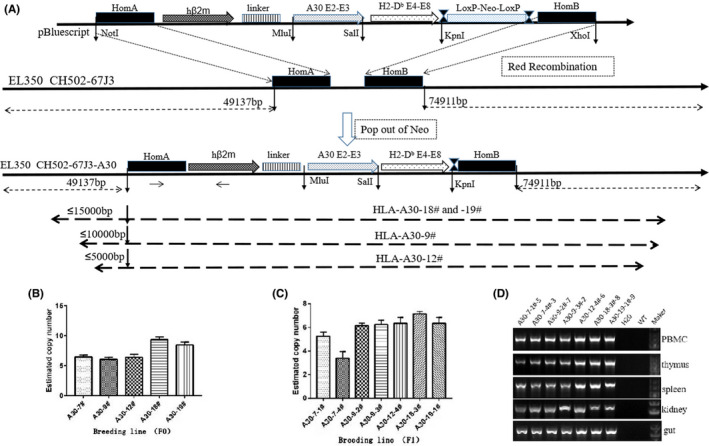
A recombinant gene encoding the chimeric HLA-A30 monochain was constructed. This HHD molecule contains the following: α1-α2 domains of HLA-A30, α3 and cytoplasmic domains of H-2D , linked at its N-terminus to the C-terminus of human β2m by a 15-amino-acid peptide linker. The recombinant gene encoding the chimeric HLA-A30 monochain cassette was introduced into bacterial artificial chromosome (BAC) CH502-67J3 containing the HLA-A01 gene locus by Red-mediated homologous recombination. Modified BAC CH502-67J3 was microinjected into the pronuclei of wild-type mouse oocytes. This humanized mouse model was further used to assess the immune responses against influenza A virus (H1N1) pdm09 clinically isolated from human patients. Immune cell population, cytokine production, and histopathology in the lung were analyzed.
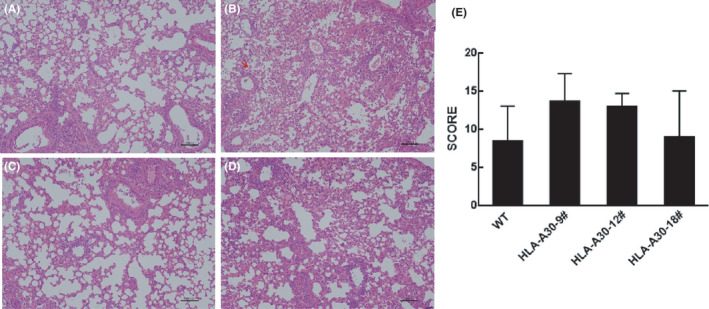
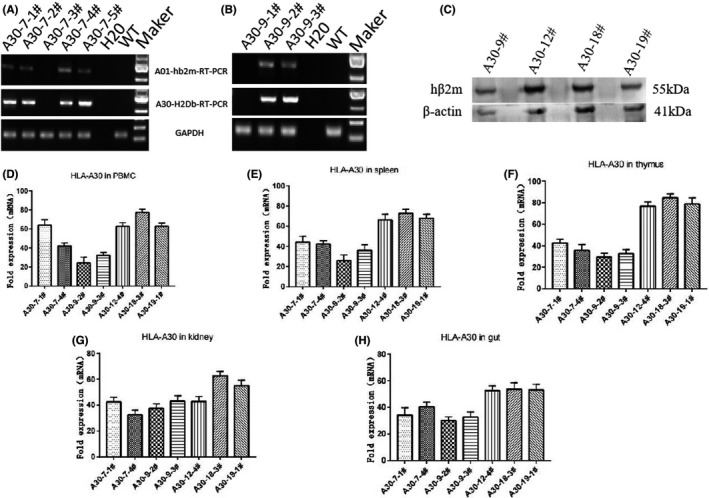
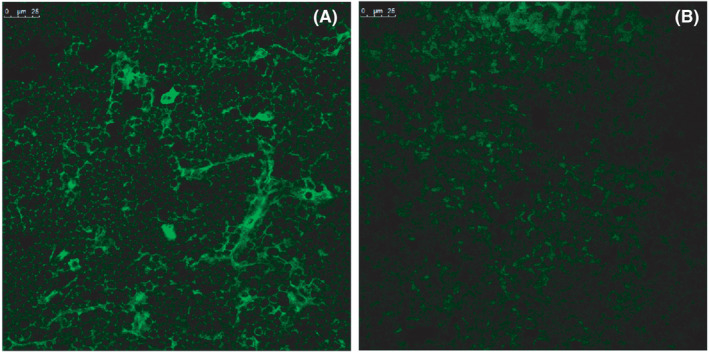
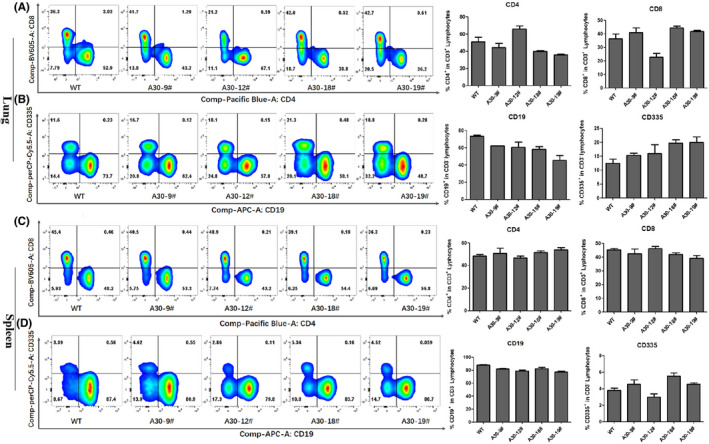
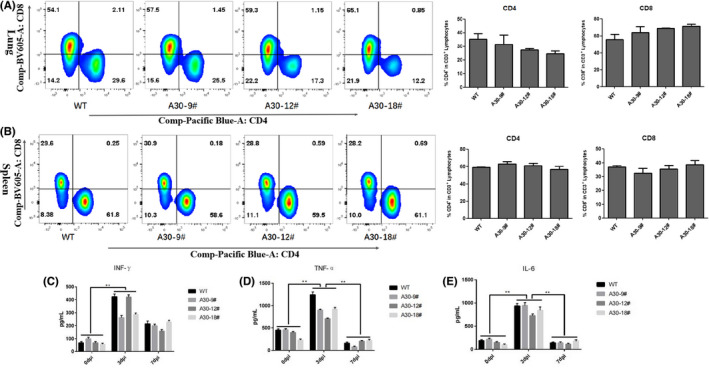
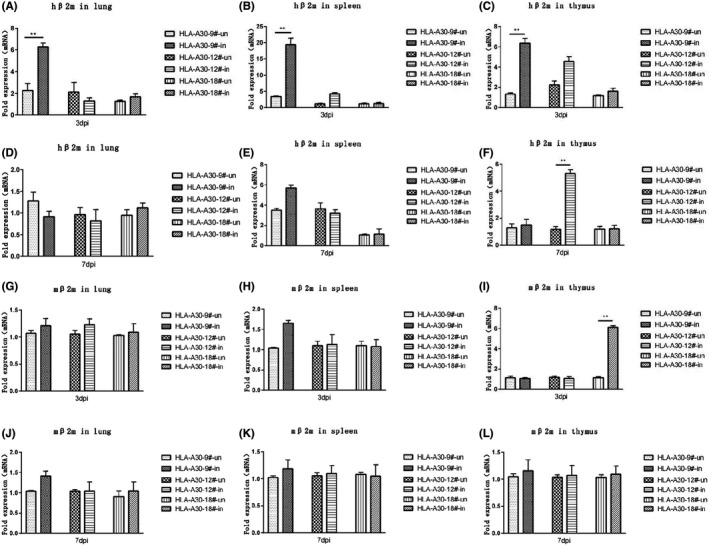
We describe a novel human β2m-HLA-A30 (α1α2)-H-2D (α3 transmembrane cytoplasmic) (HHD) monochain transgenic mouse strain, which contains the intact HLA-A01 gene locus including 49 kb 5'-UTR and 74 kb 3'-UTR of HLA-A01*01. Five transgenic lines integrated into the large genomic region of HLA-A gene locus were obtained, and the robust expression of exogenous transgene was detected in various tissues from A30-18# and A30-19# lines encompassing the intact flanking sequences. Flow cytometry revealed that the introduction of a large genomic region in HLA-A gene locus can influence the immune cell constitution in humanized mice. Pdm09 infection caused a similar immune response among HLA-A30 Tg humanized mice and wild-type mice, and induced the rapid increase of cytokines, including IFN-γ, TNF-α, and IL-6, in both HLA-A30 humanized Tg mice and wild-type mice. The expression of HLA-A30 transgene was dramatically promoted in tissues from A30-9# line at 3 days post-infection (dpi).
We established a promising preclinical research animal model of HLA-A30 Tg humanized mouse, which could accelerate the identification of novel HLA-A30-restricted epitopes and vaccine development, and support the study of HLA-A-restricted responses against infection in humans.
动物主要组织相容性复合体(MHC)系统与人类白细胞抗原(HLA)系统之间存在显著的遗传差异。HLA 转基因人源化小鼠模型系统为研究 HLA-A 相关疫苗开发的主要机制以及针对人类感染的 HLA-A 限制反应提供了更好的方法。
构建了编码嵌合 HLA-A30 单链的重组基因。该 HHD 分子包含以下内容:HLA-A30 的α1-α2 结构域、H-2D 的α3 和细胞质结构域,通过 15 个氨基酸肽接头连接到人类β2m 的 C 末端。编码嵌合 HLA-A30 单链盒的重组基因通过 Red 介导的同源重组引入含有 HLA-A01 基因座的细菌人工染色体(BAC)CH502-67J3 中。修饰后的 BAC CH502-67J3 通过微注射进入野生型小鼠卵母细胞的原核中。进一步使用这种人源化小鼠模型来评估临床分离自人类患者的甲型流感病毒(H1N1)pdm09 的免疫反应。分析了肺部的免疫细胞群、细胞因子产生和组织病理学。
我们描述了一种新型的人类β2m-HLA-A30(α1α2)-H-2D(α3 跨膜细胞质)(HHD)单链转基因小鼠品系,其中包含完整的 HLA-A01 基因座,包括 HLA-A01*01 的 49 kb 5'-UTR 和 74 kb 3'-UTR。获得了整合到 HLA-A 基因座大片段基因组区域的五个转基因系,并且在 A30-18#和 A30-19#系的各种组织中检测到了外源转基因的强表达,这些系包含完整的侧翼序列。流式细胞术显示,HLA-A 基因座大片段的引入会影响人源化小鼠中的免疫细胞组成。pdm09 感染在 HLA-A30Tg 人源化小鼠和野生型小鼠中引起了类似的免疫反应,并在 HLA-A30 人源化 Tg 小鼠和野生型小鼠中均诱导了细胞因子 IFN-γ、TNF-α 和 IL-6 的快速增加。在感染后 3 天(dpi),A30-9#系的组织中 HLA-A30 转基因的表达显著增强。
我们建立了一种有前途的 HLA-A30Tg 人源化小鼠的临床前研究动物模型,该模型可以加速鉴定新的 HLA-A30 限制性表位和疫苗开发,并支持对人类感染的 HLA-A 限制反应的研究。