Department of Rheumatology, First People's Hospital of Taizhou, Taizhou, China.
Department of Ophthalmology, First People's Hospital of Taizhou, Taizhou, China.
J Clin Lab Anal. 2022 Aug;36(8):e24594. doi: 10.1002/jcla.24594. Epub 2022 Jul 6.
Histone deacetylase 4 (HDAC4) modulates immunity, inflammation, and osteoblast differentiation to engage in rheumatoid arthritis (RA) etiology. This study aimed to evaluate the HDAC4 longitudinal change and its relationship with clinical features and outcomes in RA patients.
Eighty-three RA patients were enrolled. Their serum HDAC4 level was detected by ELISA at baseline (W0), week (W) 4, W12, and W24 after treatment. RA patients were divided into response or non-response, low disease activity (LDA) or non-LDA, remission or non-remission patients according to their treatment outcomes at W24. Meanwhile, serum HDAC4 was detected by ELISA in 20 osteoarthritis patients and 20 healthy controls (HCs).
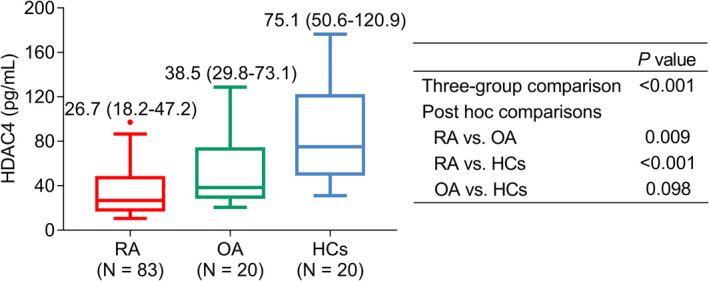
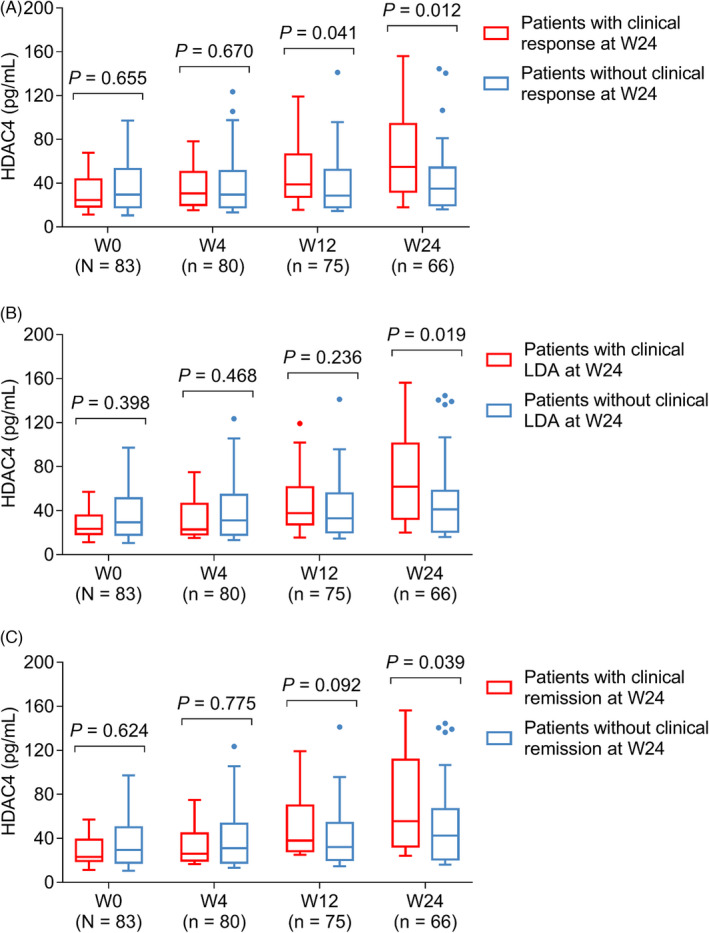
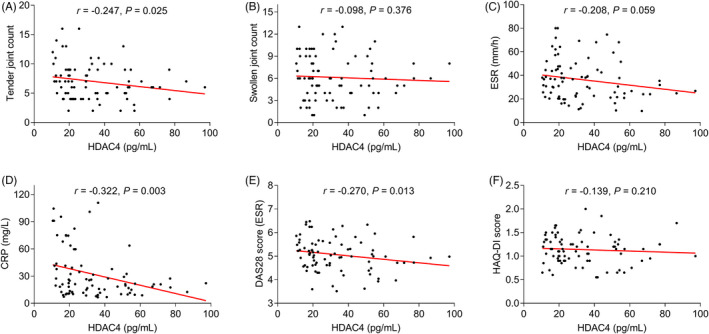
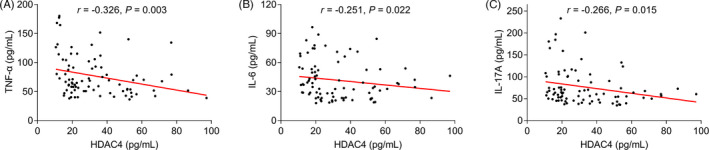
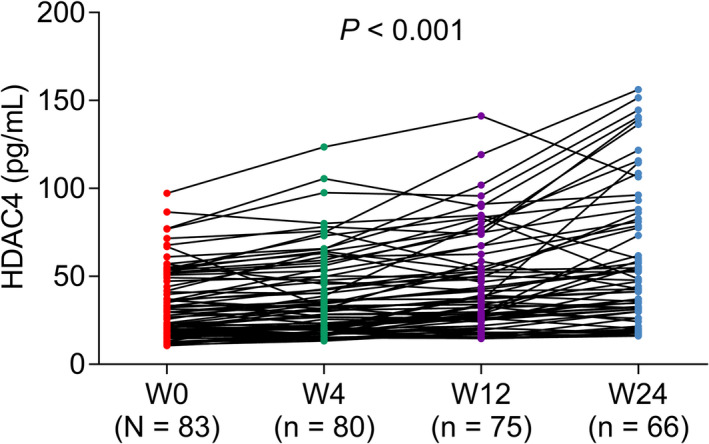
HDAC4 level was reduced in RA patients compared with HCs (p < 0.001) and osteoarthritis patients (p = 0.009). HDAC4 was negatively related to some of the disease activity indexes such as C-reactive protein (p = 0.003), tender joint count (p = 0.025), and disease activity score based on 28 joints (p = 0.013) in RA patients; it was also negatively correlated with TNF-α (p = 0.003), IL-6 (p = 0.022), and IL-17A (p = 0.015). However, the HDAC4 level was not related to different treatment histories or current initiating treatment regimens (all p < 0.05). After treatment, HDAC4 was gradually elevated along with the time (p < 0.001). Interestingly, HDAC4 level at W12 (p = 0.041) and W24 (p = 0.012) was higher in response patients versus non-response patients, and its level at W24 was higher in LDA patients versus non-LDA patients (p = 0.019), and in remission patients versus non-remission patients (p = 0.039).
HDAC4 gradually increases during treatment and its elevation estimates good treatment outcomes in RA patients.
组蛋白去乙酰化酶 4(HDAC4)调节免疫、炎症和成骨细胞分化,参与类风湿关节炎(RA)的发病机制。本研究旨在评估 RA 患者治疗后 HDAC4 的纵向变化及其与临床特征和结局的关系。
纳入 83 例 RA 患者。在治疗前(W0)、治疗后第 4 周(W4)、第 12 周(W12)和第 24 周(W24),采用 ELISA 法检测其血清 HDAC4 水平。根据 24 周时的治疗结果,将 RA 患者分为反应组和非反应组、低疾病活动组(LDA)和非 LDA 组、缓解组和非缓解组。同时,采用 ELISA 法检测 20 例骨关节炎患者和 20 例健康对照者(HCs)的血清 HDAC4 水平。
与 HCs(p<0.001)和骨关节炎患者(p=0.009)相比,RA 患者的 HDAC4 水平降低。HDAC4 与 RA 患者的一些疾病活动指标呈负相关,如 C 反应蛋白(p=0.003)、压痛关节数(p=0.025)和 28 个关节疾病活动评分(p=0.013);与 TNF-α(p=0.003)、IL-6(p=0.022)和 IL-17A(p=0.015)也呈负相关。然而,HDAC4 水平与不同的治疗史或当前起始治疗方案无关(均 p<0.05)。治疗后,HDAC4 随时间逐渐升高(p<0.001)。有趣的是,反应组患者在治疗 12 周(p=0.041)和 24 周(p=0.012)时的 HDAC4 水平高于非反应组,在治疗 24 周时的 LDA 患者高于非 LDA 患者(p=0.019),缓解组高于非缓解组(p=0.039)。
HDAC4 在治疗过程中逐渐升高,其升高预示着 RA 患者的治疗效果良好。