National Institutes of Arthritis and Musculoskeletal and Skin Diseases, National Institutes of Health (NHS), Bethesda, MD.
Leeds Institute of Rheumatic and Musculoskeletal Medicine, University of Leeds, United Kingdom.
Blood. 2022 Sep 29;140(13):1496-1506. doi: 10.1182/blood.2022016985.
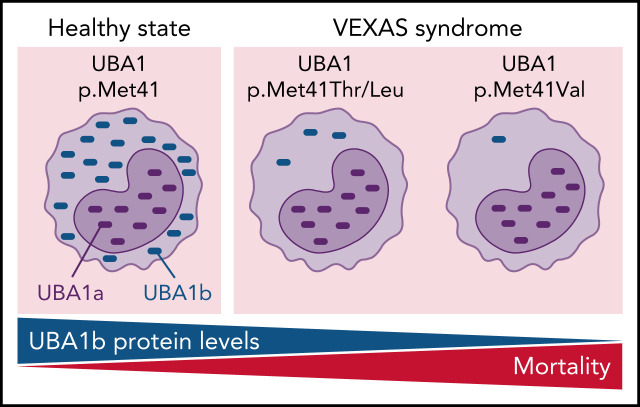
Somatic mutations in UBA1 cause vacuoles, E1 ubiquitin-activating enzyme, X-linked, autoinflammatory somatic (VEXAS) syndrome, an adult-onset inflammatory disease with an overlap of hematologic manifestations. VEXAS syndrome is characterized by a high mortality rate and significant clinical heterogeneity. We sought to determine independent predictors of survival in VEXAS and to understand the mechanistic basis for these factors. We analyzed 83 patients with somatic pathogenic variants in UBA1 at p.Met41 (p.Met41Leu/Thr/Val), the start codon for translation of the cytoplasmic isoform of UBA1 (UBA1b). Patients with the p.Met41Val genotype were most likely to have an undifferentiated inflammatory syndrome. Multivariate analysis showed ear chondritis was associated with increased survival, whereas transfusion dependence and the p.Met41Val variant were independently associated with decreased survival. Using in vitro models and patient-derived cells, we demonstrate that p.Met41Val variant supports less UBA1b translation than either p.Met41Leu or p.Met41Thr, providing a molecular rationale for decreased survival. In addition, we show that these 3 canonical VEXAS variants produce more UBA1b than any of the 6 other possible single-nucleotide variants within this codon. Finally, we report a patient, clinically diagnosed with VEXAS syndrome, with 2 novel mutations in UBA1 occurring in cis on the same allele. One mutation (c.121 A>T; p.Met41Leu) caused severely reduced translation of UBA1b in a reporter assay, but coexpression with the second mutation (c.119 G>C; p.Gly40Ala) rescued UBA1b levels to those of canonical mutations. We conclude that regulation of residual UBA1b translation is fundamental to the pathogenesis of VEXAS syndrome and contributes to disease prognosis.
UBA1 中的体细胞突变导致空泡、E1 泛素激活酶、X 连锁、自身炎症性体细胞(VEXAS)综合征,这是一种成年发病的炎症性疾病,具有血液学表现的重叠。VEXAS 综合征的死亡率高,临床表现显著异质性。我们试图确定 VEXAS 生存的独立预测因素,并了解这些因素的机制基础。我们分析了 83 例 UBA1 中 p.Met41(p.Met41Leu/Thr/Val)体细胞致病性变异的患者,p.Met41 是 UBA1 细胞质同工型(UBA1b)翻译的起始密码子。p.Met41Val 基因型的患者最有可能出现未分化的炎症综合征。多变量分析显示,耳软骨炎与生存率增加相关,而输血依赖和 p.Met41Val 变异与生存率降低独立相关。使用体外模型和患者来源的细胞,我们证明 p.Met41Val 变异支持的 UBA1b 翻译量低于 p.Met41Leu 或 p.Met41Thr,为生存率降低提供了分子基础。此外,我们表明,这 3 种经典的 VEXAS 变体产生的 UBA1b 多于该密码子中任何其他 6 种可能的单核苷酸变体。最后,我们报告了一名临床诊断为 VEXAS 综合征的患者,该患者在同一个等位基因上发生了 2 个 cis 的 UBA1 新突变。一个突变(c.121 A>T;p.Met41Leu)在报告基因实验中导致 UBA1b 的翻译严重减少,但与第二个突变(c.119 G>C;p.Gly40Ala)共表达可将 UBA1b 水平恢复至经典突变的水平。我们得出结论,残余 UBA1b 翻译的调节是 VEXAS 综合征发病机制的基础,并影响疾病预后。