Usher Institute, The University of Edinburgh, Edinburgh, UK
Usher Institute, The University of Edinburgh, Edinburgh, UK.
BMJ Open. 2022 Jul 6;12(7):e059385. doi: 10.1136/bmjopen-2021-059385.
COVID-19 is commonly experienced as an acute illness, yet some people continue to have symptoms that persist for weeks, or months (commonly referred to as 'long-COVID'). It remains unclear which patients are at highest risk of developing long-COVID. In this protocol, we describe plans to develop a prediction model to identify individuals at risk of developing long-COVID.
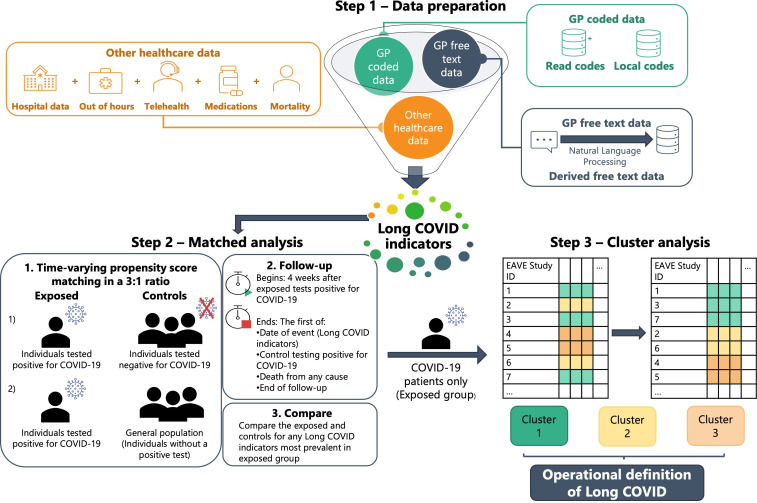
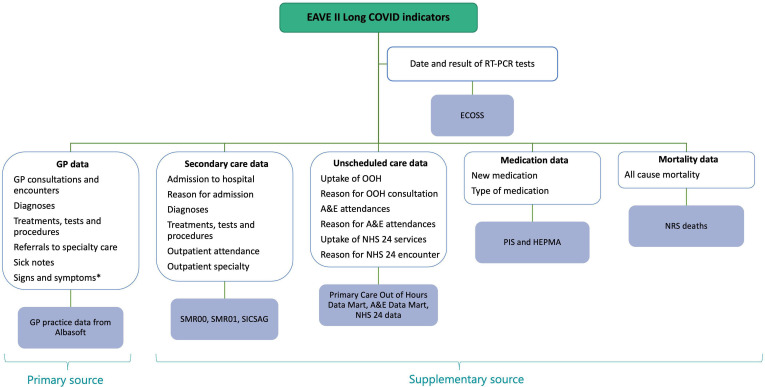
We will use the national Early Pandemic Evaluation and Enhanced Surveillance of COVID-19 (EAVE II) platform, a population-level linked dataset of routine electronic healthcare data from 5.4 million individuals in Scotland. We will identify potential indicators for long-COVID by identifying patterns in primary care data linked to information from out-of-hours general practitioner encounters, accident and emergency visits, hospital admissions, outpatient visits, medication prescribing/dispensing and mortality. We will investigate the potential indicators of long-COVID by performing a matched analysis between those with a positive reverse transcriptase PCR (RT-PCR) test for SARS-CoV-2 infection and two control groups: (1) individuals with at least one negative RT-PCR test and never tested positive; (2) the general population (everyone who did not test positive) of Scotland. Cluster analysis will then be used to determine the final definition of the outcome measure for long-COVID. We will then derive, internally and externally validate a prediction model to identify the epidemiological risk factors associated with long-COVID.
The EAVE II study has obtained approvals from the Research Ethics Committee (reference: 12/SS/0201), and the Public Benefit and Privacy Panel for Health and Social Care (reference: 1920-0279). Study findings will be published in peer-reviewed journals and presented at conferences. Understanding the predictors for long-COVID and identifying the patient groups at greatest risk of persisting symptoms will inform future treatments and preventative strategies for long-COVID.
COVID-19 通常被视为急性疾病,但有些人仍持续出现数周至数月的症状(通常称为“长新冠”)。目前仍不清楚哪些患者有发生长新冠的最高风险。本方案中,我们描述了制定预测模型以识别发生长新冠风险个体的计划。
我们将使用全国性的早期大流行评估和增强型 COVID-19 监测(EAVE II)平台,这是一个来自苏格兰 540 万人的常规电子医疗保健数据的人群水平链接数据集。我们将通过识别与家庭医生就诊、急诊就诊、住院、门诊就诊、药物开方/配药和死亡率相关的初级保健数据中的模式,来识别长新冠的潜在指标。我们将通过对 SARS-CoV-2 感染的逆转录酶聚合酶链反应(RT-PCR)检测呈阳性者与两个对照组(1)至少有一次 RT-PCR 检测呈阴性且从未检测呈阳性者;(2)苏格兰的一般人群(所有未检测呈阳性者)之间进行匹配分析,来调查长新冠的潜在指标。聚类分析将用于确定长新冠结局指标的最终定义。然后,我们将内部和外部验证预测模型,以确定与长新冠相关的流行病学危险因素。
EAVE II 研究已获得研究伦理委员会(编号:12/SS/0201)和健康与社会保健公益和隐私小组(编号:1920-0279)的批准。研究结果将发表在同行评议的期刊上,并在会议上展示。了解长新冠的预测因素并确定持续症状风险最大的患者群体,将为长新冠的未来治疗和预防策略提供信息。